Support

Bremen Airport

About the Airport

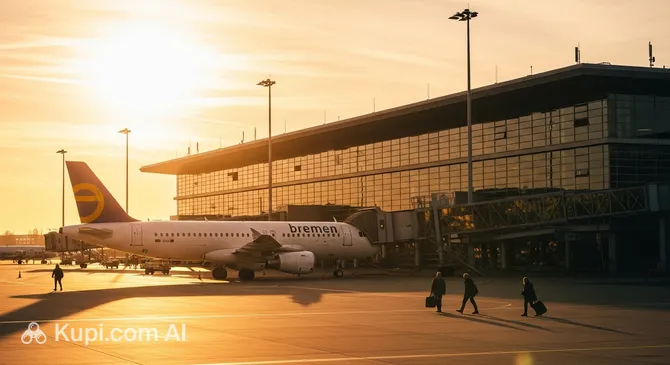
Bremen Airport. Source: Kupi.com Binoculars
Bremen Airport (BRE) is a gateway that breaks the stereotypes of long and tiring transfers. Located just a few kilometres from the historic centre, it allows travellers to find themselves on the famous market square almost immediately after landing. This cosy and compact aviation hub is named after Hans Koschnick and is ideal for those who value their time and wish to begin their exploration of Northern Germany without unnecessary hassle.
IATA Code BRE
ICAO Code EDDW
City Bremen
Distance to Centre 3.5 km
Status International
Annual Passengers ~1.8 million (2023)

Unique Transport Accessibility

The main feature of the airport is its incredible proximity to the city. Directly at the terminal exit is the stop for tram No. 6, which will take you to the very heart of Bremen in just 11 minutes. This makes it one of the most convenient airports in Europe for weekend tourists (city-breaks).

"Bremenhalle" Aviation Museum

Hidden within the terminal is a true gem for history buffs — the Bremenhalle gallery. Here you can see the legendary Junkers W33 "Bremen" aircraft, which made the first east-to-west transatlantic flight, as well as exhibits dedicated to the space industry, for which this region is renowned.

Compactness and Comfort

Thanks to its small size, navigation here is intuitive, and security control queues generally move very quickly. The airport offers everything necessary for a comfortable wait: from cosy cafes to an observation deck offering an excellent view of the runway.

Contact Information

  • Official Website: www.bremen-airport.com
  • Information Desk Phone: +49 421 5595-0
  • Airport Address: Flughafenallee 20, 28199 Bremen, Germany
  • Email: To contact airport representatives, it is recommended to use the contact form on the official website.
  • Social Media: Current information and news can be found on the airport's official pages on Facebook and Instagram.
  • Lost Luggage Information: If your luggage has been lost, please contact your airline first. For items left in the terminal building, please contact the airport's Lost and Found office (Fundbüro). Contact details are available on the official website.
  • Passenger Support Service: For general information and support, you may use the main information desk phone number.

How to Get to the Airport

Bremen Airport (BRE) is one of the most accessible in Germany, conveniently located just 3.5 km south of the city centre, making the journey there quick and simple. The most popular and economical way to reach the terminals is by public transport. Tram No. 6 goes directly to the airport, running from the University via the Central Station (Hauptbahnhof) and the city centre (Domsheide). The trip from the station takes only about 15-20 minutes, and trams run at short intervals throughout the day.

For those who value comfort or are travelling with large luggage, a taxi is an excellent choice. The drive from the city centre to the airport takes 10–15 minutes depending on traffic, and the cost is approximately 15–20 Euros. You can also book a private transfer in advance. If you are travelling by rental car, the airport is easily accessible via the A281 motorway, which is particularly convenient for travellers planning to explore the surrounding area.

Bremen Airport offers convenient parking options. Directly opposite the terminals are two multi-storey car parks (P1 and P2), offering both short-term and long-term parking. To get the best rates, it is recommended to book a parking space online in advance, especially if you plan to leave your car for several days.

If you haven't found suitable flights to Bremen, it is worth considering airports in neighbouring major cities. The nearest major international hubs are Hannover Airport (HAJ), located approximately 90 km away, and Hamburg Airport (HAM), which is about 100 km away. Münster/Osnabrück (FMO) may also be an option. You can reach Bremen from these airports by train or bus.

Terminals and Map

Bremen Airport (BRE) is distinguished by a compact and clear structure, making navigation simple and convenient for passengers. It consists of one main building divided into three connected terminals (Terminals 1, 2, 3) and a separate small terminal for budget airlines (Terminal E).

The main building unites Terminals 1, 2, and 3, which flow smoothly into one another and are essentially parts of a single complex. Most airlines are serviced here, including Lufthansa, KLM, Turkish Airlines, and other scheduled carriers. All main services — check-in counters, security checkpoints, shops, cafes, and business lounges — are concentrated in this part of the airport. The arrivals area with baggage claim belts is on the ground floor, and the departures area with gates is on the first floor.

Terminal E is a separate, simpler building located a few minutes' walk from the main one. It is primarily designed to service flights for the low-cost carrier Ryanair. The infrastructure here is minimal and designed for rapid passenger turnover.

Moving between Terminals 1, 2, and 3 takes place inside the building and does not take much time. The path to Terminal E, although outdoors, is also very short. Due to the airport's compact size, check-in and security checks usually proceed quite quickly. Nevertheless, it is recommended to arrive at the airport according to standard practice: 1.5–2 hours before Schengen flights and 2–3 hours before international flights. The main advice for passengers is to check in advance which terminal your airline operates from, so you can head straight to the correct part of the airport.

Airport History

The history of Bremen Airport (BRE) is a fascinating journey from a small airfield to a modern international hub closely linked to aviation and astronautics. Its history officially began in 1913, when the Bremen Senate granted permission to create an airbase. By 1920, the Dutch airline KLM launched the first international flights, connecting Bremen with Amsterdam, which became a significant milestone in the development of civil aviation in Germany.

Significant stages of development occurred in the post-war years. The airport was quickly restored and resumed civil air traffic as early as 1949. In the 1950s, the runway was extended to accommodate larger aircraft, opening the jet age for Bremen. One of the most significant moments in the airport's history was the launch of the first transatlantic mail flights by Lufthansa in the 1930s, cementing its status as an important logistics centre.

Major modernization took place in the 1990s, when a new, modern passenger terminal was built, which remains the main one today. This significantly increased capacity and improved the quality of passenger service. In 2001, a separate Terminal E was opened, dedicated to serving budget airlines, making the airport even more attractive to a wide range of travellers.

One of the most interesting facts about Bremen Airport is its unique location. It bears the unofficial title "City Airport Bremen", as it is located just 3.5 km from the city centre, making it one of the most accessible city airports in Europe. Furthermore, located directly on its grounds are the Airbus aerospace technology centre and the Bremenhalle exhibition centre, where you can see parts of the Spacelab spacecraft, highlighting Bremen's inseparable link with the history of aviation and space exploration.

Services and Amenities

Bremen Airport (BRE) offers passengers a wide range of services to make waiting for a flight as comfortable and productive as possible. In the terminals, you will find various shops, including classic Duty Free, where you can purchase perfumes, souvenirs, and other goods. Numerous cafes and restaurants offer both quick snacks and full meals featuring local and international cuisine.

For a more relaxing rest, you can use the services of the Bremen Lounge, available to passengers of all travel classes for an additional fee. Free Wi-Fi is available throughout the airport, and numerous charging stations for electronic devices are provided for travellers' convenience.

Financial matters can be easily resolved at the airport: bank branches, currency exchange points, and 24-hour ATMs are at passengers' disposal. In case of necessity, you can visit the first aid station. For travellers with children, special mother and child rooms and play areas are equipped.

The airport is fully adapted for passengers with reduced mobility. Escort services, special parking spaces, and equipped restrooms are provided. It is recommended to notify the airline in advance if assistance is needed. Modern conference rooms are available for business travellers. If you need a rest between flights, a hotel is located directly opposite the terminal, and several other hotels are in the immediate vicinity.

Dining

At Bremen Airport, a key transport hub in northern Germany, travellers will find diverse dining options to suit any taste and budget. Whether you are looking for a quick snack before departure or want to enjoy a leisurely lunch with a view of the runway, there is plenty to choose from.

Most establishments are located in the public area (landside), before security control. Here you will find popular bakeries, such as Kamps Backstube, where you can get fresh pastries, sandwiches, and hot coffee — an ideal option for a quick breakfast. Also in this zone are cafes offering more substantial meals, and even a restaurant with a panoramic view where you can enjoy a full lunch or dinner.

After passing security, in the departure zone (airside), the selection is slightly smaller but sufficient for a comfortable wait. Usually, there is at least one cafe-bar here where you can order beverages, light snacks, and sandwiches. Opening hours for establishments in the departure zone are generally aligned with the flight schedule, starting from early morning until the last departure.

Regarding cuisine, alongside international standards, it is worth noting the local offerings. You might find traditional German sausages with a bread roll or a classic pretzel (Brezel). For those adhering to specific diets, most cafes offer vegetarian salads and sandwiches. Vegan and gluten-free options may also be available, but it is best to check their availability with the staff. Prices at Bremen Airport align with the average European level for airports: a cup of coffee with a pastry will cost approximately 7-10 Euros, and a full lunch — 15-25 Euros per person.

Travel Tips

When planning a departure from Bremen Airport, it is worth arriving well in advance to avoid unnecessary rushing. For international flights, it is recommended to allow 2.5–3 hours before departure, while for flights within Germany and Schengen countries, 1.5–2 hours is usually sufficient. This time is enough for calm check-in, baggage drop-off, and passing through security control.

To save time, use online check-in on your airline's website. Bremen Airport is considered compact and well-organised, but security rules here are standard. Be prepared to remove laptops and other large gadgets from your hand luggage, and pack all liquids up to 100 ml in a single transparent bag.

Choosing a seat on the plane is a matter of preference. Window seats (A, F) are ideal for those who love gazing at clouds and views of the ground. Aisle seats (C, D) are convenient if you plan to get up during the flight or want more legroom. To be among the first to disembark, book seats in the front part of the cabin.

Sharp objects, weapons, and flammable substances are prohibited in hand luggage. Remember the rule for liquids: no more than 100 ml per container, and all must fit into a transparent bag with a capacity of up to 1 litre. Before leaving for the airport, be sure to check the weight and size limits for hand luggage on your airline's website, as they can vary significantly.

Passengers connecting in Bremen should check in advance whether their luggage will be automatically transferred to the next flight. If you are flying with different airlines, you may have to collect your suitcase and check it in again. Allow sufficient time for the transfer, especially if you are arriving from a non-Schengen country, as passport control will be required.

When entering from non-EU countries, "Green" and "Red" channels operate at customs. If you have no goods to declare, proceed through the "Green" channel. Otherwise, you must go through the "Red" channel and declare goods exceeding duty-free limits. Inside the Schengen area, customs control is generally absent.

To save money, use public transport to travel to or from the airport — tram line No. 6 will quickly take you to the city centre. Bring an empty water bottle with you: after security control, it can be refilled at drinking fountains. Time savings can be achieved through online check-in and travelling with hand luggage only.

In the event of a flight delay, remain calm and contact your airline representative. Under European regulations (EU261), for lengthy delays, passengers are entitled to drinks, meals, and in the case of a flight being rescheduled to the next day — hotel accommodation. Be sure to keep all receipts and your boarding pass, as they may be needed to claim compensation.
Reached the end of the page?

That means the route is fully explored