Support

Rotterdam The Hague Airport

About the Airport

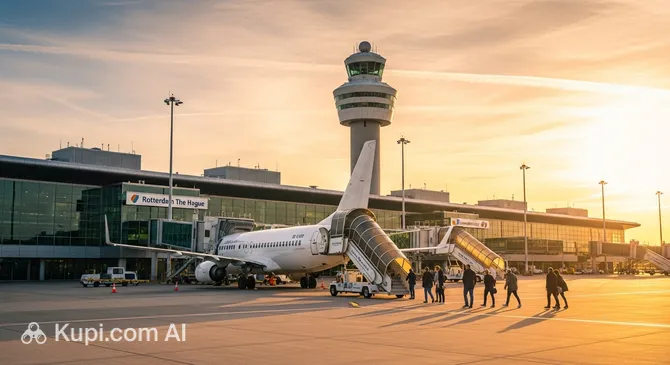
Rotterdam The Hague Airport. Source: Kupi.com Binoculars

Rotterdam The Hague Airport is a cosy and comfortable alternative to the massive Schiphol in the capital. Strategically located between two of the Netherlands' most important cities, it is perfect for those who value their time and dislike long queues. A calm atmosphere prevails here, and the terminal's compactness allows you to complete all formalities in just a matter of minutes. Travellers often choose this aviation hub for quick business trips or to start a European vacation without unnecessary stress.

IATA Code RTM
ICAO Code EHRD
City Rotterdam
Distance to City Centre ~6 km
Status International
Annual Passengers ~2.2 million
Schedule See official website

Among the main advantages of the air harbour is its incredible ergonomics. Unlike large hubs, it is impossible to get lost here: the path from the entrance to the gate takes minimum time. The airport is famous for fast baggage claim and efficient security service. Furthermore, the centre of Rotterdam can be reached in just 15–20 minutes by bus or taxi, making it one of the most convenient city airports in Europe. For passengers, a comfortable business lounge, shops, and restaurants with panoramic views of the runway are available.

Contact Information

  • Official Website: www.rotterdamthehagueairport.nl
  • Help Desk Phone: +31 10 446 34 44
  • Address: Rotterdam Airportplein 60, 3045 AP, Rotterdam, Netherlands
  • Email: For most inquiries, it is recommended to use the contact forms available on the airport's official website.
  • Social Media: The airport actively maintains pages on popular social networks such as Facebook, Instagram, and X (formerly Twitter), where it publishes news and answers passenger questions.
  • Lost & Found Information: If you have lost your belongings in the terminal building, please contact the Lost & Found service. Contact information and a form to fill out can be found in the corresponding section on the airport website.
  • Passenger Support Contacts: For immediate assistance and consultations, you can contact the help desk by phone or speak to staff at the information desks directly at the airport.

How to Get to the Airport

Getting to Rotterdam The Hague Airport (RTM) from the centre of Rotterdam and other cities in the region is quite simple thanks to the developed transport network. The choice of a suitable method depends on your budget, amount of luggage, and time preferences.

Public Transport — the most economical and popular option. The key role here is played by the RET Airport Shuttle (route 33) bus. It runs between Rotterdam Central Station (Rotterdam Centraal) and the airport. The trip takes approximately 25-30 minutes. Another convenient route is to take the Metro Line E (RandstadRail) to Meijersplein station, where you can make a quick transfer to the same bus No. 33. This method often turns out to be even faster than the trip from the Central Station. For payment, you can use an OV-chipkaart transport card, a bank card, or buy a ticket from the driver.

Taxi or pre-booked transfer — this is the most comfortable and fastest way to get to the terminal, especially if you are travelling with large luggage or at night. A trip from the centre of Rotterdam will take about 15-20 minutes excluding traffic jams. The cost of a taxi ride is usually from 30 to 45 euros. Pre-booking a transfer online can guarantee a fixed price and timely car arrival.

If you prefer independence in movement, you can use a rental car. Offices of all major international rental companies are represented at the airport. The road to the airport is well marked with signs. There are several official car parks (P1, P2, P3, P6) on the airport territory for short-term and long-term parking. It is recommended to book a parking space in advance via the internet — this usually works out significantly cheaper than paying on the spot.

For travellers coming from The Hague, the most convenient route would be a trip on Metro Line E (RandstadRail) from The Hague Central Station to Meijersplein station in Rotterdam, followed by a transfer to bus No. 33. The entire journey will take about 45-50 minutes and is an excellent alternative to travelling by train via Rotterdam Central Station.

Terminals and Map

Rotterdam The Hague Airport (RTM) is distinguished by its compactness and thoughtful organisation, making it particularly convenient for passengers. One of the main advantages of this aviation hub is the presence of just one passenger terminal, which serves both departing and arriving flights. Thanks to this, navigating here is very easy, and you will not have to spend time moving between different buildings.

The terminal layout is intuitive. The building has two main levels:

  • Ground Floor — this is the arrivals area. Passengers arrive here after the plane lands. Baggage claim belts, car rental counters, customs control, and the exit to the city are located here.
  • First Floor — the departures area. Here you will find flight check-in counters, baggage drop-off points, as well as the central security control point. After passing the screening, passengers enter the "airside zone" with shops, cafes, and boarding gates.

Since there is only one terminal, you will not have to worry about transfers or searching for shuttles to move between different parts of the airport. All services and zones are located in one building, within walking distance of each other. Navigation is simplified by clear and understandable signs in Dutch and English.

Formalities processing time is another plus of the RTM airport. Thanks to its small size, check-in and screening usually take place significantly faster than in large international hubs. Nevertheless, it is recommended to arrive at the airport in advance: approximately 2 hours before international flights and 1.5 hours before flights within the Schengen zone. This time will be sufficient to check in luggage without haste, pass control, and have a cup of coffee before the flight.

Airport History

The history of Rotterdam The Hague Airport is closely linked to the post-war reconstruction and economic growth of the Netherlands. The decision to build it was made after the old Waalhaven airfield was completely destroyed during bombings in 1940. The new airport, named Zestienhoven, was officially opened in 1956. From the very beginning, it was oriented towards serving both passenger and cargo transport, playing an important role in the region's development.

A key stage in the airport's development was the construction of a new terminal in 1967. This allowed for a significant increase in capacity and improved passenger service quality. In the following decades, the airport developed systematically, attracting new airlines and expanding the route network. Special attention was paid to the development of business aviation, which was due to the proximity to the large port of Rotterdam and the government centre in The Hague.

Significant modernisation took place in the early 2000s. In 2004, the runway was extended, enabling the reception of larger aircraft such as the Boeing 737 and Airbus A320. This opened doors for budget airlines and contributed to a sharp increase in passenger traffic. In 2007, the airport received its modern name — Rotterdam The Hague Airport, to better reflect its importance for both cities and attract international travellers.

One of the interesting facts in the airport's history is its long "proximity" to residential areas, which has repeatedly been the subject of discussions about noise levels and expansion possibilities. Despite this, Rotterdam The Hague Airport has managed to find a balance between development and the comfort of residents, becoming the third-largest airport in the country today. It continues to play an important role in the Netherlands' transport system, serving mainly European destinations and remaining an important hub for business and leisure travel.

Services and Amenities

Rotterdam The Hague Airport (RTM), despite its compact size, offers passengers a full range of services for a comfortable wait for their flight. In the terminal, you will find several restaurants and cafes where you can grab a quick sandwich and coffee or have a full lunch. Shops offer press, books, souvenirs, and last-minute travel essentials.

For those for whom staying connected is important, free Wi-Fi is available throughout the airport. Convenient charging stations for mobile phones and laptops are located throughout the terminal. If you wish to spend time before departure in a more private and quiet setting, the Rotterdam The Hague Airport Lounge is at your service, offering an enhanced level of comfort, beverages, and snacks.

Financial services are represented by ATMs where cash can be withdrawn. Travellers with small children will appreciate the presence of specially equipped mother and child rooms with changing tables. In case of necessity, first aid can be obtained at the airport.

The airport is fully adapted for passengers with reduced mobility. Assistance services, help with check-in, passing control, and boarding are provided. To guarantee assistance, it is recommended to notify your airline at least 48 hours before departure.

For business travellers and those looking for a place to stay near the terminal, the Worldhotel Wings hotel is located directly on the airport territory. It offers not only comfortable rooms but also modern conference halls and business services, making it a convenient place for holding business meetings.

Where to Eat

At Rotterdam The Hague Airport, travellers will find several cosy places to have a snack before departure or a full lunch. Despite its compact size, the airport offers a good selection of establishments located both in the public area and in the departure zone.

Before security control (Landside), in the central hall, there is usually a cafe operating where you can have coffee with fresh pastries or order a sandwich. This is a convenient option for those seeing someone off and those who have just arrived at the airport. Often, there is also a restaurant here with a panoramic view of the runway — an excellent place for a leisurely lunch or dinner while waiting for a flight.

After security control (Airside), in the departure zone, the main dining points for passengers are concentrated. Here, as a rule, a self-service restaurant is located, for example, the popular Dutch chain La Place, which focuses on fresh products. The menu includes salads, sandwiches, hot dishes, soups, freshly squeezed juices, and smoothies. This is a wonderful choice for both a quick snack and a substantial meal before the flight.

For those looking for a quick snack, the departure zone also has cafés and kiosks offering coffee, beverages, packaged snacks, and sweets. Here you can also try local Dutch specialities, for example, the famous stroopwafels (caramel waffles) or cheese sticks. Regarding special dietary needs, vegetarian dishes, such as salads and sandwiches with vegetables, are available in most establishments. It is best to check with the staff of a specific cafe or restaurant regarding the availability of vegan, gluten-free, or Halal options.

Food prices at Rotterdam The Hague Airport correspond to the average European level for airports — be prepared to pay a little more than in the city. Most establishments open early in the morning and work until the last flight departs, so you will always have the opportunity to refresh yourself, regardless of the departure time.

Travel Tips

To ensure your journey through Rotterdam The Hague Airport (RTM) goes as smoothly as possible, use a few simple tips. Although it is a relatively small and convenient airport, we recommend arriving 2–2.5 hours before international flights and 1.5–2 hours before flights within the Schengen zone. This will give you enough time in case of unforeseen queues. Try to check in for your flight online — this will save time and allow you to avoid queues at the check-in counters.

Passing security control at airports in the Netherlands is standard but requires attention. All liquids in hand luggage must be in containers with a volume of no more than 100 ml and packed in one transparent bag with a volume of up to 1 litre. Be prepared to remove laptops and other large electronics from your bag. It is forbidden to carry sharp objects, weapons, and flammable substances in the cabin. Always check your airline's rules regarding the exact dimensions and weight of hand luggage in advance.

When choosing a seat on the plane, be guided by your preferences: a window seat will offer beautiful views during takeoff and landing, while an aisle seat will allow you to stand up freely without disturbing your neighbours. To save money, take an empty reusable water bottle with you — after screening, it can be filled at drinking fountains. Also, a pre-booked transfer from the airport or parking may turn out to be significantly cheaper.

If you have a transfer in Rotterdam, check with the airline if you need to collect your luggage and check it in again. Thanks to the airport's compactness, transfers between gates usually do not take much time. Customs control upon arrival is organised according to the "green" and "red" channel system. If you are arriving from an EU country or are not carrying goods subject to declaration, feel free to go through the green channel.

In case of a flight delay or cancellation, remain calm. Remember your rights under EU Regulation No 261/2004, which provides for the right to assistance (meals, beverages) and possible compensation depending on the flight distance and waiting time. Contact your airline representative for information and instructions. Free Wi-Fi at the airport will help you stay connected and monitor updates on your flight status.

Reached the end of the page?

That means the route is fully explored