Support

Heathrow Airport

About the Airport

Heathrow Airport (LHR) is not just an airport, but an entire city moving to its own rhythm, the main aerial gateway to the United Kingdom and one of the busiest transport hubs in the world. Located approximately 25 kilometres west of the centre of London, it serves as the primary hub for British Airways and Virgin Atlantic Airways. Every year, its terminals welcome and send off tens of millions of travellers, opening pathways to over 200 destinations worldwide. In 2023 alone, the airport's passenger traffic reached almost 80 million people.
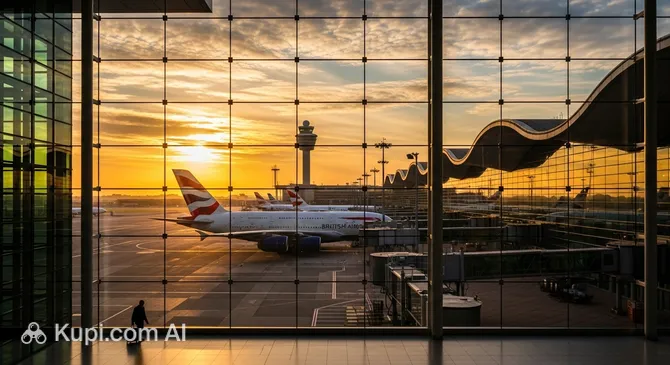
Heathrow Airport. Source: Kupi.com Binoculars

For the convenience of passengers, key information about the airport is presented below.

IATA Code LHR
ICAO Code EGLL
City London
Distance to Centre approx. 25 km
Status International
Annual Passengers 79.2 million (2023)
Popular Airlines British Airways, Virgin Atlantic, American Airlines
Schedule Heathrow Airport Online Schedule

Heathrow is renowned not only for its scale but also for its exceptional level of service. Passengers have access to four modern terminals (2, 3, 4, and 5), connected by complimentary transport. The airport offers magnificent shopping opportunities: from world-famous luxury brand boutiques to classic Duty Free stores. Numerous restaurants, cafés, and lounges allow you to spend your waiting time in comfort.

One of the key features of Heathrow is its superb transport accessibility. You can reach the centre of London in several ways: the high-speed Heathrow Express train will take you to Paddington Station in just 15 minutes, the modern Elizabeth Line offers a fast and comfortable route through the city centre, and the Piccadilly Underground line is the most economical option. Additionally, National Express coaches depart from the airport to many cities across the UK. For art connoisseurs, a permanent art gallery operates in Terminal 5, and various art installations are regularly exhibited in other terminals.

Contact Information

For your convenience, we have compiled the essential contact information for Heathrow Airport (LHR). We recommend always checking the validity of the data on official resources before your trip.

  • Official Airport Website: www.heathrow.com — here you will find the most up-to-date information on flights, services, and airport regulations.
  • Information Service Phone: +44 (0)844 335 1801. Please note that calls may be chargeable depending on your operator.
  • Airport Address: Heathrow Airport, Longford, Hounslow, Middlesex, TW6, United Kingdom.
  • Email: Heathrow Airport prefers to process inquiries via online forms on the official website to direct your query to the correct department.
  • Social Media: You can follow news and updates on the airport's official pages on networks such as Twitter (X), Facebook, and Instagram.
  • Lost Property Information: If you have lost personal items within the airport, use the online Lost Property service on the Heathrow website. If checked baggage is missing, you should immediately contact your airline's representative.
  • Passenger Support Contacts: For assistance directly at the airport, please approach the information desks located in all terminals. For general enquiries, you can call the information service.

How to Get to the Airport

Getting to Heathrow Airport from the centre of London is possible via a multitude of ways suitable for any budget and schedule. Thanks to an extensive transport network, the journey to the United Kingdom's largest aviation hub will be simple and straightforward.

Public Transport

The most popular and reliable way to reach Heathrow is by using public transport. You have several excellent options:

  • Heathrow Express: This is the fastest route. The train departs from Paddington Station every 15 minutes and reaches the airport in just 15-20 minutes non-stop. This is the most expensive rail option, but it is ideal if you are in a hurry.
  • Elizabeth Line (TfL Rail): A more affordable alternative to the express. Trains also depart from Paddington but make several stops along the way. The journey takes about 30-40 minutes. This option offers a good balance between speed and cost.
  • The Tube (London Underground): The most budget-friendly method. The Piccadilly Line (dark blue) connects central London directly to all Heathrow terminals. A trip from the central part of the city (e.g., from Piccadilly Circus station) will take about 50-60 minutes. Payment is possible via Oyster card or contactless bank card, making it very convenient.
  • National Express Coaches: Comfortable coaches run between Victoria Coach Station and Heathrow around the clock. Travel time depends heavily on traffic and ranges from 60 to 90 minutes. This is a good choice if you have a lot of luggage or are travelling from areas without direct rail or tube connections.

Taxi, Transfer, and Car Rental

For maximum comfort, you can choose a taxi or pre-book a transfer. A ride in a famous black cab from central London will be costly but ensures "door-to-door" service. Travel time is 45-90 minutes depending on traffic conditions. A more budget-friendly option would be ride-hailing apps (such as Uber, Bolt) or pre-booked minicabs.

If you plan to travel around the country by car, offices of all major rental companies are present at Heathrow Airport. For those arriving in their own vehicle, numerous parking options are available: short-stay, long-stay, and valet parking. It is strongly recommended to book a parking space online in advance, as this is significantly cheaper than paying on the spot.

Terminals and Map

Heathrow Airport (LHR) is one of the busiest and largest airports in the world. Its structure may seem complex, but thanks to well-thought-out signage, navigating here is quite simple. Currently, four terminals operate at Heathrow: Terminals 2, 3, 4, and 5. It is worth noting that Terminal 1 was closed and demolished as part of reconstruction efforts.

Structure and Purpose of Terminals:

Each terminal typically serves specific airlines or alliances, so it is extremely important to check in advance from which specific terminal your flight departs.

  • Terminal 2 (The Queen's Terminal): This is the main base for Star Alliance airlines (Lufthansa, Air Canada, Singapore Airlines, United Airlines, and others). It is a modern and bright terminal with a large selection of shops and restaurants.
  • Terminal 3: Mainly serves Oneworld alliance flights (except British Airways), as well as Virgin Atlantic and several other carriers. Although it is one of the older terminals, it has been modernised multiple times and offers all necessary services.
  • Terminal 4: Located separately from the others. Airlines of the SkyTeam alliance (including KLM, Air France) and other non-alliance carriers are based here.
  • Terminal 5: Used almost exclusively by British Airways and its partner Iberia. This is the newest and largest terminal, consisting of the main building (5A) and two satellite buildings (5B and 5C), connected by an automated train.

Navigation and Transfers Between Terminals:

Movement between terminals is well-organised and free for passengers.

  • Terminals 2 and 3: Located within walking distance of each other. They are connected by an underground pedestrian walkway; the walk takes about 10-15 minutes.
  • To Terminals 4 and 5: You can reach them from the central area (T2 and T3) via free shuttle trains (Heathrow Express or Elizabeth Line) or special buses. The train journey takes just a few minutes. Always follow the signs for "Inter-terminal transfers".

Departure and Arrival Zones, and Processing Time:

Procedures at Heathrow are standard: Departures zones are located on the upper floors, and Arrivals zones on the lower floors. Navigation is intuitive thanks to clear signage. For international flights, it is recommended to arrive at the airport 3-4 hours before departure, and for European flights — at least 2-3 hours. The time required for security checks and passport control can vary greatly depending on the load, but queues can be significant during peak hours. Allow extra time, especially if you need to transfer between terminals for a connecting flight.

Recommendations:

Before your trip, be sure to check the airport website or your ticket to see which terminal your flight departs from. Use the Heathrow Airport mobile app to track flight status, view maps, and receive up-to-date information. Follow the clear signs: purple for departing passengers and yellow for arriving ones. The main thing is to allow enough time, and your journey through Heathrow will go smoothly.

Airport History

The history of Heathrow Airport is an amazing journey from a small airfield to one of the busiest and most significant aviation hubs in the world. What is today the global gateway to London and the entire United Kingdom began as a modest private flying field known as the Great West Aerodrome, established in 1929.

A key turning point in its fate occurred during the Second World War when the airfield was requisitioned to build a Royal Air Force base. However, the war ended before construction was completed, and in 1946, the airfield was officially opened for civil aviation under the name London Airport. The first passengers were served in temporary tents, which contrasts sharply with modern terminals.

The rapid development of aviation in the 1950s and 1960s required massive expansion. In 1955, Queen Elizabeth II opened the first permanent terminal building, the Europa Building (later becoming Terminal 2), and in 1961 — the Oceanic Terminal (future Terminal 3), designed for long-haul flights. In 1966, the airport received its current name — Heathrow, after the hamlet of Heath Row, which was demolished for its expansion.

Significant milestones in the airport's history include the extension of the Piccadilly Underground line to Heathrow in 1977, which significantly improved transport accessibility. In 1986, Terminal 4 was opened, and in 1998, the high-speed Heathrow Express rail service was launched. Heathrow was also home to the supersonic Concorde airliner, which operated regular flights from here from 1976 to 2003, becoming a symbol of the jet age.

In the 21st century, modernisation continued: in 2008, the grandiose Terminal 5 opened, becoming one of the largest free-standing buildings in the United Kingdom. In 2014, a new terminal was built on the site of the old Terminal 2, named The Queen's Terminal. Today, Heathrow continues to break passenger traffic records, being not just an airport, but an entire city that has played a key role in the history of global aviation.

Services and Amenities

Heathrow Airport (LHR) offers passengers a wide range of services and amenities to make their stay as comfortable as possible. Throughout all terminals, you will find a huge variety of shops: from world-renowned brands and high-fashion boutiques to classic Duty-Free stores where you can purchase perfumery, gifts, and souvenirs. Gastronomic opportunities are equally impressive — at your service are numerous cafés, restaurants, and dining venues offering both quick snacks and exquisite dishes from famous chefs.

For those who value comfort and privacy, numerous lounges operate at Heathrow. In addition to lounges belonging to specific airlines, there are independent lounges where access can be purchased separately. Here, passengers can rest in peace, use shower facilities, and enjoy complimentary beverages and food. Free Wi-Fi is provided throughout the airport, and numerous charging stations for gadgets allow you to always stay connected.

Financial matters are easily resolved at the airport: bank branches, ATMs, and currency exchange points are at passengers' disposal. In case of need, you can visit pharmacies or medical centres ready to provide first aid. For travellers with children, special play areas and baby care rooms equipped with everything necessary for looking after little ones are provided.

Heathrow pays great attention to accessibility for passengers with reduced mobility. A special assistance service is provided, which is recommended to be booked in advance through your airline. The airport is fully equipped with ramps, lifts, and dedicated washrooms. For those who need to rest between flights, hotels are located directly within the airport grounds and in the immediate vicinity, many of which can be reached on foot via covered walkways or by free shuttles. Business travellers can utilise conference rooms and business centres for meetings and work.

Where to Eat

Heathrow Airport (LHR) offers a huge selection of establishments for every taste and budget, turning the wait for a flight into a true gastronomic journey. Regardless of which terminal you are in and how much time you have, you will easily find a suitable option — from a quick coffee to an exquisite dinner.

For those in a hurry, popular coffee shop chains and eateries operate in every terminal, both in the public zone (`landside`) and after security control (`airside`). At `Pret A Manger`, `Costa Coffee`, and `Starbucks`, you can grab fresh sandwiches, salads, pastries, and, of course, excellent coffee. This is an ideal choice for a quick and high-quality snack before your flight.

If you wish to enjoy traditional British cuisine, visit one of the dining venues, such as `The Fuller's Bar`. Here you can order a classic `English breakfast`, the famous `fish and chips` (battered fish with fries), or simply enjoy a refreshing beverage in an authentic atmosphere. Such establishments are usually located in the departure area and offer a full menu for a leisurely meal.

For connoisseurs of haute cuisine and those with a couple of hours to spare, Heathrow offers restaurants from famous chefs. For example, `Gordon Ramsay Plane Food` is located in `Terminal 5`, and `The Perfectionists' Café` by Heston Blumenthal is in `Terminal 2`. Besides this, there are many restaurants with international cuisine at the airport: `Wagamama` with Pan-Asian dishes, `Carluccio's` with Italian classics, and `YO! Sushi` for lovers of Japanese food.

Passengers with special dietary needs need not worry. Most restaurants and cafés offer `vegetarian` and `vegan` dishes, which are clearly marked on the menu. `Gluten-free` options are also widely available, especially in chains like Pret A Manger. Information about `Halal` dishes is best checked directly at the establishments. Opening hours for most cafés and restaurants in the `airside` zone are aligned with flight schedules, starting from early morning until late evening.

Travel Tips

Heathrow Airport is one of the largest and busiest aviation hubs in the world, so preparing for a flight through it requires special attention. To ensure your journey goes smoothly, use these proven tips.

Arrival Time and Check-in. Due to the immense size of the airport and high passenger traffic, it is recommended to arrive in advance. For international flights, allow at least 3-4 hours before departure, and for European and domestic flights — about 2-3 hours. To save time, complete online check-in and print your boarding pass or save it on your phone. Security checkpoints can be crowded, especially during morning and evening peak hours.

Security Control and Hand Luggage. Be prepared for thorough screening. All electronics (laptops, tablets) will need to be removed from bags. Remember the standard rule for liquids: all containers must be no more than 100 ml in volume and packed in a single transparent re-sealable bag with a capacity of up to 1 litre. It is prohibited to carry sharp objects, weapons, and flammable substances in hand luggage.

Passengers with Transfers. If you have a connecting flight at Heathrow, carefully follow the Flight Connections signs. You may need to change terminals, which takes considerable time — special buses and trains run between terminals. In most cases, you will need to pass through security control again. Ensure you have enough time between flights (it is recommended to have at least 90 minutes, and even more if changing terminals).

Customs Control. Upon arrival in the UK, you will need to pass through customs. If you have no goods to declare, follow the "Green Channel". If you are carrying items subject to declaration, use the "Red Channel". If you are flying in transit, you do not need to pass customs control provided you do not leave the transit zone.

How to Save Money. To save on transport to the city, consider taking the Underground (Piccadilly Line) instead of the more expensive Heathrow Express — it will take longer but will be significantly cheaper. Bring an empty water bottle with you, which can be filled after passing security at special water fountains. Food and drinks at the airport can be quite pricey, so taking a light snack with you won't hurt.

In Case of Flight Delay. If your flight is delayed, first contact your airline representative for information. Depending on the length of the delay, you may be provided with vouchers for food or even hotel accommodation. Heathrow has many shops, restaurants, and lounge areas where you can comfortably spend time waiting for your flight.

Reached the end of the page?

That means the route is fully explored