Support

Charles de Gaulle Airport

About the Airport

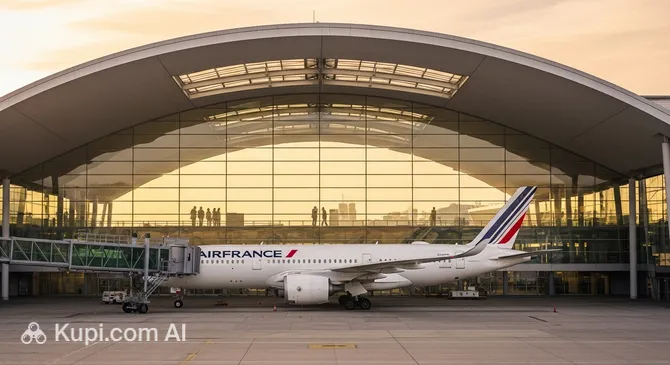
Charles de Gaulle Airport. Source: Kupi.com Binoculars
Charles de Gaulle Airport is not merely a transport hub, but a truly futuristic gateway to the world of French elegance and romance. This grandiose aviation hub, often referred to simply as Roissy, impresses with its scale and avant-garde architecture, reminiscent of sets from science fiction films. Thousands of paths cross here daily, as for many, this is where a long-awaited rendezvous with Paris begins, and the glass escalator tunnels of Terminal 1 have long become a recognisable symbol of the start of a journey.
IATA Code CDG
ICAO Code LFPG
City Paris
Distance to Centre ~25 km
Status International
Annual Passengers Over 67 million (2023)
Schedule Available on the airport website

France's main aerial gateway is a veritable city within a city that never sleeps. One of the airport's key features is its incredible transport accessibility: railway stations are located directly beneath the terminals, from where high-speed TGV trains depart across France, as well as suburban RER B trains, delivering passengers to the centre of Paris in just 30–40 minutes.

For shopping enthusiasts, Charles de Gaulle offers an exceptional experience. The Duty Free zones here resemble branches of famous Parisian department stores, where you can acquire the latest collections from Chanel, Dior, and Hermès, or purchase a box of legendary Ladurée macarons before your flight. Furthermore, the airport is renowned for its comfortable lounge areas and even its own museum, Espace Musées, which regularly hosts art exhibitions, allowing you to touch upon the beautiful without leaving the transit zone.

Contact Information

To obtain the most up-to-date information and contact representatives of Charles de Gaulle Airport, please use the following details:

  • Official Website: www.parisaeroport.fr — here you will find flight schedules, terminal maps, information on parking and services.
  • Information Service Phone: +33 1 70 36 39 50. Please note that for calls from within France, the short number 3950 is used.
  • Address: 95700 Roissy-en-France, France.
  • Email: To contact various airport departments, it is recommended to use the specialised contact forms available on the official website in the "Contact" section.
  • Social Media: The airport actively maintains pages on popular social networks (for example, X (formerly Twitter) and Facebook) under the name Paris Aéroport, where important updates are published.
  • Lost Luggage Information: If you have lost items within the terminal, please complete the online form on the airport website. If luggage was lost during a flight, you must first contact your airline.
  • Passenger Support Service: Most queries can be resolved via online chat or the contact centre, accessible via the phone number listed above.

How to Get to the Airport

Charles de Gaulle Airport (CDG) is the main air hub of France, and it is excellently connected to Paris by an extensive transport network. The choice of how to get to the city or, conversely, to the airport depends on your budget, amount of luggage, and personal preferences. Let us review all available options.

Public Transport is the most popular and economical method.

  • RER B Train: This is arguably the fastest and most reliable option. The suburban train line B directly connects the airport terminals (stations Aéroport Charles de Gaulle 1 and 2) with central Paris stations such as Gare du Nord, Châtelet-Les-Halles, and Saint-Michel Notre-Dame. The journey to the centre takes approximately 35–45 minutes. The ticket cost is around €11.80.
  • Roissybus: A comfortable express bus that runs between the airport and the Opéra Garnier area in the centre of Paris. This is an excellent choice if your hotel is located in this district. Travel time is about 60–75 minutes depending on traffic conditions, and the fare is approximately €16.60.
  • City Buses No. 350 and No. 351: The most budget-friendly, but also the slowest method. They travel to the eastern outskirts of Paris (Porte de la Chapelle and Nation, respectively). The trip can take up to 90 minutes. This option is suitable for travellers without heavy luggage and with time to spare.

Taxis and Transfers offer maximum comfort, especially if you are travelling with family or a large number of suitcases. For journeys by official taxi between Charles de Gaulle Airport and Paris, fixed rates apply: around €56 to the Right Bank (rive droite) and €65 to the Left Bank (rive gauche). Ride-hailing services (such as Uber) also operate at the airport, and private transfers can be booked in advance.

Car Rental and Parking. If you plan to travel outside of Paris, renting a car can be a convenient solution. All major international rental companies are represented in the airport terminals. However, for driving within the city itself, a car is not recommended due to heavy traffic and parking difficulties. For those arriving at the airport in their own vehicle, numerous car parks are provided — from short-term ones at the terminals to more budget-friendly long-term ones, serviced by free shuttles.

Although Charles de Gaulle is the main hub, it is worth remembering that the capital region is served by other air harbours as well. Many European and domestic flights are handled by Orly Airport, while budget airlines often use Beauvais-Tillé Airport, located further from the city.

Terminals and Map

Charles de Gaulle Airport (CDG) is one of the largest and busiest aviation hubs in Europe, known for its complex yet functional structure. Understanding its layout is key to a smooth start or end to your journey.

Structure and Terminals

The airport consists of three main terminals: Terminal 1, Terminal 2, and Terminal 3. However, this simplicity is deceptive, as Terminal 2 is a vast complex divided into seven sub-terminal halls: 2A, 2B, 2C, 2D, 2E, 2F, and 2G.

  • Terminal 1: Historically the first terminal of the airport, featuring a unique circular shape. It mainly serves international flights for airlines not part of the SkyTeam alliance.
  • Terminal 2: The main hub for Air France and its SkyTeam alliance partners, as well as many other major carriers. Halls 2A-2F serve both Schengen and international destinations. Hall 2G is a separate building dedicated to regional flights within the Schengen zone.
  • Terminal 3: The simplest and most compact terminal, serving primarily low-cost carriers and charter flights.

Navigation and Transfer Between Terminals

To move between terminals, car parks, and the RER/TGV station, the free automated train CDGVAL is used. It operates around the clock with short intervals and connects Terminal 1, Terminal 3 (Roissypole stop), and Terminal 2. Between some halls of Terminal 2 (for example, from 2A to 2F), you can move on foot by following the signs. To access the remote hall 2G from other parts of Terminal 2, it is necessary to use a special shuttle bus (N2).

Terminal Features and Security Checks

Each terminal has its own characteristics. Terminal 1 is designed as a central building with several boarding satellites connected by underground walkways with travelators. Terminal 2 is a long series of buildings, where halls 2E (for long-haul flights) and 2F (for Schengen) are the most modern and largest, with a wide selection of shops and restaurants. Terminal 3 offers a basic set of services consistent with its purpose.

Time for passing through procedures varies significantly. CDG Airport is known for potential queues.

  • For flights within the Schengen zone, it is recommended to arrive 2–2.5 hours before departure.
  • For international (non-Schengen) flights, allow at least 3 hours, and if you are departing from large halls such as 2E, allow strictly 4 hours. Passport control can take a considerable amount of time.

Navigation Recommendations

Main tip: always check your terminal and, more importantly, the hall (e.g., 2E, Hall K) in advance on the airline's website or on your ticket. Information boards at the airport are numerous and clear, but due to huge distances, a mistake could cost you a lot of time. Use the official Paris Aéroport app for navigation and flight tracking. If you have a transfer, ensure there is enough time between flights, especially if a change of terminal is required.

Airport History

The history of Charles de Gaulle Airport, the main aerial gateway of Paris and all of France, began in the 1960s when it became obvious that the existing Le Bourget and Orly airports could not cope with the growing passenger traffic. Construction of the new airport, initially named "Paris-Nord", began in 1966. The official opening took place on 8 March 1974. The airport received its current name in honour of the prominent French general and president Charles de Gaulle, who was a symbol of national resurgence.

From the very beginning, the airport stood out for its futuristic design. The first terminal (Terminal 1) was designed by architect Paul Andreu in the form of a central circular building from which seven satellites radiate. This avant-garde concept was intended to optimise passenger movement. In the 1980s, the phased opening of Terminal 2 began, which was initially intended for Air France. An important stage of development was the opening of the railway station in 1976, linking the airport to the city centre via the RER B line.

Over its years of operation, the airport has witnessed several significant, including tragic, events. In 2000, shortly after taking off from Charles de Gaulle, the supersonic Concorde flight Air France 4590 crashed. Another sad event occurred in 2004, when a partial roof collapse occurred in the new Terminal 2E. These incidents led to a review of safety standards and large-scale reconstructions.

The airport has continuously expanded and modernised to match the status of one of the busiest in the world. New sections of Terminal 2 (2F, 2G) were built, as well as Terminal 3 for budget and charter airlines. To facilitate movement between terminals, the automated light metro line CDGVAL was launched. Today, Charles de Gaulle is not only the largest airport in France by passenger traffic but also one of Europe's main cargo hubs.

One of the most amazing facts in the airport's history is connected with Iranian refugee Mehran Karimi Nasseri, who lived in Terminal 1 for a whole 18 years (from 1988 to 2006) due to document issues. His incredible story formed the basis of the plot for Steven Spielberg's famous film "The Terminal". This case forever inscribed the name of Charles de Gaulle not only in the annals of aviation but also in world culture.

Services and Amenities

Charles de Gaulle Airport offers passengers a huge selection of services to make waiting for a flight as comfortable as possible. Here you will find numerous Duty Free shops, boutiques of world-famous brands, as well as souvenir shops. Gastronomic possibilities range from restaurants of high French cuisine and cosy cafes to popular fast-food chains where you can have a snack before departure.

Free Wi-Fi is available throughout the airport, and numerous charging stations for gadgets will allow you to always stay connected. For those who value enhanced comfort, waiting lounges and VIP lounges of various airlines and alliances operate. In these, you can relax in a quiet environment, use shower facilities, have a snack, and work.

For resolving financial matters, bank branches, ATMs, and currency exchange points are located in the terminals. In case of necessity, passengers can seek medical assistance at round-the-clock medical points. There are also pharmacies on the airport territory where necessary medicines can be purchased.

Travellers with children will appreciate the presence of play areas and mother-and-child rooms equipped with everything necessary for baby care. For passengers with reduced mobility, special services are provided, including assistance in moving around the airport, adapted toilets, and parking spaces. It is recommended to notify the airline in advance about the need for assistance.

For business travellers, business centres and conference rooms are equipped where you can hold a meeting or work in silence. If you have a long layover or an early departure, you can stay at one of several hotels located either directly within the airport territory (for example, in Terminal 2) or in the immediate vicinity, to which free shuttles run regularly.

Where to Eat

Charles de Gaulle Airport (CDG) offers an impressive variety of establishments for every taste and budget, allowing passengers to enjoy both a quick snack and an exquisite dinner. Dining options are scattered across all terminals, both in public zones (landside) and in zones after passing security control (airside).

For a quick snack and coffee. If you are short on time, pay attention to the numerous cafes and bakeries. The Paul chain, present in almost all terminals (e.g., 2E, 2F, 1), is the ideal place to try fresh French pastries: croissants, raisin swirls, or baguette sandwiches. Establishments like Pret A Manger and Starbucks also offer familiar and reliable options for salads, sandwiches, and beverages. Most of them operate from early morning until late evening, adjusting to flight schedules, and are located both before and after passport control.

For a full lunch or dinner. Those with time to spare should visit one of the table-service restaurants. At the airport, you can find both classic French bistros and fine dining restaurants. For instance, Bistrot Benoît in Terminal 2F offers traditional Parisian dishes in a cosy atmosphere. For gastronomy connoisseurs, the award-winning restaurant I Love Paris by Guy Savoy operates in Terminal 2E (Hall L, passengers only). Here you can enjoy modern French cuisine from a famous chef. This is an excellent opportunity to spend time before departure in a relaxed setting.

Local cuisine and signature dishes. While in France, you must try local delicacies. Visit the Ladurée patisserie (Terminals 1, 2E, 2F) for world-famous macaron pastries — a wonderful souvenir or treat for the journey. In most brasseries and bistros, you will be offered classics like onion soup, quiche, or duck leg confit. This is a great way to get acquainted with the country's cuisine without leaving the airport.

Special diets and prices. In many establishments, especially in large chains, vegetarian, vegan, gluten-free, and halal options are available — look for the corresponding marks on the menu. The price range is very wide: from budget-friendly coffee with pastries (about 10–15 euros) to a full lunch in a mid-range restaurant (30–50 euros per person) and an exclusive dinner in gastronomic restaurants, where the bill can be significantly higher. The largest selection of establishments is located in the sterile area (airside), after passing security control.

Traveller Tips

To ensure your journey through one of Europe's largest aviation hubs goes smoothly, use our tips. Charles de Gaulle Airport (CDG) is vast, and a little preparation will help save time and nerves.

Arrival time at the airport: For international flights, arrive at the airport at least 3 hours before departure. For flights within the Schengen zone, 2 hours is usually sufficient. Consider that terminals can be far from each other, and queues for check-in and security screening can be long, especially during peak season.

Check-in and security: It is strongly recommended to complete online check-in to save time. If travelling with hand luggage only, this allows you to proceed straight to security screening. Be prepared for thorough security checks: pack all liquids (up to 100 ml each) in a transparent bag in advance and be ready to take electronics out of your bag.

Seat selection on the plane: Want to admire views of Paris during takeoff or landing? Choose a window seat. If the ability to stretch your legs or easily access the washroom is more important to you, an aisle seat is better suited. For greater comfort on long-haul flights, you can study the seating map of your aircraft on specialised websites in advance.

Hand luggage: Standard EU rules prohibit carrying liquids in containers larger than 100 ml (total volume must not exceed 1 litre per passenger), as well as sharp objects, explosives, and flammable substances. Pack valuables, documents, and medicines in your hand luggage.

Transfer passengers: Carefully study your tickets. A transfer at CDG may require a change of terminal. The automated train CDGVAL and special shuttle buses run between terminals. Allow sufficient time for movement and possible re-screening at security.

Customs control: When arriving from a country outside the EU, you will have to pass passport control and then customs. If you have no goods to declare, proceed confidently through the "Green Channel". For travellers within the Schengen zone, the procedure is maximally simplified.

Saving time and money: The fastest and relatively inexpensive way to get to the centre of Paris is the suburban RER B train. This is often more cost-effective than a taxi, especially during rush hours. To avoid overpaying for water, bring an empty bottle with you and fill it at drinking fountains after the security zone.

Flight delays: In case of a flight delay or cancellation, contact your airline representative. According to EU rules, for long delays, you are entitled to food and drinks, and if necessary — accommodation in a hotel. Remain calm and check information at the airline counter or on information screens.
Reached the end of the page?

That means the route is fully explored