Support

Paris Orly Airport

About the Airport

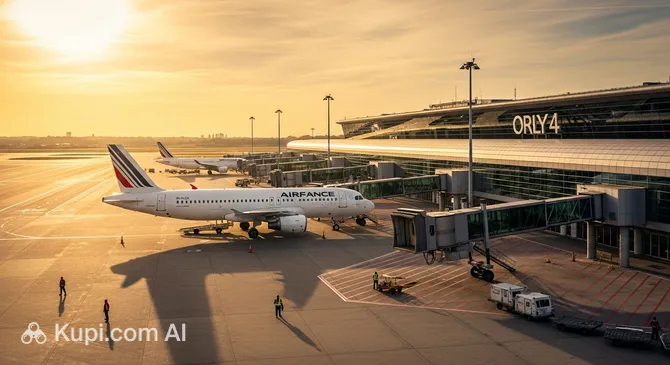
Paris Orly Airport. Source: Kupi.com Binoculars

Paris-Orly Airport (ORY) is not merely the second-largest aviation hub of the French capital, but the true historical gateway to Paris. Opened back in 1932 for airships, today it represents a modern complex that harmoniously combines rich history with advanced technology. Located just 14 km south of the city centre, Orly traditionally serves as the main hub for domestic flights within France, although it also services numerous international destinations. Its four terminals (Orly 1, 2, 3, 4) are integrated into a single space, making movement between them convenient for passengers.

IATA Code ORY
ICAO Code LFPO
City Paris
Distance to Centre 13-14 km
Status International (with a focus on domestic flights)
Passengers per Year Approx. 32.3 million (based on 2023 data)
Popular Airlines Transavia, Vueling, Air France
Schedule Online Board "Orly Airport"

The main advantage of Orly is its compactness and convenient location. Thanks to its proximity to the city, you can reach the centre of Paris in just 25-30 minutes by taxi or the dedicated Orlybus. The airport is well-integrated into the public transport system: buses, the T7 tram, and the high-speed Orlyval train, which connects the terminals to the RER line B station, all depart from here. Inside the airport, passengers have access to a wide range of services: numerous shops, restaurants, relaxation zones, free Wi-Fi, and even an on-site cinema, allowing for a comfortable wait before your flight.

Contact Information

To obtain the most up-to-date information regarding flights, services, and regulations at Orly Airport (ORY), it is recommended to use official sources. Below are the main contact details:

  • Official Website: Detailed information can be found on the Paris Aéroport website: www.parisaeroport.fr.
  • Information Service Phone: For calls from abroad: +33 1 70 36 39 50. For calls from within France: 3950.
  • Address: Avenue Sud, 94390 Orly, France.
  • Email: A direct email address for general inquiries is not provided. It is recommended to use the contact forms on the official website for communication.
  • Social Media: You can follow news and updates on the official Paris Aéroport social media pages, such as X (formerly Twitter), Facebook, and Instagram (@ParisAeroport).
  • Lost Luggage Information: If your belongings were lost within the airport premises, you must fill out a special form in the "Lost Property" section on the official website. In case of luggage loss during a flight, you should primarily contact your airline's representative office.
  • Passenger Support Service: Support is provided via the information service phone, as well as through online chat and feedback forms on the airport's official website.

How to Get to the Airport

Orly Airport (ORY), the second-largest aviation hub of Paris, is conveniently located south of the city. There are several ways to reach it from the centre, each with its own advantages depending on your budget, time, and amount of luggage. The average travel time is between 30 to 60 minutes.

Public Transport — the most popular and economical option:

  • Orlybus: A special shuttle bus departing from Denfert-Rochereau station (Metro lines 4, 6 and RER B). The journey takes about 30-40 minutes and costs approximately 11 Euros. This is a fast and direct way to reach any Orly terminal.
  • RER B Train + Orlyval: You can take the RER B train to "Antony" station and then transfer to the automated Orlyval shuttle train, which goes directly to the airport. The entire journey takes about 35-45 minutes, and a combined ticket costs approximately 14 Euros.
  • RER C Train: A more budget-friendly rail route. You need to take the RER C train to "Pont de Rungis" station and transfer there to the "Go C Paris" shuttle bus. This option may take up to 50-60 minutes, but it is cheaper than the RER B + Orlyval option.
  • Tram T7: The cheapest, but also the slowest method. The T7 tram connects Villejuif-Louis Aragon metro station (terminus of line 7) with Orly Airport. The tram ride takes about 35 minutes, not counting the time on the metro.

Taxis and Transfers. For those who value comfort, especially with large luggage, a taxi is an excellent choice. In Paris, there are fixed rates for trips to airports. A trip from the city centre (Left Bank) to Orly will cost about 36 Euros, and from the Right Bank — about 44 Euros. Travel time depends heavily on traffic and can range from 25 to 60 minutes. Services from apps like Uber and Bolt are also available.

Car Rental and Parking. If you plan to travel around France by car, you can rent one directly at the airport. Orly Airport itself has numerous parking lots — from short-term ones near the terminals to more budget-friendly long-term options connected to the terminals by free shuttles. It is recommended to book a parking space online in advance to get the best rates. Please note that driving within Paris itself can be difficult due to heavy traffic.

When planning your departure, be sure to check exactly which airport you need. Besides Orly, the capital of France is served by the large Charles de Gaulle Airport and the more distant budget Beauvais-Tillé Airport.

Terminals and Map

Orly Airport (ORY) has undergone significant modernization, resulting in the replacement of the old South (Sud) and West (Ouest) terminal system with a unified, more intuitive structure. Today, the airport consists of four interconnected terminals: Orly 1, Orly 2, Orly 3, and Orly 4. This single structure simplifies navigation and movement for passengers.

Layout and Navigation:
The terminals are arranged linearly and connected into one long building, allowing movement between them on foot. Clear signage is installed throughout the airport for passenger convenience.

  • Orly 1 and 2 occupy the site of the former Orly Ouest terminal and primarily serve Schengen zone flights and domestic routes.
  • Orly 4 corresponds to the former Orly Sud terminal and specializes in international, long-haul, and some budget flights.
  • Orly 3 is a new connecting building constructed between the old structures. It serves as a link and handles flights from various airlines.

Transfers and Transport:
For quick movement between terminals, especially between distant points (e.g., from Orly 1 to Orly 4), you can use the free automated train Orlyval. This same train connects all terminals with the parking lots and the "Antony" RER B station, from where you can reach central Paris. Walkways inside the building are well-marked and take between 5 to 15 minutes on foot depending on the distance.

Departure and Arrival Zones:
As in most major airports, departure zones at Orly are located on the upper floors. Here you will find check-in counters, baggage drop-off points, and security screening areas. Arrival zones with baggage claim belts and customs control are located on the lower, ground floor. After exiting the arrivals area, passengers enter a general hall with access to taxis, buses, and the Orlyval shuttle.

Procedure Times and Recommendations:
It is recommended to allocate sufficient time for check-in and security procedures. On average, for international flights, you should arrive at the airport 2.5-3 hours before departure, and for domestic and Schengen flights — 1.5-2 hours prior. Wait times may increase during peak hours and the tourist season. Always check your terminal number (1, 2, 3, or 4) on your ticket or the airline's website, as this determines which part of the airport you need to head to initially. For convenience, you can use the Paris Aéroport mobile app, which offers an interactive map and up-to-date flight information.

Airport History

The history of Paris-Orly Airport (ORY) is a fascinating journey through aviation eras. Founded as an airfield back in 1923, it was initially used for military purposes and airships. During World War II, the airfield was occupied and significantly expanded by German forces, and after liberation, it was used by the US Air Force before being handed over to French authorities in 1946 for the development of civil aviation.

The true "Golden Age" for Orly arrived in the post-war decades. It became the main aerial gateway of France and a symbol of economic rise. A key moment was the opening of the South Terminal (Orly Sud) in 1961, an ultra-modern building for its time made of glass and steel, which became the airport's hallmark. In 1971, the West Terminal (Orly Ouest) was built to serve domestic flights. Until the opening of Charles de Gaulle Airport in 1974, it was Orly that received the majority of international flights and was one of the busiest airports in Europe.

The airport's history has not been without dramatic events. In the 1970s and 1980s, it was the target of several security incidents, which led to a fundamental review and strengthening of security measures at airports worldwide. These events left their mark but also contributed to the development of modern safety protocols that are the standard in aviation today.

In recent decades, Orly has undergone several stages of large-scale modernization. One of the most significant projects was the unification of the South and West terminals into a single complex, completed in 2019. As a result of this reconstruction, the airport was reorganized, and the terminals received new names: Orly 1, 2, 3, and 4. This allowed for the optimization of passenger flows and improved infrastructure. Today, Orly Airport continues to play an important role, serving primarily domestic, European, and North African destinations, remaining a living monument to the history of civil aviation.

Services and Amenities

Orly Airport (ORY) offers passengers a wide range of services and amenities to make waiting for a flight as comfortable as possible. Everything here is thought out to the smallest detail, from dining and shopping to specialized services for various categories of travellers.

Within the terminals, you will find numerous restaurants and cafés to suit every taste and budget — from fast food outlets to restaurants serving exquisite French cuisine. For shopping enthusiasts, numerous stores are open, including Duty Free, boutiques of famous clothing brands, accessories, cosmetics, and souvenir shops.

To wait for their flight in comfort, passengers can use the free Wi-Fi available throughout the airport. Numerous charging stations for electronic devices are located in the waiting lounges and at boarding gates. For those who value enhanced comfort, VIP lounges and business lounges are available, where you can relax in silence, work, and enjoy refreshments.

Financial matters are easily resolved on the spot: bank branches and currency exchange points operate at the airport, and ATMs are also installed. In case of necessity, passengers can visit medical points for first aid.

Travellers with children will appreciate the specially equipped play areas and mother-and-child rooms. For passengers with reduced mobility, a full range of services is provided: dedicated parking spaces, ramps, elevators, and personal assistance upon prior request.

If you have a long layover or an early departure, you can stay at one of the hotels located directly on the airport grounds or a few minutes' drive away. For business travellers, Orly features business centres and conference rooms equipped with everything necessary for meetings and negotiations.

Where to Eat

Orly Airport (ORY) offers a wide selection of establishments for every taste and budget, allowing passengers to either grab a quick snack before departure or enjoy a full lunch or dinner. Dining options are conveniently located in all terminals, both in the public zone (landside) and in the departure zone after security control (airside).

Quick Snacks and Coffee. If you are short on time, look for the numerous coffee shops and bakeries. Chains such as Paul, Brioche Dorée, and Starbucks offer fresh pastries, sandwiches, salads, and hot beverages. They are ideal for breakfast or a light lunch. Such spots can be found in almost every terminal, including Orly 1-2, Orly 3, and Orly 4, primarily in the departure zones.

Restaurants and Full Meals. For those who prefer a leisurely meal, the airport features à la carte restaurants. Here you can try dishes of French and international cuisine. For example, in Orly 4, you can find brasserie-style establishments serving classic French dishes. In Orly 1-2, there are also restaurants offering everything from pizza and pasta to more refined options. Prices range from the average range in cafés to higher prices in full-service restaurants.

Local Cuisine and Specialties. Being in France, do not miss the opportunity to enjoy local delicacies. Be sure to try the famous almond macaron cakes at the Ladurée kiosk, which is usually located in Orly 4. In many bakeries, you will find authentic croissants and baguettes. This is a great way to experience the taste of Paris without even leaving the airport.

Special Dietary Requirements. Most establishments strive to accommodate the needs of different passengers. Vegetarian sandwiches, salads, and pastries can be found in most cafés. Some restaurants offer vegan and gluten-free options on their menus. Information regarding Halal dishes is best verified directly with the staff of the specific café or restaurant.

Opening Hours and Location. Most dining establishments open early in the morning to serve passengers on the first flights and operate until late evening. Main restaurants and cafés in the departure zones (airside) are available throughout the flight operation period. In the public zones (landside), there are also fast-food outlets, which is convenient for those meeting passengers and those arriving late at night.

Travel Tips

To ensure your journey through Orly Airport goes smoothly and without hassle, make use of our tips. These recommendations will help you save time, money, and stress, making the start or end of your trip to Paris as comfortable as possible.

Arrival Time and Check-in: For international flights, it is recommended to arrive at the airport 2.5-3 hours before departure, and for domestic flights or flights within the Schengen zone — 1.5-2 hours prior. Orly can be quite busy, especially in the morning and evening hours. To save time, complete online check-in and, if travelling without checked luggage, proceed directly to security.

Security Checks and Seat Selection: Be prepared for screening: pack liquids (up to 100 ml each) in a transparent bag in advance and be ready to remove electronics from your hand luggage. When choosing a seat on the plane, consider your preferences: by the window for beautiful views, or by the aisle for more legroom and ease of movement. Refer to the cabin map during check-in.

Hand Luggage and Customs: Standard rules prohibit carrying sharp objects, flammable substances, and liquids in containers larger than 100 ml. Always check your airline's allowances, as they may differ. When arriving from a non-EU country, follow the "Red" or "Green" channels depending on whether you have goods to declare. Within the Schengen zone, customs control is usually a formality.

For Transfer Passengers: Orly Airport has several terminals (Orly 1-2-3-4), between which the free automated Orlyval train operates. Ensure you know which terminal your next flight departs from, and allow sufficient time for the transfer, re-screening, and passport control if necessary.

Savings and Flight Delays: To save money, use public transport to the city, such as the Orlybus or the RER B train. Bring an empty water bottle and fill it after passing security. In case of a flight delay, immediately contact the airline representative for information about your rights (including vouchers for food or a hotel) according to EU regulations. Having travel insurance can also be beneficial.

Reached the end of the page?

That means the route is fully explored