Support

Lille Airport

About the Airport

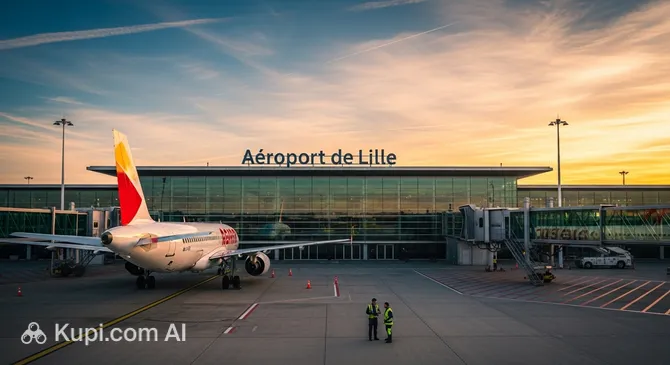
Lille Airport. Source: Kupi.com Binoculars

Lille-Lesquin Airport (Aéroport de Lille-Lesquin) represents the welcoming gateway to the Hauts-de-France region, situated at a strategic crossroads between Paris, Brussels, and London. Unlike the bustling hubs of the capital, an atmosphere of tranquillity prevails here, and the compact dimensions of the terminal allow passengers to complete all pre-flight formalities in a matter of minutes. It is an ideal starting point for those who value comfort and wish to begin their journey through northern France or towards Mediterranean resorts without unnecessary hassle.

IATA Code LIL
ICAO Code LFQQ
City Lille
Distance to Centre ~10 km
Status International
Annual Passengers ~1.9 million

Airport Features and Advantages

Lille Airport is renowned for its ergonomics and passenger-oriented approach. Thanks to intuitive navigation and the modest size of the single terminal, the path from the entrance doors to the boarding gate is as short and simple as possible. This makes the air harbour an excellent choice for families with children and those who prefer to avoid the stress of massive airport complexes.

Key benefits for travellers:

  • Transport Accessibility: You can reach the city centre in just 20 minutes on the dedicated shuttle (Navette), which runs between the airport and the Lille-Flandres railway station. Additionally, the immediate proximity to the A1 and A23 motorways is convenient for those renting a car.
  • Speed of Procedures: Queues for security screening and passport control are typically minimal here, allowing you to plan your arrival at the airport with less buffer time than at major hubs.
  • Convenient Parking: There are several parking zones with reasonable rates located on the premises, within walking distance of the terminal entrance.
  • Connectivity and Services: Despite its compact size, the airport offers modern amenities, including a business centre, work zones, and free unlimited Wi-Fi throughout the area.

Contact Information

Below you will find essential contact information for Lille Airport (LIL), which will help you plan your trip and resolve any potential queries.

  • Official Website: www.lille.aeroport.fr — here you will find the most up-to-date information on flights, services, and airport regulations.
  • Information Desk Phone: +33 3 20 49 67 47 — for general questions regarding airport operations.
  • Airport Address: Route de l'Aéroport, 59810 Lesquin, France.
  • Email: You can contact airport representatives via the contact form on the official website in the "Contacts" section.
  • Social Media: Follow news and updates on the official pages on Facebook, X (formerly Twitter), and Instagram.
  • Lost Luggage Information: If your luggage was lost during the flight, you should primarily contact your airline's baggage tracing service. For items left within the terminal, please contact the airport's Lost and Found service (Objets Trouvés), contact details for which are listed on the website.
  • Passenger Support Service: Information desks are located within the airport terminal. You can also use the information desk phone number for assistance.

How to Get to the Airport

Reaching Lille Airport, located approximately 10 km south of the city centre, is possible via several convenient methods. The choice depends on your budget, time, and comfort preferences. The journey from the centre of Lille usually takes from 15 to 30 minutes.

Public Transport: Shuttle Bus
The most popular and economical method is the dedicated shuttle bus, Navette Lille Aéroport. It runs between the airport and the city centre, making a stop near the Euralille shopping centre, in immediate proximity to the Lille Flandres and Lille Europe railway stations. The trip takes about 20 minutes. A one-way ticket costs approximately €8, and a return ticket is around €10. Buses depart every 20-30 minutes throughout the day.

Taxi and Transfer
For maximum convenience, especially if you are travelling with large luggage or family, you can take a taxi. The taxi rank is located directly outside the terminal exit. A trip to the city centre will take about 15-20 minutes depending on traffic conditions and will cost approximately €25-€35. You can also pre-book a private transfer, which often guarantees a fixed price and a meeting with the driver in the arrivals hall.

Car Rental and Parking
If you plan to travel around the Hauts-de-France region and explore the beauty of northern France, renting a car is an excellent solution. Offices of leading international rental companies are present at the airport. Reaching the airport by car is easy via the A1 motorway. There are several car parks on the airport grounds: from short-term (P1, P2) located near the terminal, to more budget-friendly long-term ones (P4, P5). It is recommended to book a parking space online in advance to secure the best price.

Other Nearby Airports
Lille is conveniently located, allowing you to consider other airports in the region. For instance, at a distance of about 100 km, there are major Belgian air hubs: Charleroi Airport and the main Brussels Airport. Also within reach (about 140 km) is Beauvais-Tillé Airport, serving budget airlines flying to Paris.

Terminals and Map

Lille Airport (LIL) is distinguished by a well-thought-out and compact structure, making it very convenient for passengers. All passenger traffic is handled in one modern terminal, so you won't have to worry about long transfers or searching for the right building. Such organisation significantly simplifies navigation and reduces the time required for pre-flight formalities.

The terminal has several levels, and its layout is intuitive:

  • Level 0 (Ground Floor): Arrivals Zone. All passengers arrive here after reclaiming their luggage. Car rental desks, the tourist information centre, and the exit to taxis and buses are also located here.
  • Level 2 (First Floor): Departures Zone. Airline check-in counters and the main security checkpoint are located on this level. After passing through control, passengers enter the general departure lounge with shops, cafes, and boarding gates.

Because there is only one terminal at the airport, transitions between zones are kept to a minimum. Navigation is very simple: for departures, you need to go up to the first floor (Level 2), and upon arrival, you will find yourself on the ground floor. All signs are clear and duplicated in English, which helps to orient yourself easily. Check-in and screening times are usually short compared to major hubs, but it is still recommended to arrive at the airport 1.5-2 hours before departure for domestic and Schengen flights, and 2.5 hours before international flights to avoid rushing.

Airport History

The history of Lille Airport (LIL), also known as Lille-Lesquin Airport, dates back to the 1930s, when a decision was made to create an airfield to serve the growing industrial region. Officially opened for flights, it had a dual purpose from the very beginning — civil and military, which determined its fate for many decades. The early years were dedicated to establishing infrastructure and operating infrequent commercial flights.

A key period in the airport's history was during the Second World War. Following the occupation of France, the airfield was actively used by the German Luftwaffe air forces. After the region was liberated by the Allies, it became an important base for the Royal Air Force (RAF) and the United States Army Air Forces (USAAF). This military phase left a significant mark, and after the war, serious efforts were required to restore and reorient the airport towards peaceful purposes.

A real breakthrough in civil aviation for Lille occurred in 1963, when the first proper terminal building was constructed. This event marked the beginning of the era of regular passenger transport and laid the foundation for future growth. The airport gradually expanded its flight geography, becoming an increasingly important transport hub for the north of the country.

The most significant modernisation in the history of Lille Airport took place in 1996 with the construction of a new, modern terminal. This project was part of a large-scale strategy to transform Lille into a European transport hub, coinciding with the launch of high-speed Eurostar and TGV trains. The new terminal, which is still in use today, allowed for a significant increase in capacity and offered passengers a service of a completely new level.

Today, Lille Airport is a dynamically developing gateway to the Hauts-de-France region, serving millions of passengers annually. It plays an important role in the network of European low-cost carriers and charter airlines, offering flights to a multitude of popular destinations. An interesting fact: thanks to its strategic location near the border, the airport is highly popular not only with the French but also with residents of neighbouring Belgium, making it truly international.

Services and Amenities

Lille Airport (LIL) cares for the comfort of its passengers by offering a wide range of services and amenities for a pleasant wait before a flight. Before departure, you can have a snack in one of the restaurants or cafes, drink coffee, or buy sandwiches for the road. The airport shops offer a good selection of goods: from souvenirs and press to perfumery and luxury items in the Duty Free zone.

For those for whom staying connected is important, free Wi-Fi is available throughout the terminal, and numerous charging stations will allow you to charge your gadgets. If you prefer to wait for your flight in a calmer atmosphere, a VIP lounge with a higher level of comfort is at your service, where you can rest or work in silence.

The airport provides all necessary practical services. You will easily find ATMs and currency exchange points to handle financial matters. For travellers with small children, special nursery rooms are equipped. In case of necessity, you can contact the medical centre for first aid.

The airport is fully equipped to serve passengers with reduced mobility: special assistance is provided for boarding and disembarking, and the terminal infrastructure is adapted for free movement. For business travellers from France and other countries, conference rooms and business centres are available where meetings can be held or work can be done.

If you have an early departure or a long layover, there are several hotels located in the immediate vicinity of the airport offering comfortable accommodation. This makes the journey even more convenient and allows you to rest before the road ahead.

Where to Eat

At Lille Airport (LIL), travellers will find several establishments where they can have a snack or a full meal. Dining outlets are located both in the public area before security control and in the departure lounge, allowing you to choose a convenient option depending on the remaining time.

In the public area (Level 2, landside), before check-in, you will find the Trib's cafe. This is an excellent place for a quick snack, offering sandwiches, salads, pastries, and beverages. You can also find the world-famous coffee house Starbucks here. These establishments are ideal for meeting with those seeing you off or for those who have arrived at the airport early.

After passing through security control, in the departure zone (airside), the choice becomes wider. For those who wish to have a substantial lunch or dinner in a calm atmosphere, the restaurant Le Flandre is open. Its menu features brasserie-style dishes, including hot meals and appetisers. If time is short, there is also a Trib's outlet in the departure zone, offering quick and convenient food and drink options. The main dining establishments at the airport operate from the first to the last flight, adjusting to passenger traffic.

Being in the north of France, pay attention to dishes with local flair. On the menu, you might encounter sandwiches with the famous *Maroilles* cheese or traditional waffles. Regarding dietary preferences, most establishments offer vegetarian options, such as salads or meat-free sandwiches. It is best to check directly with the staff regarding the availability of Halal-friendly or gluten-free dishes.

Tips for Travellers

To ensure your journey through the airport of Lille city proceeds as comfortably as possible, take advantage of a few useful tips. Lille-Lesquin Airport (LIL) is a modern and relatively small transport hub in the north of France, which makes navigating it quite simple. We recommend arriving at the airport 2 hours before departure for flights within the Schengen zone and 3 hours for other international destinations. This will give you enough time for check-in, baggage drop, and passing through security control without rushing.

To save time, use online check-in for your flight, which is offered by almost all airlines. When passing through security, remember standard EU safety rules: all liquids in hand luggage must be in containers of no more than 100 ml and packed in a single transparent resealable bag. Laptops and other large electronics must be removed from bags and placed in a separate tray.

When choosing a seat on the plane, be guided by your preferences: a window seat is ideal for those who love to contemplate clouds and views of the earth, while an aisle seat gives more freedom of movement around the cabin. If you want to be one of the first to leave the plane upon arrival, choose seats in the front part of the cabin.

If you have a transfer in Lille, the process depends on your itinerary. When flying between countries in the Schengen zone, you do not need to pass passport control. If you are arriving from a country not in Schengen, or flying to one, passing border control will be mandatory. At customs when entering the EU from third countries, there are "green" (if you have no goods to declare) and "red" (if there are such goods) channels.

To save a little, take an empty water bottle with you. After passing security control, you can fill it with drinking water at special fountains or dispensers. Food prices at the airport are traditionally higher, so it is not forbidden to carry light snacks with you, such as biscuits, fruit, or nuts.

In case of a flight delay or cancellation, first of all, contact your airline representative for current information. According to European legislation (Regulation EC 261/2004), depending on the duration of the wait and the distance of the flight, you may be entitled to meals, refreshments, and in case of long delays — hotel accommodation. Be sure to keep all receipts for forced expenses. While waiting for your flight, you can use the free Wi-Fi, visit cafes, or browse the duty-free shops.

Reached the end of the page?

That means the route is fully explored