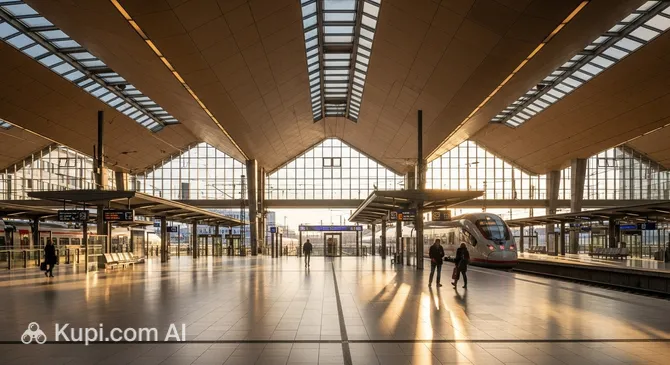
Münster Hauptbahnhof is the city's main railway gateway and one of the most important transport hubs in the North Rhine-Westphalia region. Following a major renovation, the station welcomes travellers with a modern glass façade and spacious, light-filled halls. Dozens of trains depart from here daily, connecting Münster with major German metropolises such as Hamburg, Cologne, and Berlin, as well as picturesque corners of the region.
It is important for passengers to know that navigation at the station is intuitive. The main building opens onto Bremer Platz, and a wide underground passage leads to the platforms. The station is equipped with elevators and escalators for convenient access to the tracks. Electronic display boards in the main hall and on the platforms show real-time information about train arrivals and departures.
Contact Information
To plan your journey and clarify details, you can use the following contact information for the station and Deutsche Bahn support services:
Official website: bahnhof.de (section Münster (Westf) Hbf)
Information service phone: +49 30 2970 (DB hotline)
Address: Bremer Platz 1, 48155 Münster, Germany
Opening hours: The station is open 24 hours a day. Ticket offices (Reisezentrum) usually operate from early morning until evening (Mon-Fri: 06:00–21:00, Sat-Sun: 07:00–21:00).
Luggage storage: Automatic lockers (Schließfächer) of various sizes are available within the station building.
Accessibility: Assistance for passengers with reduced mobility (Mobility Service Center) is available upon prior request.
How to Get There
Getting to Münster Hauptbahnhof is very simple, as it is located on the eastern edge of the historic centre. If you are in the Prinzipalmarkt area or near the cathedral, a walk will take just 10–15 minutes through lively shopping streets.
Public transport is excellently developed here. Directly in front of the main entrance, at Bremer Platz, numerous city and regional buses stop. On the other side of the station (exit towards Bremer Straße / Hansaring), there are also transport stops. A taxi ride from the centre will take about 5–7 minutes.
Given that Münster is considered the bicycle capital of Germany, many locals arrive at the station by bike. Nearby is a huge bicycle parking facility (Radstation), offering safe storage and service.
Services and Amenities
The station offers a wide range of services for comfortable waiting and travel preparation. At the traveller service centre (DB Reisezentrum), you can purchase tickets and receive advice, while numerous machines (Fahrkartenautomat) are installed for quick purchases.
Free Wi-Fi (network WIFI@DB) is available throughout the station for 30 minutes, after which reconnection may be required. Power outlets are provided in waiting areas for charging gadgets. Passengers can use automatic luggage lockers located in the main tunnel or hall.
For hygiene, paid Rail & Fresh toilets are provided, distinguished by their cleanliness and modern equipment. For citizens with reduced mobility, the station is equipped with elevators to all platforms and tactile navigation.
Where to Eat
It is difficult to go hungry at the station in Münster. Inside the building, there are many bakeries and cafes where you can buy fresh pastries, sandwiches, and coffee for the journey. Popular chain establishments, such as Le Crobag or Ditsch, offer a quick snack at affordable prices (average bill 5–10 euros).
If you have 30–40 minutes to spare, we recommend exiting through the eastern exit to the Hansa-Viertel district. There you will find many cosy cafes and restaurants with a more diverse menu, ranging from Italian pasta to Asian cuisine. Inside the station building itself, there are also small supermarkets where you can buy water, fruit, and snacks.
Station History
The history of railway communication in Münster began back in the mid-19th century. The first station building was opened in 1848, but since then, the transport hub has undergone many changes. During World War II, the station was almost completely destroyed by bombing raids.
In the 1950s, a new building was constructed in the style characteristic of that time, which served the city for more than half a century. However, by the beginning of the 21st century, it ceased to meet modern requirements. In 2017, a major reconstruction was completed: the old building was demolished, and a modern glass complex rose in its place, becoming a new architectural highlight of the city. Today, the station plays a key role, serving tens of thousands of passengers daily.
Passenger Tips
Arrive at the station at least 15–20 minutes before your train departs, especially if you need to buy a ticket at the counter or find the right platform. During peak hours (Friday mornings and evenings), the station can be crowded.
For convenience, download the DB Navigator app: it allows you to buy tickets online and track schedule changes in real-time. In Germany, there are no turnstiles on the platforms, but you must have a ticket with you before boarding — controllers on trains check them regularly.
The station is generally safe, but as in any crowded place, keep an eye on your belongings. At night, it is better to spend time waiting for a train in the illuminated main hall or in the 24-hour fast-food zones.