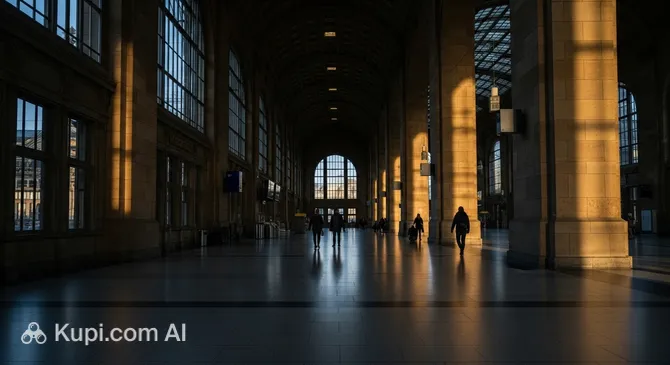
Stuttgart Central Station (Stuttgart Hauptbahnhof) is not just a key transport hub, but also a famous architectural landmark of the capital of Baden-Württemberg. Its historic building with its characteristic tower, topped with a rotating Mercedes-Benz star, is one of the most recognizable symbols of the city. The station serves both international high-speed ICE/TGV trains and regional routes, connecting Stuttgart with Paris, Munich, and Frankfurt.
Important information for passengers: The station is currently undergoing massive reconstruction as part of the "Stuttgart 21" project. Due to construction work, routes to platforms may change, and transfers may take longer than usual. The main hall (Bonatz-Bau) is partially closed, but navigation is clearly marked with coloured lines on the floor and signs. The suburban train stations (S-Bahn) are located on the underground level.
Contact Information
Official website: bahnhof.de (Stuttgart Hbf section)
Information Service Phone (DB): +49 30 2970 (general Deutsche Bahn hotline)
Opening Hours: The station itself is open 24/7. The Traveler Service Centre (DB Reisezentrum) usually operates from 07:00 to 21:00 (schedule may vary on weekends).
Luggage Storage: Automatic lockers (Schließfächer) of various sizes are available and operate 24/7.
Accessibility: The Mobility Service provides assistance with boarding and alighting (advance booking is recommended).
How to Get There
Getting to Stuttgart Central Station is very simple, as it is located in the very heart of the city, at the end of the main shopping street Königstraße.
Public Transport (VVS): The station is a central hub. All city rail lines or S-Bahn (S1–S6, S60) arrive here, stopping at the underground level (Stuttgart Hbf tief). Numerous metrotram lines or U-Bahn (Stadtbahn) also intersect here.
From the Airport: Direct S-Bahn lines S2 and S3 connect Stuttgart Airport with the main station. The travel time is approximately 27–30 minutes, and trains run frequently.
Taxis and Cars: Taxi ranks are located at the north and south exits. Due to construction work, access by private car to the main entrance may be restricted.
On Foot: You can walk from Palace Square (Schlossplatz) to the station in 5–10 minutes via the pedestrian zone.
Services and Amenities
Stuttgart Station offers a full range of services for a comfortable wait and journey.
Tickets and Information: A large DB Reisezentrum service centre, as well as many self-service ticket machines (red for long-distance and regional trains, orange for urban transport).
Waiting Lounges: For 1st class passengers and status customers, a comfortable DB Lounge with refreshments and press is available. For other passengers, there are waiting areas on the platforms and in the concourse.
Connectivity and Charging: Free Wi-Fi (network WIFI@DB) is available on the premises. Power outlets can be found in waiting areas and some cafes.
Luggage and Hygiene: Automatic luggage lockers are in operation. Paid toilets of the Rail & Fresh system (with the option to use a voucher in station shops) and shower cabins are maintained in a clean and hygienic condition.
Assistance: A help point for passengers with reduced mobility and a station mission branch (Bahnhofsmission).
Where to Eat
It is impossible to stay hungry at the station or in its immediate vicinity. The gastronomic zone offers options for every taste and budget.
Quick Snacks: In the passageways and the main hall, there are many bakeries (e.g., Yormas, Kamps), where you can buy fresh pretzels, sandwiches, and pastries. The average check is 3–6 Euros.
Coffee and Drinks: Popular chain coffee shops, such as Starbucks and Coffee Fellows, open early in the morning.
Full Meals: Inside the station building, there is a food court featuring Asian cuisine, burgers (McDonald's, Burger King), and hearty local dishes.
Near the Station: If you have time, simply step out onto Königstraße — there you will find dozens of restaurants, cafes, and outdoor terraces serving traditional Swabian cuisine.
Station History
The history of Stuttgart Station is a history of bold architectural decisions. The current building was constructed between 1914 and 1928 according to the design of architect Paul Bonatz. It is considered an outstanding example of conservative modernism (the Stuttgart School) and is known for its austere limestone walls.
Originally designed as a terminus station (Kopfbahnhof), it served as the city's main gateway for decades. In the 21st century, a new chapter began — the implementation of the grandiose and technically complex "Stuttgart 21" project. The goal of the project is to transform the terminus station into a through underground station, which will significantly speed up train movements and free up surface areas for urban development. Despite debates, the old Bonatz building is being preserved as an architectural monument, integrating into an ultra-modern transport system.
Passenger Tips
To ensure your journey through Stuttgart goes smoothly, use the following tips:
Allow Extra Time: Due to large-scale construction, the paths from the entrance to the platform may be longer than you expect. Arrive at least 20–25 minutes before your train departs.
Boarding: Watch the display boards carefully. Platforms are divided into sectors (A, B, C, etc.) — the train diagram indicates in which sector your carriage will stop.
Luggage: If you have heavy suitcases, look for elevators and escalators, but be prepared for queues during peak hours.
Night Time: The station is open 24/7, but most shops close after 22:00. At night, it is safer to wait for your train in designated areas or in 24-hour fast-food establishments.
Transfers: To transfer to the S-Bahn, follow the green signs with the letter "S". The descent is located inside the main building.