Source: Kupi.com AI
| Characteristic | Value |
|---|---|
| IATA code | ACC |
| ICAO code | DGAA |
| City | Accra |
| Country | Ghana |
| Time zone | Africa/Accra |
| Popular airlines | ASKY, ITA AIRWAYS, Turkish Airlines, United Airlines, Emirates |
| Schedule | Online timetable |
| Characteristic | Value |
|---|---|
| IATA code | ACC |
| ICAO code | DGAA |
| City | Accra |
| Country | Ghana |
| Time zone | Africa/Accra |
| Popular airlines | ASKY, ITA AIRWAYS, Turkish Airlines, United Airlines, Emirates |
| Schedule | Online timetable |
For your convenience, we have compiled the main contact information for Kotoka International Airport (ACC). We recommend verifying the data on official resources before your trip.
Kotoka International Airport (ACC) is located directly within the city limits of Accra, the capital of Ghana, making the journey relatively quick and convenient. Depending on your budget and preferences, you can choose from several ways to reach the terminals.
Taxis and Ride-Hailing Services are the most popular and comfortable option for tourists. You can use official taxis, with ranks located at the terminal exits, or book a car via mobile apps such as Uber or Bolt. The latter option is often more cost-effective and convenient, as the fare is fixed within the app. A trip from central districts, such as Osu or Cantonments, to the airport will take between 20 minutes to an hour, depending on traffic conditions. Traffic in Accra can be very heavy, so always allow extra time for the journey, especially during peak hours.
Public Transport is represented mainly by shared minibuses known as "tro-tros". This is the most budget-friendly way to get around the city, but it can be challenging for those visiting Accra for the first time. "Tro-tros" do not have a strict schedule, are often overcrowded, and finding the right route without local knowledge is difficult, especially with luggage. There are no direct bus shuttles to the airport similar to those in Europe. This option is more suitable for experienced and budget-conscious travellers.
If you prefer independence in your movements, you can use a car rental service. Offices of both international and local rental companies are present at Kotoka Airport. This is a convenient method if you plan to travel extensively around the country. For those arriving at the airport in their own or a rented car, parking is available—there are zones for both short-term and long-term parking. However, please note that driving in Accra requires adaptation due to chaotic traffic and the specific driving style of local motorists.
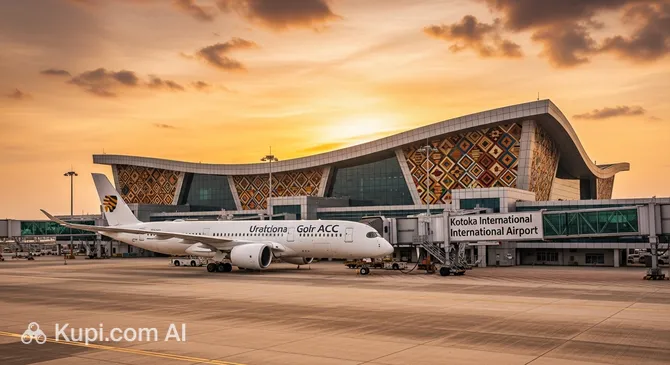
Kotoka International Airport (ACC) in Accra, the capital of Ghana, features a modern and clear structure consisting of several terminals. The main passenger flow is handled by two primary buildings: Terminal 3 for international flights and Terminal 2 for domestic and some regional flights. There is also a separate VIP terminal for private and government aircraft.
Terminal 3 is a state-of-the-art facility serving all international destinations. Its layout is intuitive: the departure zone with numerous check-in counters is located on the upper floor, while the arrival zone is on the lower floor. After passing through passport control and security, passengers enter a spacious departure lounge with Duty-Free shops, restaurants, and business lounges. Navigation through the terminal is made easy thanks to clear signage in English.
Terminal 2, which was previously the main international terminal, now specialises in serving domestic flights within the country and flights to neighbouring West African states. It is smaller than Terminal 3 in size and amenities, but its compactness is an advantage—all procedures here generally take place significantly faster.
Terminals 2 and 3 are within walking distance of each other; the distance between them can be covered in approximately 10–15 minutes. There is no special covered walkway, so weather conditions should be considered when planning a transfer. To navigate the airport, simply follow the signs—they will help you easily find the correct terminal, check-in counters, or boarding gates.
For international flights from Terminal 3, it is recommended to arrive at the airport 3 hours before departure. Check-in and security screening can take from 45 minutes to 1.5 hours, especially in the evening when most flights to Europe and North America depart. For domestic flights from Terminal 2, arriving 1.5–2 hours before departure is usually sufficient.
The history of Kotoka International Airport dates back to World War II, when a military airfield was constructed on the site by the British Royal Air Force. After the war ended, it was converted into a civil facility and became the main airport for the capital of Ghana — the city of Accra, serving growing passenger and cargo flows.
One of the most significant events in the airport's history occurred in 1969. It was then that it received its current name in honour of Lieutenant General Emmanuel Kwasi Kotoka, a member of the National Liberation Council, who was killed on the airport grounds during an attempted coup in 1967. This name is an important part of the country's national memory.
Over the years, the airport has been expanded and modernised multiple times. The original terminal eventually ceased to cope with the load, leading to the construction of new facilities. The most large-scale project was the construction of Terminal 3, which was grandly opened in 2018. This modern complex, equipped with six boarding bridges, spacious waiting halls, and advanced service systems, allowed for a significant increase in capacity and raised the quality of service to an international level.
Thanks to these improvements, Kotoka Airport has repeatedly been awarded the title of "Best Airport in Africa" in its category by the Airports Council International (ACI). Today, it is not only a key transport hub in West Africa but also a symbol of Ghana's dynamic development and hospitality, welcoming flights from all over the world.
Kotoka International Airport (ACC) offers passengers a wide range of services to make their stay as comfortable and productive as possible. The modern terminal is designed with the needs of travellers in mind, whether for business trips or holidays.
Inside the terminal, you will find numerous restaurants and cafés where you can have a snack before your flight. The selection ranges from fast-food outlets to restaurants offering local and international cuisine. For those wishing to shop, there are Duty Free stores offering perfumes, beverages, and souvenirs, as well as boutiques with clothing and accessories.
For a more comfortable wait, the airport operates premium lounges (VIP lounges), such as the Adinkra Lounge and Akwaaba Lounge. Access is available to business class passengers of certain airlines, loyalty programme members, and to all visitors for a fee. The lounges offer snacks, drinks, comfortable seating, and business press.
Free Wi-Fi is available throughout the terminal, allowing you to stay connected. There is also a sufficient number of charging stations for electronic devices. For financial transactions, there are bank branches, currency exchange points, and ATMs operating 24/7.
In case of necessity, passengers can visit the medical centre for first aid. Mother and child rooms are equipped for travellers with children. The airport also provides services for passengers with reduced mobility, including special ramps, lifts, and staff assistance upon prior request.
Although there are no hotels directly inside the airport building, world-class hotels such as the Accra Marriott Hotel and Holiday Inn Accra Airport are located in the immediate vicinity and can be easily reached by shuttle or taxi. For business travellers, some VIP lounges offer basic business services, such as work zones and access to office equipment.
Kotoka International Airport (ACC) in Accra offers passengers diverse dining options to comfortably pass the time while waiting for a flight. Most establishments are concentrated in the modern Terminal 3, which serves the majority of international flights.
In the departure area, after passing through passport control (airside), you will find the largest selection of cafés and restaurants. A food court with well-known international fast-food chains is located here for those in a hurry, as well as restaurants offering both European and African cuisine. This is an excellent opportunity to enjoy the flavours of Ghana one last time—look for the famous Jollof rice, Waakye (rice and beans), or spicy fried plantains known as Kelewele on the menu.
For travellers preferring a full lunch or dinner in a quiet atmosphere, the airport has several full-service restaurants. In the public area (landside), accessible before check-in and security, the choice of venues is more modest, but you will always find coffee shops where you can order drinks, fresh pastries, or sandwiches.
Many establishments strive to accommodate dietary preferences. Vegetarian dishes are not difficult to find, especially in restaurants serving local cuisine rich in vegetable side dishes. It is recommended to check directly with café staff regarding the availability of Halal, vegan, or gluten-free options. Most food outlets in the departure zone operate around the clock or synchronise their hours with flight schedules, ensuring you won't go hungry even during a night departure.
To ensure your journey through Kotoka International Airport in Accra goes as smoothly as possible, follow these tips. As the airport is the main transport hub of Ghana, advance preparation will help avoid stress and unnecessary expenses.
Arrival Time and Check-in. For international flights, it is recommended to arrive at the airport at least 3 hours before departure, and for domestic flights — 2 hours. This time is sufficient to calmly complete all formalities, especially during peak hours. If possible, complete online check-in for your flight; this will save you time in queues at airline counters. Have your passport and boarding pass ready when passing through security control.
Hand Luggage and Seat Selection. Rules for hand luggage are standard: liquids in containers of no more than 100 ml each must be packed in a transparent bag. Sharp objects are prohibited. Be sure to check your airline's weight and size allowance for hand luggage. When choosing a seat on the plane, consider your preferences: a window seat offers beautiful views during take-off and landing, while an aisle seat provides more legroom and the ability to stand up without disturbing neighbours.
For Transit Passengers. The transit zone in the modern Terminal 3 is well-organised. If you have a long layover, you can use the business lounges (for a fee) or relax in a café. Clarify in advance whether you need to collect and re-check your luggage—this depends on the airlines and your ticket.
Customs Control. Upon entering Ghana, be prepared to present not only your passport and visa (if required for your nationality) but also a Yellow Fever vaccination certificate—this is a mandatory requirement. Fill out the migration card honestly and legibly to avoid delays.
Saving Time and Money. To avoid overpaying for taxis, use official services or ride-hailing apps (such as Uber or Bolt), which are widely used in Accra. Exchange only a small amount of money at the airport for initial expenses—the exchange rate in the city is generally more favourable. Free Wi-Fi is available in the terminal building, which will help save on mobile roaming charges.
In Case of Flight Delay. First, contact your airline representative for the latest information and instructions. Ask about the possibility of provided meals or accommodation if the delay is lengthy. Review the terms of your travel insurance—you may be entitled to compensation. While waiting for your flight, you can spend time in the numerous Duty Free shops, cafés, or restaurants at the airport.
Have you reached the end of the page?
So the route has been studied inside and out