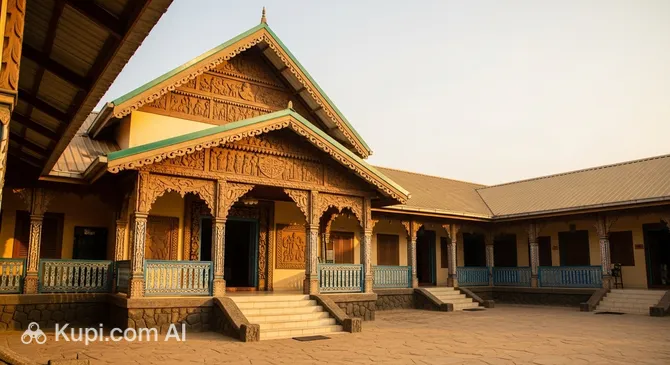
Imagine a place where time seems to slow down, opening doors to a world of living traditions for the traveler. The Sagnarigu Chief Palace is not just a historical site, but the beating cultural heart of the Dagomba people in the city of Tamale. As a significant cultural landmark, this complex of buildings serves as a striking example of the unique architecture of northern Ghana.
Sagnarigu Chief's Palace. Illustration.
Source: Kupi.com AI
Traveler photos:
The palace's architectural style immediately catches the eye: it is an ensemble of traditional round huts topped with neat conical roofs made of dried grass. The walls of the buildings, constructed from clay and natural stone, fit closely together, forming protected inner courtyards. This layout is typical for savanna peoples and highlights a communal way of life, where every detail of the home has its own symbolic meaning.
Today, the Sagnarigu Chief Palace remains the active residence of the local chief and an important administrative center for the district. Tourists are drawn here by the opportunity to see authentic life without embellishment: from unique wall ornaments to traditional hospitality. This place is perfect for those seeking authenticity and wanting to experience the heritage of Ghana's northern regions away from bustling metropolises.
Contacts
To clarify visit details or the possibility of an organized tour, you can use the contact information provided below. Since this is an active chief's residence, visitors are encouraged to show respect for local rules and customs during their visit.
A visit to the palace is, above all, a visual journey into a world of tradition. Your main attention should be given to the traditional architecture: you can examine the structure of the round huts in detail and learn how conical roofs help keep things cool in the hot savanna climate. Be sure to notice the exterior walls—many of them are decorated with relief ornaments, each of which can tell the story of a family or clan.
For those interested in culture, this is a wonderful opportunity to observe the daily activities of local residents. Often, you can see artisans at work on the grounds or nearby: whether weaving baskets, creating traditional fabrics, or applying patterns to clay surfaces. Interacting with local residents will allow you to learn firsthand about etiquette and the role the chief plays in the life of the modern community.
For photography enthusiasts, the palace offers many unique shots—the harmony of natural materials (clay, wood, and straw) against the backdrop of the vast African sky looks exceptionally picturesque. Also, don't miss the chance to try local cuisine near the palace or purchase handmade souvenirs, which make for great reminders of northern Ghana's hospitality.
Getting There
The Sagnarigu Chief Palace is located in the northern part of the city at C49G+P45, Sagnarigu Rd. If you are arriving in the region by plane via Tamale International Airport, the trip to the attraction is about 15–20 kilometers. A taxi ride from the airport will take approximately 20–30 minutes depending on traffic.
From the central part of the city, you can reach the palace much faster—in just 10–15 minutes. The most popular and colorful way to get around is by local tro-tro minibuses or motor rickshaws, which regularly ply Sagnarigu Rd. For precise navigation, you can use the coordinates 9.419263, -0.8746496.
Travelers arriving from Accra or Kumasi by intercity bus usually arrive at Tamale Central Station. From the central bus station to the Sagnarigu district, it is easiest to take a taxi, agreeing on the fare beforehand. The roads in this area are paved, making access to the palace comfortable at any time of year.
Nearest city: Tamale
History & Facts
The history of the Sagnarigu Chief Palace is closely intertwined with the traditions of the peoples of northern Ghana, where architecture has always served as a reflection of social and ancestral hierarchy. Historically, cities in this region were built on a centric principle: the palace was erected at the heart of the settlement, and residential quarters radiated from it, emphasizing status and proximity to the ruler. Interestingly, in the Middle Ages, these lands were home to developed settlements with stone buildings, whose traditions eventually transformed into the unique savanna style.
The palace's architectural ensemble is an example of timber-framing techniques (wattle and daub) using local materials—clay and straw. These construction methods have remained virtually unchanged for centuries. Even when the southern regions of Ghana began actively interacting with Europeans in the 15th century due to gold deposits, the northern territories maintained their authenticity, preserving traditional forms and ways of life from external influence.
As an official residence, the palace has served for centuries not only as a living space but also as a community center. The walls of the most important buildings in the complex were often decorated with relief ornaments that carried encoded symbols and lineage histories. Modern buildings in Tamale, constructed in the form of round bungalows, are a direct architectural legacy of these ancient huts, confirming the unbreakable link between the past and the present.
Time Needed
A full exploration of the Sagnarigu Chief Palace usually takes about 1.5–2 hours. This is quite enough time to leisurely view the traditional architecture of the complex, explore the inner courtyards, and take atmospheric photos of the unique ornamented facades.
About 30–45 minutes will be spent on a visual inspection of the buildings, while the remaining time is best dedicated to interacting with local residents or a guide, if one is available. This unhurried pace will allow you to feel the rhythm of life in the northern community and better understand the cultural context of this place.
Working Hours
The palace follows a specific operating schedule; however, as it is an active residence, visiting hours can sometimes change depending on community ceremonies. On weekdays, the complex is usually open from early morning until evening:
Monday — Friday: approximately from 07:30 to 17:30 (it may close slightly earlier on Friday, around 17:00). Saturday: from 10:00 to 16:30. Sunday: Closed. Before planning your visit, it is recommended to check for current information locally or through official resources, if available.
Day
Opening hours
Monday
07:30–17:30
Tuesday
07:30–17:30
Wednesday
07:00–17:30
Thursday
07:00–17:30
Friday
07:30–17:00
Saturday
10:00–16:30
Sunday
Закрыто
Nearby
The city of Tamale and its surroundings offer many interesting places that will complement your impression of the northern region's culture. A walk through the adjacent neighborhoods will allow you to see the daily lives of the townspeople and find cozy spots to relax after your tour.