Support

Itilleq

Airports in the city

About the Airport

Itilleq. Source: Kupi.com Binoculars

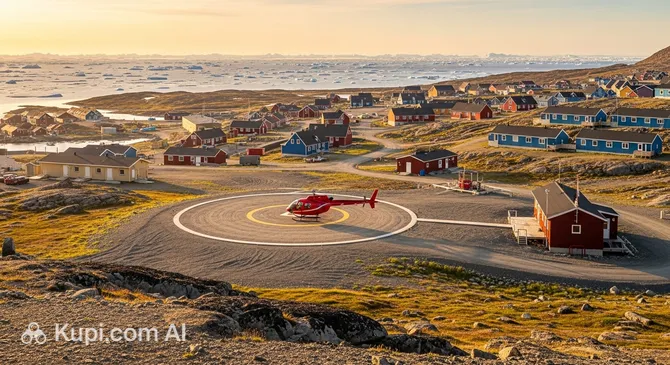
Itilleq Airport (or rather, Itilleq Heliport) is not a bustling transport hub, but a cosy aerial gateway into a world of true Greenlandic authenticity. Arriving here by helicopter becomes a breathtaking prologue to exploring a colourful settlement lost amidst the rugged waters of the Davis Strait. Here, on a tiny island with no cars or paved roads, this helipad serves as the main thread connecting local residents and rare guests to civilisation.

AirportItilleq
IATAQJG
ICAOBGIQ
CitySisimiut
TimezoneAmerica/Nuuk
ScheduleOnline board

Features and advantages of the heliport:

  • A vital artery: For the residents of this isolated island, the helicopter is the most reliable way to reach the nearest city, Sisimiut, especially during the winter season when sea travel is hindered by ice.
  • Panoramic views: The flight lasts only about 15–20 minutes, but offers incredible impressions from observing icebergs, rocky shores, and the boundless Arctic tundra from a bird's-eye view.
  • Unique atmosphere: There are no terminals, queues, or security zones in the traditional sense here. Disembarkation takes place literally a few steps away from colourful houses, immersing travellers in the local flavour from the very first minute.
  • Walking distance: Thanks to the compactness of the settlement, you can walk from the helipad to any guest house or shop, enjoying the silence and fresh sea air.

Contact Information

  • Official airport website: www.airports.gl (website of the state operator Mittarfeqarfiit).
  • Help desk phone: +299 34 17 90 (Administration of Sisimiut Airport, which oversees this heliport).
  • Airport address: Itilleq Heliport, 3911 Sisimiut, Greenland (Itilleq settlement, Qeqqata Municipality).
  • Email: bgss@airports.gl (contact for airports in the Sisimiut region) or info@airports.gl (general enquiries).
  • Social media: facebook.com/mittarfeqarfiit (news and announcements from the Greenland airport operator).
  • Lost luggage information: The heliport does not have its own tracing service. For luggage issues, please contact the carrier Air Greenland at +299 34 34 34.
  • Passenger support contacts: www.airgreenland.com (booking, ticket changes, and flight schedules).

How to get to the airport

Getting to Itilleq Heliport (airport) is a task that is both simple and unique. Since Itilleq is a small, isolated settlement on an island with no conventional road network connecting it to other towns, logistics here are subject to the harsh but romantic laws of the Arctic. Standard concepts of transfers and taxis take on a completely different meaning here.

On foot: the main method of transport

Given the compactness of the village, walking is the main and practically the only way to get to the helipad from any point in Itilleq. The heliport is located on the southern outskirts of the settlement.

  • Travel time: You can walk from the furthest house in the village to the heliport at a leisurely pace in 5–10 minutes. The distance from the nominal centre is only about 500 metres.
  • Features: The route follows dirt paths (in summer) or packed snow (in winter). Comfortable trekking shoes are recommended.
  • Cost: Free.

Public transport, taxis, and transfers

In Itilleq, public transport such as buses, minibuses, or a metro is completely absent. There are also no official taxi services here. The narrow streets of the village are not designed for active car traffic.

However, if you have heavy luggage or difficulty moving, you can count on the help of local residents:

  • In summer, quad bikes (ATVs) or small cargo carts are sometimes used for transporting goods.
  • In winter, the only "mechanised" transport becomes snowmobiles and dog sleds. You can arrange a ride privately on the spot; prices are negotiable and often symbolic.

Car rental and parking

There are no car rental points in the settlement, as there is simply nowhere to drive — the roads end immediately outside the built-up area. Consequently, airport parking services are irrelevant and not provided. The helipad does not have a fenced parking area for private transport.

How to get there from other cities

Since it is impossible to reach Itilleq by land, the main route for tourists lies through the nearest major transport hub — Sisimiut Airport. It is located approximately 43 kilometres away.

  • Helicopter: Regular flights by Air Greenland connect Itilleq with Sisimiut. The flight time is about 15 minutes. This is the fastest and most reliable method.
  • Water transport: In the summer period (from June to September), it is possible to arrive by boat from Sisimiut. This takes more time but allows you to see whales and icebergs.
  • Dog sleds: An exotic winter option for adventurers is a trip on sleds from Sisimiut, which can take several hours or even days as part of an expedition.

For international travellers, the entry point into Greenland is usually Kangerlussuaq Airport, from where a transfer is made to a domestic flight to Sisimiut, and then by helicopter to Itilleq.

Recommendations before departure

Although you can reach the heliport on foot in a matter of minutes, the weather in Greenland changes instantly. Always check the flight status in advance, as helicopters are very sensitive to wind and fog. Arrive at the pad 30 minutes before departure to calmly complete check-in, which takes place here in a very informal and friendly atmosphere.

Terminals and Map

The infrastructure of Itilleq Airport (heliport) is distinguished by extreme minimalism, which fully corresponds to the spirit of this secluded Greenlandic settlement. Here you will not find confusing corridors, multi-level car parks, or jet bridge systems. The entire airport complex is designed to ensure basic comfort and passenger safety in harsh Arctic conditions without disturbing the natural harmony of the island.

Number of terminals and their layout

There is one single terminal operating in Itilleq. It is a small single-storey building located in immediate proximity to the landing pad. The terminal serves as a universal space catering to both arriving and departing passengers.

  • Waiting Hall: The main part of the building is occupied by a small heated area where passengers can take shelter from the wind and frost while waiting for the helicopter. There are seats and, typically, a restroom.
  • Check-in Desk: Inside, there is a desk for the airport employee (usually a representative of Mittarfeqarfiit or Air Greenland), who acts as the check-in agent, dispatcher, and baggage handler.
  • Technical Rooms: Part of the building is reserved for service needs and the storage of equipment for maintaining the helipad.

Navigation scheme and transitions

The concept of an "airport map" is simplified to the maximum here. Navigation is intuitive, as the passenger's entire path consists of a straight line:

  1. Entrance: You enter the building from the street (from the village side).
  2. Registration: Immediately at the entrance, you undergo document checks and luggage weighing.
  3. Waiting: You stay in the general hall (everything is within one room).
  4. Boarding: Upon the staff's command, you exit through the door leading directly to the helipad.

There are no corridors, lifts, or escalators. The distance from the entrance door to the helicopter steps is just a couple of dozen metres.

Departure and Arrival Zones

Due to the compactness of the terminal, departure and arrival zones are not physically separated by barriers or different floors; they are separated in time.

  • Departure Zone: This is the space inside the terminal. After check-in, passengers wait for boarding. Access to the apron is permitted only when accompanied by a staff member and only after the helicopter rotors have completely stopped (or upon the pilot's signal).
  • Arrival Zone: Arriving passengers disembark from the helicopter and immediately head towards the exit from the pad. Luggage is usually unloaded by staff and handed to passengers right at the helicopter or at the building entrance.

Features of procedures

Procedures in Itilleq are much faster and more informal than in major international airports, yet aviation safety requirements are strictly observed.

  • Check-in: Usually opens 30–60 minutes before the helicopter's arrival. The main feature is strict weight control. Not only luggage is weighed, but often passengers themselves along with their hand luggage, as balance and total load are critically important for helicopters.
  • Security: There are no full-body scanners or belts for X-raying bags here. Inspection is typically visual or selective manual checking. Items prohibited for carriage (weapons, dangerous substances) are handed over to the crew according to the rules.
  • Processing time: The entire process takes from 5 to 10 minutes if there is no queue.

Recommendations for navigation and comfort

Despite the simplicity, there are a few tips that will make your stay at the heliport more comfortable:

  • Dress warmly: The walk from the terminal to the helicopter takes place in the open air. In Greenland, strong winds on the airfield can be piercing even in summer.
  • Listen to the staff: It is noisy on the airfield. Watch closely for gestures from employees who will indicate the safe route to approach the helicopter (usually from the front or side, never from the tail rotor side).
  • Keep documents handy: Although the atmosphere is relaxed, your passport and ticket may be checked immediately before boarding the helicopter.

Airport History

The history of Itilleq Airport (Itilleq Heliport) is inextricably linked with the history of civil aviation development in the remote corners of Greenland. Unlike major international hubs, you will not find a chronicle here filled with dates of new terminal openings or runway extensions. This is a story about how a small isolated settlement gained a reliable connection with the outside world.

Opening and establishment

The heliport in its modern form was equipped as part of a large-scale Greenlandic government programme to ensure transport accessibility for remote villages. Before the advent of regular air services, residents of Itilleq depended entirely on sea transport in summer and dog sleds in winter. The official inclusion of the helipad in the national network managed by the state company Mittarfeqarfiit marked a new era for the local community, guaranteeing the delivery of mail, supplies, and, most importantly, emergency medical assistance.

Stages of development and modernisation

Initially, the site was merely a levelled patch of rocky tundra. Over time, the infrastructure improved:

  • Paving: A solid Final Approach and Take-Off area (FATO) was created, capable of accepting Sikorsky S-61 type helicopters, and later more modern Bell 212 and Airbus H155 models.
  • Terminal construction: The erection of a small service building (Service House) allowed passengers to wait for flights in warmth, which is critically important in Arctic winter conditions.
  • Navigation equipment: The installation of lighting equipment and radio communications increased flight safety, allowing operations even in conditions of difficult visibility characteristic of the Davis Strait.

Historical events: "Summit" in the tundra

The most striking event in the history of this modest airport was in 2003. It was through the Itilleq heliport that high-ranking delegations arrived in the village to sign the famous "Itilleq Declaration". This agreement between the governments of Denmark and Greenland concerned issues of the autonomy's participation in foreign policy and security. In those days, the tiny helipad worked at peak capacity, receiving government helicopters with prime ministers and journalists, which became a real test and triumph for local logistics.

Interesting facts

  • Postal hub: For a long time, the helicopter was the only way to deliver fresh press and letters to the island. The arrival of the flight with mail was historically the main event of the week for the entire village.
  • Connection of generations: The site for the heliport was not chosen by chance — it is one of the few flat elevations near the village that locals used for observing the sea long before the appearance of aviation.
  • No fences: Itilleq is one of the few licensed airports in the world where a massive perimeter fence is historically absent. The boundary is served only by the natural landscape and special markers, which highlights the trusting relationships within the community.

Services and Facilities

When waiting for a flight in Itilleq, it is important to remember that you are not in an international hub, but at a tiny heliport in the Greenlandic outback. Infrastructure here is reduced to the necessary minimum, and the level of service is defined not by the number of automated kiosks, but by the warmth and responsiveness of the staff. Since the helipad is just a few minutes' walk from the centre of the settlement, many "airport" services are essentially provided by the village infrastructure itself.

Food and Shops

Inside the terminal building, there are no cafes, restaurants, or Duty-Free shops. You will not find vending machines with coffee or sandwiches here.

  • If you are hungry, the nearest and only shop is the Pilersuisoq supermarket, located in the village centre (about 5–7 minutes on foot). There you can buy fresh pastries, snacks, drinks, and daily necessities.
  • It is recommended to take care of snacks in advance, especially if you are flying with connections.

Waiting lounges and comfort

There are no special VIP halls or business lounges at the heliport. The entire terminal is essentially one general waiting room.

  • The room is small but heated and protected from the wind, which is the main convenience in the Arctic.
  • There are several chairs for resting and a restroom.
  • The atmosphere here is intimate and quiet; passengers often pass the time chatting with station staff.

Connectivity and Electronics

There is no public Wi-Fi network in the terminal. Passengers are advised to rely on their own mobile internet (coverage from the operator Tusass, formerly Tele-Post, works in the village), although the signal can be unstable depending on the weather.

There are no specialised stands for charging gadgets. If you urgently need to charge your phone, you can politely ask an airport employee — usually, such requests are not refused here, using ordinary sockets in the service area.

Financial Services

There are no ATMs or currency exchange points on the territory of the heliport or in the village of Itilleq itself.

  • Important: It is strongly recommended to carry cash in Danish Krone (DKK). It may be needed to buy souvenirs from locals or pay for private services.
  • The local Pilersuisoq shop usually accepts major credit cards (Visa, MasterCard), but terminals may temporarily not work due to connection failures.

Medical Services

The heliport has a basic first aid kit. There is no full medical centre in the terminal. In case of serious health problems, you should contact the village Nursing Station, where a nurse is on duty. In emergencies, the helicopter is used for medical evacuation to the hospital in the city of Sisimiut.

Services for passengers with children

There are no special mother and child rooms or play areas here. However, Greenlanders are very warm towards children. If you need privacy to feed or change a child, the staff will try to find a secluded corner for you in the service room.

Passengers with reduced mobility

Due to its size and simple layout (one floor, no stairs), the terminal is relatively accessible for passengers with reduced mobility. However, there is no specialised equipment, such as ambulifts, here.

  • Boarding the helicopter is carried out with the help of the crew and ground staff, who manually assist passengers up the steps into the cabin.
  • If you require assistance, be sure to notify Air Greenland when booking your ticket so that staff in Itilleq are ready to meet you.

Hotels and Accommodation

There are no sleeping places or capsule hotels directly in the airport building. Since flights can be delayed due to weather, the issue of overnight accommodation is resolved in the village:

  • Itilleq Bed & Breakfast: A small cosy guest house located within walking distance. This is the main accommodation option for tourists.
  • In the event of a sudden flight cancellation and lack of space in the guest house, the airline and local administration usually help accommodate passengers in private homes of local residents or in the community centre.

Business Services

Conference rooms and business centres are absent in Itilleq. If you need to hold a meeting or work with documents, the only option will be to arrange the use of a table in the general waiting hall or in the guest house, while enjoying absolute silence and the absence of city bustle.
Where to Eat

When it comes to dining at Itilleq Airport (QJG), it is important for travellers to adjust their expectations immediately. Since this is a tiny heliport serving a settlement with a population of fewer than 100 people, typical international airport attributes are completely absent here: there are no food courts, coffee shops, or fine dining restaurants overlooking the runway. The concept of a "pre-flight snack" here is closely intertwined with village life itself.

Restaurants and cafes in the terminal

Inside the single terminal building, there are no food outlets whatsoever. There are not even vending machines with chocolate bars or coffee. The waiting area is intended exclusively for a short stay before boarding the helicopter.

  • Terminal: Catering services are not provided.
  • Airside/Landside: There is no separation into zones in terms of service; there is no food either before or after check-in.

Where to eat: alternatives in the village

Given that the entire village of Itilleq can be walked around in 10 minutes, the role of the "airport cafe" and "Duty-Free shop" is fulfilled by the local general store. It is located 5–7 minutes' walk from the helipad.

Pilersuisoq Supermarket

This is the heart of the settlement and the only place where you can buy food.

  • Assortment: Here you can find fresh pastries (famous Danish pastries), bread, canned goods, cheese, sausages, chocolate, soft drinks, and juices. Sometimes hot sausages or ready-made sandwiches are on sale, but this depends on supply.
  • Opening hours: The shop usually opens from 09:00 or 10:00 to 17:00 on weekdays, and until lunch on Saturdays. On Sundays and public holidays, it may be closed.
  • Location: The centre of the village, a blue or red building (ask any local resident, they will show you the way).

Local flavour: what to try

Although there are no restaurants here, you have a chance to experience authentic Greenlandic snacks by buying them at the shop or, if you are lucky, being treated by locals:

  • Dried fish (Tørfisk): Cod or halibut, dried in the Arctic wind. This is the most popular and nutritious snack in Greenland, which satisfies hunger perfectly while waiting for the helicopter.
  • Mattak: Whale skin with a layer of blubber. A specific delicacy rich in Vitamin C. It is difficult to find it for free sale, but sometimes it is available in the shop's freezers.
  • Greenlandic Coffee: If you are staying at a guest house, you may encounter this warming drink containing whisky, Kahlua liqueur, and whipped cream (you would usually have to prepare it yourself or arrange it with the hosts). Please note this beverage contains alcohol.

Special Dietary Requirements (Vegetarian, Halal, Gluten-Free)

Travellers with strict dietary restrictions will find it challenging in Itilleq.

  • Vegetarians and Vegans: The choice is extremely limited. Fresh vegetables and fruits are scarce and expensive. In the shop, you can find pasta, rice, canned vegetables, and bread.
  • Gluten-Free: Specialised "Gluten Free" products are practically non-existent in the village shop.
  • Halal and Kosher: It is impossible to find certified products. The main diet here is fish and local meat (musk ox, reindeer, seal).

Important tip: If you follow a special diet, bring food with you from Sisimiut or Kangerlussuaq. Do not count on buying specialised products locally.

Price range

Food prices in Itilleq are high even by Scandinavian standards, as all goods are delivered by sea or helicopter.

  • Simple snack (pastry + drink): about 40–60 DKK (Danish Krone).
  • Groceries for a full meal: from 100–150 DKK.

Recommendations for passengers

  • Quick snack: Buy a pack of nuts, chocolate, or biscuits and a bottle of water at Pilersuisoq before going to the heliport.
  • Full meal: If you are flying in transit through Sisimiut, it is better to have a substantial meal there in a hotel restaurant or airport cafe. In Itilleq, the opportunity to eat properly (a hot meal) is available only to those staying in a guest house and cooking for themselves in the kitchen.
  • Water: Bring an empty bottle. Tap water in Greenland is pristine and delicious; you can fill up at any house or public tap in the village before departure.

Travel Tips

Travelling through Itilleq Heliport is a unique experience that differs significantly from flying through major international hubs. Harsh weather conditions and the cosy atmosphere of a small community rule here. To ensure your trip goes smoothly, we have prepared a series of practical tips considering the specifics of local aviation.

Recommendations on arrival time

Unlike large airports, there is no need to arrive 2–3 hours in advance here. However, punctuality in Greenland is important.

  • Optimal time: Arrive at the heliport 30–45 minutes before departure. This is sufficient to calmly complete check-in and weighing.
  • Do not be late: The helicopter will not wait. The flight schedule is tight, and a delay of one flight can disrupt the schedule for the entire region.
  • Watch the weather: If there is fog or strong wind outside, do not sit at home until the last moment. It is better to come to the terminal and check the flight status personally with a staff member, as online boards may update with a delay.

Check-in and security features

Procedures in Itilleq take place in a relaxed, almost family-like setting, but safety rules are strictly observed.

  • Total weighing: Be prepared for the fact that you will be asked to stand on the scales not only with your luggage but also yourself along with your hand luggage. This is critically important for the helicopter's centre of gravity. Do not take this as tactlessness — it is a matter of flight safety.
  • Documents: Keep your passport or ID handy. Despite the fact that staff may know locals by sight, documents are always checked for tourists.
  • Inspection: There are no metal detector frames or liquid scanners here. Inspection is usually visual. However, remember that the rules for carrying dangerous items (knives, flammable substances, gas canisters for burners) apply just as strictly as elsewhere. Check such items into luggage or hand them to the crew.

Tips for choosing a seat in the helicopter

Air Greenland helicopter tickets usually do not indicate specific seats.

  • Free seating: The principle is simple — whoever enters first chooses a seat. However, the pilot or loader may ask you to move for proper weight distribution. Always follow their instructions.
  • Best views: Helicopters fly at a low altitude, so the view from any window will be stunning. Try to take a window seat to capture unique shots of fjords and icebergs.
  • Noise: It is quite noisy in the helicopter. You will be given protective headphones, which also serve to protect your hearing.

Hand luggage: what is allowed and what is not

Space on the shelves in the helicopter (Sikorsky S-61 or Bell 212) is extremely limited.

  • Soft bags: It is better to use backpacks or soft sports bags rather than rigid "cabin size" suitcases. They are easier to place in the limited space.
  • Photo equipment: Keep your camera around your neck or in your hands — during the short flight, you will surely want to take photos. Taking equipment out of a bag during the flight will be inconvenient.
  • Minimum items in the cabin: Take only the essentials into the cabin (money, documents, phone, medicine). It is better to check the rest into the helicopter's luggage compartment.

Recommendations for passengers with connections

Most often, Itilleq is the starting point of a route with a transfer in the city of Sisimiut or Kangerlussuaq Airport.

  • Luggage: Clarify at check-in whether your luggage will be checked through to the final destination. Usually, on Air Greenland flights, luggage is checked through, but due to the change of aircraft type (helicopter — plane) at the hub airport, your confirmation may be required.
  • Connection time: Never plan tight connections. In the Arctic, weather changes instantly. Allow a minimum of 2–3 hours, or better yet — a day in the hub airport, especially in winter, so as not to miss an international flight due to fog in the settlement.

Customs control

Since Itilleq serves only domestic flights, there is no customs control here.

  • You will go through all customs formalities at the airport of arrival in Greenland (usually Kangerlussuaq or Nuuk) or upon arrival in Denmark/Iceland.
  • However, if you are carrying souvenirs made of whalebone or seal bone, arrange a CITES certificate in advance at the local administration or shop to avoid problems when leaving the country.

How to save time and money

  • Food with you: Food in Itilleq is expensive, and you cannot buy it at the airport at all. Bring snacks and an empty water bottle with you (you can fill water from the tap for free).
  • Cash: Have small denominations of Danish Krone (DKK) with you. The card terminal may not work due to lack of connection.
  • Walk instead of transfer: Do not try to look for a taxi. The village is tiny; walking to the heliport is free and fast.

What to do in case of flight delay

Delays and cancellations due to weather are common in Greenland. This is part of the adventure, which should be treated philosophically.

  • Stay in touch: Do not go far from the terminal building if a delay is announced "until the weather improves". A window of flying weather can open suddenly for just 20 minutes.
  • Dress warmly: Waiting can drag on, and heating in the terminal sometimes works intermittently. Have a warm jacket or blanket at hand.
  • Entertainment: Download books, films, or games to your phone in advance. There is no Wi-Fi at the heliport, and mobile internet can be slow.
  • Communication: Airport staff are your best friends. Polite communication will help you get information or assistance with accommodation faster if the flight is rescheduled for the next day.

Reached the end of the page?

That means the route is fully explored