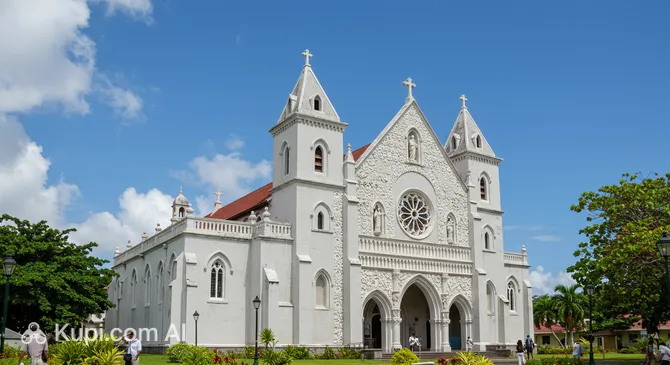
The Dulce Nombre de Maria Cathedral-Basilica is a majestic symbol of faith and history located in the heart of Hagåtña. As the primary Catholic church representing the island of Guam, it draws the eye with its soaring spires and classical facade, which contrasts harmoniously with the tropical greenery of the surrounding palm trees.
Dulce Nombre de Maria Cathedral-Basilica. Illustration.
Source: Kupi.com AI
Traveler photos:
The interior of the cathedral houses one of the region's most revered relics—the statue of Santa Marian Kamalen, the patroness of the island. According to legend, this figure was found by a local fisherman in coastal waters back in the 17th century, and it has been an object of deep veneration ever since. The cathedral serves as the seat of the Archdiocese of Agaña and remains a vital spiritual center for the entire Catholic community.
For travelers, this site is interesting not only for its religious significance but also as a vivid testament to the strong influence of Spanish culture in the Pacific region. The cathedral is an important pilgrimage site and a point of attraction for tourists wishing to explore the rich and layered history of this remote corner of the world.
Contacts
For those planning a visit, it is important to have up-to-date contact information at hand. You can easily find the Dulce Nombre de Maria Cathedral-Basilica in the historic center of Hagåtña using the details below or by visiting their official website to check the schedule.
Visiting this iconic landmark in Hagåtña offers guests numerous options for cultural and spiritual engagement. One of the most vibrant traditions on the island of Guam is the solemn Sunday masses, where you can witness liturgies that bring together generations of local residents. The cathedral often serves as the center for important religious rites—from weddings to confirmations—allowing tourists to experience the island's living traditions.
Art and history enthusiasts should definitely stop by the National Museum of the Dulce Nombre de Maria, located above the Chapel of St. Therese of Lisieux. It features rotating exhibitions of inspiring art created by local artists, providing an opportunity to see Guam's contemporary talents through the lens of spiritual heritage.
Furthermore, simply viewing the building's architecture—from the elegant facade to the interior decor—is an aesthetic pleasure. Since the cathedral borders sites like Plaza de España and the Guam Museum, it is very convenient to combine a visit with a walk along the Hagåtña Heritage Walking Trail.
Getting There
The main cathedral of Guam is located at 207 Archbishop Felixberto Chamacho Flores St in the city of Hagåtña. Thanks to its central location in the historic district, it is easy to find—the main landmarks are the Plaza de España and the modern Guam Museum building.
The most convenient way to reach the cathedral is by taxi or a rental car, following the main city thoroughfares to the very center. Parking spaces are available near the church, from which the entrance is just a couple of minutes' walk away. The public transport system here is moderately developed, so traveling by car remains the most comfortable and reliable option for tourists.
Nearest city: Hagatna
History & Facts
The history of this site dates back to the mid-17th century when the first Catholic mission arrived on the island of Guam. The earliest church was built in February 1669 under the leadership of missionaries Diego Luis de San Vitores and Luis de Medina. Interestingly, the land for the church was donated by the local Chief Quipuha, and Queen Maria Anna provided financial support of 300 pesos for the construction.
Just a year later, the simple structure of logs and thatch was replaced with a more durable coral stone building using masonry techniques. This unique structure allowed the building to stand for several centuries until it was destroyed in 1944. The reconstruction of the church became a symbol of the local residents' resilience, and the modern building of the Cathedral-Basilica was officially consecrated in the spring of 1959.
In 2009, the Dulce Nombre de Maria Cathedral-Basilica celebrated its golden jubilee, confirming its status as the oldest and most significant Catholic institution in the Marian Islands. It continues to serve as a living monument to the historical development of faith, as the indigenous Chamorro people embraced and adapted Catholicism, making it an integral part of their culture.
Time Needed
To leisurely explore the cathedral's interiors, enjoy the tranquility, and visit the museum exhibit, tourists are recommended to set aside about 1–2 hours. This is sufficient time to fully appreciate the main architectural details and the atmosphere of this spiritual center.
If you plan to attend a festive mass or study the rotating exhibits at the National Museum of the Dulce Nombre de Maria in detail, you should factor in a bit more time. Also, keep in mind that the cathedral is located on a popular tourist route, and a visit is often combined with a walk through the neighboring historic squares.
Working Hours
The doors of the Cathedral-Basilica are generally open to visitors on weekdays: Monday, Tuesday, Wednesday, and Friday from 8:00 AM to 12:00 PM and, after a break, from 1:30 PM to 4:30 PM. Please note that there are no visiting hours on Thursdays, Saturdays, and Sundays; however, the cathedral is open on weekends for religious services.
Before planning your visit, it is highly recommended to check the official website, as the schedule may change depending on the church calendar, religious holidays, or special solemn events held by the archdiocese.
Day
Opening hours
Monday
08:00–12:00, 13:30–16:30
Tuesday
08:00–12:00, 13:30–16:30
Wednesday
08:00–12:00, 13:30–16:30
Thursday
Закрыто
Friday
08:00–12:00, 13:30–16:30
Saturday
Закрыто
Sunday
Закрыто
Nearby
Exploring the surroundings of the Cathedral-Basilica in Hagåtña can significantly enrich your travel experience. Just steps away from the cathedral are important colonial-era monuments and modern cultural centers that provide a deeper understanding of the region's multifaceted heritage.