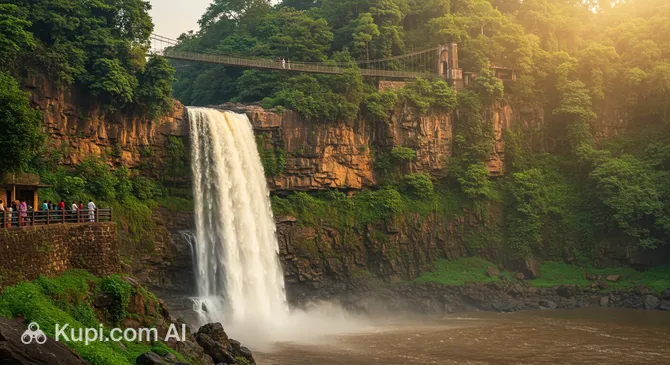
Gokak is a vibrant industrial and administrative center located in the state of Karnataka in India. The city is nestled in a scenic location at the confluence of the Ghataprabha and Markandeya rivers, which gives its surroundings significant hydrographic importance. As the second-largest economic hub of the Belgaum district, the city lives to the rhythm of textile mills and sugar factories while maintaining an atmosphere of authentic provincial India.
Gokak. Illustration.
Source: Kupi.com AI
The city's geographical position defines its character: the landscape, featuring river floodplains, creates green oases amidst the industrial scenery. The population is growing actively and is estimated by experts to be approaching 120,000 people. The rich history of Gokak is inextricably linked to the development of industry and trade, which transformed a small settlement into an important regional transport and production hub.
For tourists, the city is primarily interesting as an access point to the famous Gokak Falls and a place to witness the daily life of Karnataka's working class without the tourist polish. Bustling markets, traditional Kannada neighborhoods, and industrial landscapes create a unique flavor that attracts explorers of "real" India. We invite you to get to know this hardworking city and feel its unmistakable energy.
Weather Overview
The climate in Gokak is distinctly tropical with three clear seasons. The hottest period is spring and early summer (from March to May), when temperatures can rise to 35–40°C. During this time, a dry heat envelops the city, while humidity levels remain low. We recommend planning activities for the early morning or evening hours to avoid peak solar activity.
From June to September, monsoons arrive in the region, bringing heavy rainfall and long-awaited coolness. During this period, the nature around the city flourishes, and the waterfalls are filled with power. However, it is worth remembering that heavy rains can lead to flooding in the floodplains of the Ghataprabha and Markandeya rivers. If you want more precise forecasts, check the current weather in Gokak before your trip.
The most comfortable time to visit the city is considered to be the winter season (from October to February). These months see pleasant weather with daytime temperatures in the 20–30°C range and cool nights. Expect warm, sunny skies and a virtually complete absence of precipitation, making it ideal for long walks and exploring the city's industrial and natural attractions.
Average monthly temperature
Average monthly precipitation
Interesting Facts
The city of Gokak hides many curious details that make it an important point on the map of Karnataka. Here are a few facts to help you better understand this industrial hub:
Economic leader: Gokak holds an honorable second place in terms of GDP in the Belgaum district, second only to its administrative center.
River confluence: The city is located exactly at the meeting point of two rivers—the Ghataprabha and the Markandeya—which historically determined its development as an agricultural and industrial center.
Demographic growth: According to statistics, Gokak is among the top 400 most populous cities in India and ranks 16th in terms of population in the state of Karnataka.
Industrial heart: The city is known for its textile mills, which provide jobs for thousands of residents not only in Gokak itself but throughout the entire taluka.
How to Get There
The transport accessibility of Gokak largely depends on its proximity to a major regional hub—Belgaum, which is just 70 kilometers away. There is no direct air connection to the city, so most travelers choose combined routes involving a flight, followed by a train or bus ride. Detailed information on routes can be found in the how to get to Gokak section.
The nearest airport is in Belgaum (IXG), from where you can reach the city by taxi or local bus in about 1.5–2 hours. Travelers also frequently use Dabolim Airport in Goa, located 200 kilometers away, which is convenient for those planning to combine industrial tourism with a coastal vacation.
Railway connection is one of the most reliable ways to reach the city. The Gokak Road station connects the city with major metropolises such as Bangalore, Mumbai, and Pune. Auto-rickshaws and local buses regularly run from the station to the city center, with a travel time of about 15–20 minutes.
Station
Passenger traffic
Distance
Belagavi railway station
4
47 km
Chattrapati Shahu Maharaj Terminus
5
86 km
Shree Siddharoodha Swamiji - Hubballi Junction railway station
10
96 km
Karmali railway station
6
121 km
Madgaon Junction railway station
10
134 km
The bus service in the region is very well-developed thanks to the KSRTC company. From Belgaum, buses depart every 30–60 minutes. However, it's worth noting that during the monsoon season or peak hours, travel time can increase significantly due to traffic on the NH48 highway and regional roads being congested with trucks from the textile mills.
Main Attractions
Although Gokak is primarily an industrial center, it offers several interesting places to visit. One of the most popular spots for a stroll is Spice Garden, where visitors can immerse themselves in a world of aromas and see how famous Indian spices are grown. It is an excellent place for those who want to take a break from the city noise and learn more about the local flora.
For those with a sweet tooth, a visit to Sadanand Sweets is a must. This establishment is famous for its traditional desserts that reflect the culinary traditions of Karnataka. Trying local treats here is a way to touch a piece of the city's everyday culture.
While the city itself is not rich in historical monuments, its main natural gem—Gokak Falls—is located just 8 kilometers from the center. This majestic sight on the Ghataprabha River is often called the Niagara of India. It is also worth taking the time for walks along the banks of the Ghataprabha and Markandeya rivers, which serve as natural recreation areas for the city's residents.
Local Cuisine
The local cuisine of Gokak is a vivid reflection of North Karnataka's gastronomic traditions. The diet is based on rice and legume dishes, generously seasoned with local spices. One of the main hits is jolada rotti—unleavened sorghum flatbreads, usually served with spicy lentil soup (dal) or vegetable curry. A characteristic feature of the local food is the use of coconut chutneys and spicy pickles.
If you want to try something truly unique, be sure to stop by Sadanand Sweets. This establishment is considered one of the best places to discover the region's traditional sweets. Here you can taste the famous kardant—a nutritious treat made from dried fruits and nuts, which is the pride of the district.
For fans of more substantial dishes, Spice Garden and other local eateries offer biggi mensu (a spicy pea soup) or classic missi dosa and idli. The food culture in the city is centered around bustling markets and bus stations, where numerous family-run cafes operate. Don't forget to finish your meal with a cup of strong South Indian filter coffee or a refreshing lassi, especially during the hot summer months.
Travel Tips
A trip to Gokak will be a great experience of immersion into authentic Indian life if you prepare in advance for the characteristics of this industrial region. Our tips will help make your journey comfortable and safe.
Clothing and Essentials: Choose light clothing made of natural fabrics, as it can get quite hot in Gokak. During the monsoon period (June–September), a sturdy umbrella or raincoat is essential. When visiting temples or factories, follow a modest dress code: shoulders and knees should be covered.
Transport: To get around the city, it is best to use auto-rickshaws. If you plan a trip to Gokak Falls, negotiate a round trip with the driver, as finding transport for the return journey can be difficult.
Finances: The main currency is the Indian Rupee (INR). There are many ATMs in the city, but small shops and markets only accept cash. Keep small bills with you for fares and tipping.
Health: Drink only bottled water and avoid ice in street drinks. During the dry season, the city can be dusty due to the factories, so people with sensitive respiratory systems should carry a protective mask.
Communication: The main language here is Kannada, but hotel staff and young people understand English quite well. Learn a couple of greeting phrases in the local language—it always wins favor with the townspeople.
Local Etiquette: Always remove your shoes when entering homes or temples. In India, it is customary to eat and pass things with your right hand, as the left is considered unclean.
What to Avoid: It is not recommended to walk alone in the industrial outskirts of the city at night due to poor lighting and heavy truck traffic.
Specific Tip: Visit local markets early in the morning when it's not yet so hot and you can find the freshest goods and unique textiles.
Gokak is a city with a working-class character and a kind heart. Accept it as it is, and it will reveal its most interesting facets to you!
Entertainment & Nightlife
Nightlife in Gokak is virtually non-existent, as the city follows the strict working schedule of its industrial enterprises. After sunset, life here quiets down, and locals prefer to spend time with their families or in small traditional tea shops. If you are looking for loud clubs or bars, you should head to neighboring Belgaum, located 70 kilometers away.
In the evening, the main entertainment for residents consists of walking through central squares and visiting local markets. During holidays, the city is transformed, especially during the Ganesha Chaturthi festival, when the streets are filled with music and colorful processions. On regular days, you can stop by Sadanand Sweets to enjoy evening tea with traditional Indian sweets in a calm atmosphere.
Daytime activities in the city include visiting the Spice Garden park or taking trips to Gokak Falls. For those who want to feel the local color, we recommend visiting the central markets, which are true hubs of social life. Given the industrial nature of the city, safety in the evening remains at an average level; however, tourists are advised to avoid outlying areas and use official auto-rickshaws for travel after dark.
Parks & Museums
The park infrastructure of Gokak is closely linked to its waterways. The main green zones of the city are the banks of the Ghataprabha and Markandeya rivers. Residents often use these spaces for family picnics and outdoor recreation. The most significant natural site in the vicinity is the area around Gokak Falls, which functions as a nature park and attracts tourists with its spectacular views.
Within the city itself, you can visit the Spice Garden—a cozy area combining elements of a garden and an educational platform where tropical plants and spices are grown. This is one of the few places in the city where you can enjoy peace and greenery away from the industrial noise of the textile mills.
As for museums, there are none in Gokak itself. For cultural enrichment and historical exhibits, travelers are encouraged to go to Belgaum, which houses museums dedicated to military history and the culture of Karnataka. However, the spirit of history can be felt simply by walking through the old trading rows of Gokak or visiting Sadanand Sweets, an establishment that is a gastronomic landmark in its own right with long-standing traditions.
Getting Around
The public transport system in Gokak is typical for small industrial cities in India. The primary means of transportation for locals and tourists are the buses of the state-run KSRTC company, which connect the city center with the outskirts and neighboring settlements. Buses run frequently, but be prepared for them to be quite crowded with textile mill workers during peak hours.
The most convenient and popular way to travel short distances is the auto-rickshaw. This is a maneuverable vehicle that easily navigates the chaotic traffic on narrow streets. It's worth agreeing on the fare in advance, as meters are rarely used here. The average cost of a trip around the city ranges from 50 to 150 rupees, depending on the distance.
There is no metro or tram in Gokak, and the city itself is compact enough to get around on foot during the cooler parts of the day. However, due to dust on the roads and heavy truck traffic, many people prefer bicycles. Car rental is not developed in the city, so for trips outside Gokak, it is best to hire a taxi with a driver for the whole day, which provides comfort and safety when visiting remote attractions.
Accommodation
Accommodation options in Gokak are primarily geared toward business travelers and transit tourists. You won't find luxury five-star hotels here, but the city offers a decent selection of budget hotels and guesthouses. Most of the lodging is concentrated in the central areas and near transport hubs like the bus station and railway station.
The typical price range per night is from 500 to 2,500 Indian Rupees. Traditional dharmashalas and small private hotels offering basic amenities are popular. If you require a higher level of comfort and service, it is recommended to consider staying in nearby Belgaum, where the choice of hotels is significantly wider.
For those planning to visit places like the Spice Garden, it is better to choose accommodation in the city center for easy access to transport. It is worth booking rooms in advance during major festivals, when the influx of residents from neighboring villages increases. At other times of the year, a free room can usually be found upon arrival.
Nearby Cities
Thanks to its location in the northern part of Karnataka, Gokak serves as an excellent starting point for exploring nearby attractions and colorful settlements. The region around the city is rich with small towns, each possessing its own unique character and pace of life.
Just 9 kilometers away is Konnur, which is easily reached by local bus or auto-rickshaw. Another interesting destination for a short trip is Pachhapur, and the journey there takes very little time. For those who want to see larger centers, it is recommended to head to Hukkeri or visit Ankalgi.
City
Population
Distance
Konnur
23,733
9 km
Pachhapur
9,585
15 km
Ankalgi
9,798
20 km
Hukeri
26,290
24 km
Kaujalgi
12,179
26 km
The most significant neighbor is the city of Belgaum, located 70 kilometers away, where you can find modern shopping malls and historical forts. We recommend not limiting yourself to the center of Gokak and taking the time to explore its picturesque surroundings, which hide the authentic charm of rural India.
Shopping & Souvenirs
Shopping in Gokak is primarily about immersing yourself in the atmosphere of traditional Indian bazaars. The city does not have large shopping malls with global brands, but it is famous for its textile products. Since Gokak is an industrial center for the textile industry, you can find high-quality cotton fabrics and clothing at very attractive prices in the local markets.
The central shopping streets are concentrated around the bus station and main city squares. Life is bustling here: vendors offer fresh spices, aromatic coffee, and essential goods. If you are looking for something special, visit Sadanand Sweets to buy the local kardant sweet as a souvenir; it travels well and makes a wonderful gift.
For those who love exotic items, Spice Garden is an interesting place where you can purchase freshly harvested spices and essential oils. Shops in the city usually operate from 10:00 AM to 8:00 PM, though many stalls may close for a lunch break. Payment at most outlets is in cash, although larger stores are starting to accept bank cards. For large-scale shopping and branded items, locals usually head to nearby Belgaum.