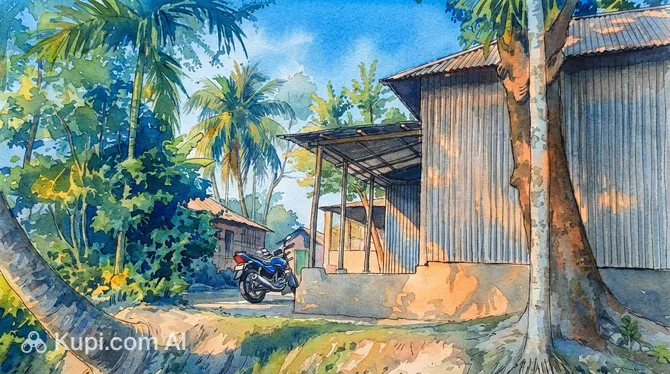
Located in the state of West Bengal, Rasulpur is an authentic reflection of rural India. It is a place where time seems to slow down, and daily life is dictated by the rhythms of agriculture and centuries-old traditions of Bengali culture. Although urban infrastructure is limited here, the settlement attracts visitors with its sincerity and tranquility.
Rasulpur. Illustration.
Source: Kupi.com AI
Geographically, this village is situated in the Purba Bardhaman district. While some sources suggest a large population, official data indicates that approximately 5,000 people live here. In the history of Rasulpur, there are no great battles or monumental palaces; however, it serves as a typical example of a resilient agrarian community that has preserved its identity in the era of globalization.
Tourists rarely stop here, but that is exactly what makes a visit to Rasulpur special. The main charm lies in the endless agricultural fields, traditional architecture, and the hospitality of the local residents, who predominantly speak Bengali. It is an ideal spot for those who want to see "real" provincial life in the region, far from the noisy metropolises.
We invite you to visit Rasulpur to experience the unique flavor of West Bengal, stroll along quiet rural roads, and get acquainted with the lifestyle of people whose lives are inextricably linked to the land.
Weather Overview
In Rasulpur, a typical tropical monsoon climate prevails, characteristic of all West Bengal. The weather here is clearly divided into three seasons: hot summer, a rainy monsoon period, and a cool, dry winter. Before your trip, it is recommended to check what weather in Rasulpur is expected in the near future to choose the right wardrobe.
Summer lasts from March to June, when temperatures can rise to 40°C, creating a rather sweltering atmosphere. From July to September, the monsoons arrive, bringing heavy rainfall (up to 300 mm per month) and high humidity, which sometimes leads to local flooding of the fields. Winter (December–February) is the most comfortable time to visit: the average temperature fluctuates between 17–21°C, and the sky remains clear.
Expect very hot days in the middle of the year with occasional thunderstorms, and in winter—mild warmth during the day and freshness at night. Air quality in the village is usually better than in major Indian cities; however, during the dry season, the roads can be dusty, and during agricultural work, smoke from burning crop residues is possible.
Average monthly temperature
Average monthly precipitation
Interesting Facts
High Literacy Rate: Despite its rural status, the literacy rate in Rasulpur is about 84.19%, which is significantly higher than the average for many agrarian areas of the state.
Gender Balance: The population of the settlement is distributed surprisingly evenly: according to census data, the number of men and women in the town is almost equal (50/50).
Telephone Identification: If you decide to call this region, you will need the STD code 03213, which is assigned to this area.
Young Population: About 8.3% of the town's population are children under 6 years old, highlighting Rasulpur's status as a place with strong family traditions.
How to Get There
The transport accessibility of Rasulpur is determined by its location in the Purba Bardhaman district. Since it is a small settlement, it does not have its own airport or a major railway station. Travelers should head toward the nearest major hubs, from where they can continue their journey by ground transport. More details on logistics can be found in the section on how to get to Rasulpur.
The nearest significant transport hub is the city of Bardhaman, located approximately 20–30 kilometers away. It is easily reachable by train from Kolkata (Howrah or Siliguri Junction stations), with the journey taking about 1–2 hours. From Kolkata, you can also travel by taxi or bus along the NH19 highway, covering a distance of 100–120 km. The trip can take between 2 to 4 hours depending on traffic and the monsoon season.
Local communication between Bardhaman and Rasulpur is primarily carried out by buses or rickshaws. The trip along rural roads takes about 30–45 minutes. It is important to consider that during peak hours and rainy periods, travel time may increase. Within the village itself, the most convenient way to get around is on foot or by using the services of cycle rickshaws.
Station
Passenger traffic
Distance
Howrah railway station
21
74 km
Durgapur railway station
7
81 km
Jashore Junction railway station
5
121 km
Rajshahi Railway Station
3
144 km
Dhanbad Junction railway station
8
177 km
Main Attractions
Rasulpur is not a classic tourist center, so you won't find majestic monuments or modern entertainment complexes here. The city's main "attraction" is its atmosphere. Walking through the rural outskirts allows you to see the traditional way of life in West Bengal, where fields stretch to the horizon and locals are busy with their daily labor.
For those interested in culture, it's worth paying attention to the local markets and small shrines scattered throughout the village. These are places where real life pulses, free from commercial tourism. Here you can watch artisans at work or simply enjoy the silence that is so rare in densely populated India.
If you are looking for more monumental sites, it is recommended to head to nearby Bardhaman. The region's main historical treasures are concentrated there, including ancient temples and architectural monuments. In this case, Rasulpur serves as an excellent base for immersing yourself in the rural environment between trips to larger cultural hubs.
Local Cuisine
The culinary traditions of Rasulpur are inextricably linked with general Bengali gastronomy, where the main ingredients are rice and freshwater fish. You should definitely try "Machher Jhol"—a fragrant fish curry in a spicy sauce, which is a staple of the local diet. Also popular is "Shukto"—an exquisite vegetable medley with a slight bitterness, traditionally served at the beginning of a meal.
No lunch is complete without Dal (lentil soup) and various vegetable side dishes. The local cuisine is characterized by moderate spiciness and a rich use of mustard oil, which gives the dishes a distinctive flavor. For a snack, you can find freshly made samosas or batter-fried vegetables on the streets.
As for drinks, the undisputed leader is "Cha"—strong Indian tea with milk and plenty of sugar, served in small clay or glass cups. During the hot season, locals cool off with fresh coconut water or juices from ripe mangoes, which grow in abundance in this region.
The food culture in Rasulpur is simple: there are no luxury restaurants, and most meals happen at home or in small street stalls. For a full gastronomic tour, it is better to head to Bardhaman, where authentic Bengali restaurants operate, offering a full range of local delicacies and the region's famous sweets.
Travel Tips
A trip to Rasulpur requires some preparation, as this place is not spoiled by tourist attention. Our tips will help you make your stay here comfortable and safe.
Clothing and Essentials: Choose light clothing made of natural fabrics, as the climate here is hot and humid. For visiting local shrines, shoulders and knees should be covered. Be sure to bring comfortable shoes for walking on rural roads and a Type D/M power adapter.
Transport: The primary way to get around is by buses to Bardhaman and rickshaws. Be prepared for schedules to often be ignored. Renting a car here makes little sense; it's better to rely on local carriers.
Finance: Bring enough cash in rupees in small denominations. ATMs in the village are very rare, and bank cards are only accepted in major cities like Kolkata.
Health: Always carry bottled water and use mosquito repellents. Pharmacies with a standard set of medicines can be found in Bardhaman; medical care in the village itself is limited.
Communication: The main language is Bengali. English is poorly understood, so learn a few basic phrases or use an offline translator. It's best to buy a SIM card in advance at the airport or a major city.
Local Etiquette: Greet people with a slight bow or the word "Namaste." Always ask for permission before taking photos of local residents or their homes.
What to Avoid: Do not walk alone after dark, as there is virtually no lighting on the rural roads. Avoid drinking raw water and eating at questionable street stalls without thermal processing.
Base for Accommodation: It is best to use Bardhaman as your primary place of residence, coming to Rasulpur for day trips.
May your acquaintance with authentic Bengal leave only the warmest memories and provide a unique experience of immersion into real Indian life!
Entertainment & Nightlife
Entertainment in Rasulpur is exclusively traditional and family-oriented. There are no night clubs, bars, or discos in the conventional sense. The town's evening life quiets down after sunset, when locals gather with their families or discuss news at small street stalls over a cup of tea.
The main events for the local residents are religious holidays and festivals, which transform the rural streets into bright theatrical venues. On such days, you can see folk dances and listen to traditional music. At other times, leisure is limited to outdoor walks and visits to the weekly markets, which serve as shopping centers for the residents.
For active nightlife and modern entertainment, such as cinemas or restaurants with diverse cuisine, tourists will have to travel to Bardhaman or Kolkata. The trip to these cities can take from one to three hours, so it's better to plan such outings in advance.
Parks & Museums
In Rasulpur itself, there are no organized city parks or museums. The role of recreation areas here is fulfilled by natural landscapes: shady groves, the banks of local water bodies, and endless rice fields. For the villagers, this is their natural habitat, and for the tourist, it's an opportunity to enjoy wild nature and silence away from industrial noise.
If you are interested in museum exhibitions or garden art, it is worth visiting Bardhaman. There you will find historical sites that can serve as open-air museums, as well as well-maintained green zones. In Rasulpur itself, the focus is shifted toward the utilitarian use of land, which is typical for the agrarian regions of India.
The lack of cultural institutions is compensated by a living culture. Observing daily rituals, field work, and local festivals replaces a visit to any gallery. This is a place for those who prefer contemplative rest and want to study culture not through display cases, but through direct interaction with the environment.
Getting Around
The public transport system in Rasulpur is minimally developed and geared toward the needs of local residents. The main means of communication with other cities are suburban buses that run to Bardhaman. It's worth noting that buses are often crowded, especially during morning and evening hours when people are commuting to work or school.
Within the settlement itself, the most popular and convenient transport options are cycle rickshaws and auto rickshaws. They allow for quick movement along the narrow rural roads. Many residents also use bicycles or motorbikes. For a tourist, walking around Rasulpur can be just as effective, given the small size of the settlement.
Fares are paid in cash to the driver; fixed rates for rickshaws often do not exist, so it is better to agree on the price in advance. Bus tickets are inexpensive, but travel comfort will be minimal. Overall, the transport situation in the town requires patience and readiness for a typically Indian pace of movement with possible delays.
Accommodation
Tourist infrastructure in Rasulpur is virtually non-existent, so you won't find a classic hotel or hostel directly within the settlement. Most residential buildings here are private homes of local residents. If you are planning a visit, consider long-term room rentals from locals or staying in a guesthouse in larger neighboring settlements.
The most convenient solution for travelers is to stay in Bardhaman. There is a wide selection of guesthouses and mid-range hotels available there. Accommodation prices in this region are quite affordable, starting from 500–2,000 Indian rupees per night. This will allow you to stay comfortably overnight and visit Rasulpur during the day to experience rural life.
It is recommended to book accommodation in advance, especially if your trip coincides with major Bengali festivals when demand for hotel rooms in Bardhaman increases sharply. Main booking methods include international services, though booking on the spot remains popular in this part of India.
Nearby Cities
Rasulpur is an excellent starting point for exploring the rural areas and cultural centers of West Bengal. The city's surroundings offer tourists the opportunity to get acquainted with the region's historical heritage in just a few hours' journey.
The most popular destination for a day trip is the city of Bardhaman. It is a major cultural center where you can see famous temple complexes and historical monuments. The journey there takes no more than an hour by bus or rickshaw. Also of interest is the town of Memari, located just 8 kilometers away, where you can observe the lively trade and pace of life of a small Indian town.
For those who miss metropolitan comfort and large-scale shopping, the road to Kolkata is always open. Despite the distance of about 100 km, this direction remains accessible for a full-day trip. We recommend not limiting yourself to Rasulpur alone and definitely taking the time to explore neighboring locations such as Dattapara or Satgachia to get a full impression of the region.
Shopping & Souvenirs
Shopping in Rasulpur primarily involves visiting local markets, known as "haats". These weekly or daily bazaars are the center of the village's social and economic life. You won't find brand boutiques here, but you can purchase fresh vegetables, fruits, as well as fabrics and simple household goods used by locals in their daily lives.
There are no specialized tourist souvenirs in the town, but as a keepsake, you can bring back products from local artisans or traditional Bengali cotton, which is often sold at the markets. Such purchases will be truly authentic and serve as an excellent reminder of your trip to the heartland.
Most retail outlets are small shops operating from early morning until sunset. It is important to remember that payment is accepted exclusively in cash in Indian rupees, as bank terminals are practically non-existent in rural areas. For more significant purchases and modern shopping centers, you should head to Bardhaman, where the selection of goods is much wider.