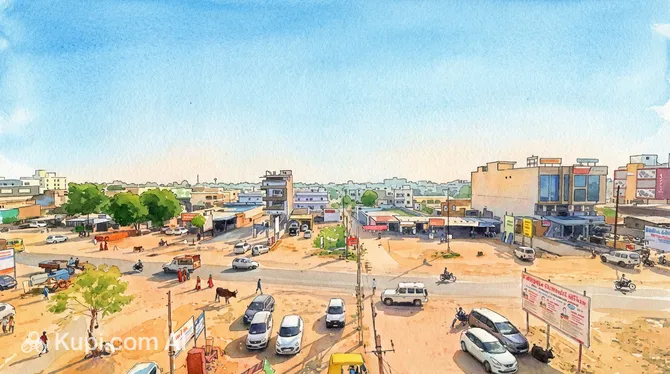
Tharad is an authentic city in the northern part of the state of Gujarat, located in the heart of India. Situated on the edge of the majestic Thar Desert, the city serves as an important administrative and commercial hub for the region. With a population of over 320,000 people (including surrounding rural areas), it maintains the atmosphere of a traditional province where the modern pace of life blends harmoniously with the centuries-old customs of local farmers and traders.
Tharad's geographical position makes it a strategically important transit point for travelers heading along National Highway 68 toward Rajasthan or the border. The climate here is arid, which gives the urban landscapes a distinct desert character. Tourists appreciate this place for its tranquility and the opportunity to see the real, unvarnished life of the Gujarati hinterland.
Tharad. Illustration.
Source: Kupi.com AI
The city boasts a rich heritage and was once known as Thirpur. A deep dive into Tharad's past reveals traces of history dating back nearly two thousand years. The main centers of attraction here are the ancient Jain temples, which impress with their architecture and atmosphere of peace.
A visit to Tharad is an invitation to journey through dusty but lively streets filled with the sounds of traditional markets and the aromas of spices. It is an ideal destination for those seeking an authentic experience and wanting to encounter the religious traditions of Jainism in their natural environment.
Weather Overview
The climate of Tharad is defined by its proximity to the Thar Desert, making the weather here quite extreme during the summer months. Expect very hot and dry summers, when air temperatures in May can reach levels of +41°C...45°C. Winters, by contrast, are very mild and pleasant: in January, the average daytime temperature is around +25.7°C, while nights bring a chill, dropping to +11°C. Rainfall is extremely low, with most occurring during the monsoon season.
The period from July to September is characterized by the arrival of humid air masses, when rains bring long-awaited freshness but can also increase air humidity. At this time, the dustiness typical for the region significantly decreases. If you are planning a trip, be sure to study the detailed information about the weather in Tharad to choose the most comfortable time for your visit. The most favorable season is considered the period from October to March, when dry and sunny weather sets in, ideal for walking.
Average monthly temperature
Average monthly precipitation
Interesting Facts
Tharad is a city with a rich past and unique geographical features that distinguish it from other settlements in the state. Here are a few interesting facts about this place:
Ancient Roots: Modern Tharad stands on the site of the historical settlement of Thirpur, whose history goes back centuries and dates back nearly 2,000 years.
Strategic Hub: The city is the first major settlement in Gujarat encountered by travelers heading along National Highway 68 from the state of Rajasthan.
Seismic Activity: The Tharad area is known for its seismic activity; small tremors are often recorded here, which is characteristic of the geology of the state of Gujarat.
Neighboring the Desert: Tharad borders the edges of the Great Thar Desert, providing views from the city of typical arid landscapes and traditional farms.
Transit Status: Due to its proximity to the borders of neighboring states (just 40–45 km), the city maintains its status as an important transit point for trade caravans and freight transport.
How to Get There
Tharad is an important transport hub in northern Gujarat, providing the state's connection with Rajasthan. Thanks to its location on National Highway 68, the city is easily accessible for those who prefer traveling by bus or private car. Road communication here is considered the most reliable, linking Tharad with cities such as Palanpur (about 100 km) and major centers in neighboring regions. Travel time to Palanpur is usually 2-3 hours.
For travelers planning to fly, it is worth noting that there is no airport in the city itself. The nearest major air hubs are in Ahmedabad and Bhuj, at a distance of 200–300 kilometers. From there, Tharad can be reached by taxi or intercity bus, although the journey can take from 4 to 6 hours. More detailed information on routes can be found in the section describing how to get to the city.
Railway service in Tharad is represented by a local station, but the number of trains passing through it is limited. Most tourists prefer to use railway hubs in larger neighboring cities with a subsequent transfer to road transport. During the monsoon season, potential delays due to the condition of secondary roads leading to rural areas should be taken into account.
Station
Passenger traffic
Distance
Ahmedabad Junction railway station
11
181 km
Gandhidham Junction railway station
5
211 km
Udaipur City railway station
5
211 km
Bhuj railway station
4
235 km
Rajkot junction railway station
8
246 km
Main Attractions
Although Tharad is not a typical tourist center, it hides several gems, particularly significant for pilgrims and lovers of spiritual heritage. The main objects of interest here are the magnificent Jain temples. Among them, the Shri Jamkaar Devi Mataji Temple stands out—a place with a special energy, revered by locals and visiting Jains for its ancient roots and exquisite design.
Another important center of spirituality is Shree Mota Mahaveer (Adinath Sw. Jain Temple). This temple draws attention with its traditional architecture and serves as a place for quiet reflection and prayer. It is also worth visiting the Kanku Chiman Vihar Dham complex and the Sakal tirth derasar temple, which reflect the local population's deep devotion to religious traditions and the art of temple construction.
For those interested in history, exploring the ruins of the ancient Tharad Fort will be of interest. Although time has not spared its walls, the remains of the fortifications allow one to imagine the city's former greatness when it was an important defensive point in the region. A walk along these walls in the rays of the setting sun creates a unique sense of connection with the past.
To round off your sightseeing, visit the city's central markets. These are not just trading floors but a living museum of everyday life. Here you can see traditional crafts, hear the colorful Gujarati dialect, and feel the true rhythm of Tharad life, which has changed little over the last decades.
Local Cuisine
The gastronomic face of Tharad is the quintessence of Gujarati culinary traditions. The cuisine here is predominantly vegetarian, hearty, and rich in flavors. The basis of the local diet consists of dal (a thick legume soup), freshly baked roti flatbreads, and sabzi—various vegetable stews seasoned with local spices. The proximity of the desert has left its mark: millet and a variety of dairy products are frequently used in dishes.
While walking around the city, be sure to try the traditional drinks. Masala tea will warm you and give you strength, while a cool lassi (a yogurt-based drink) is the perfect rescue on a hot afternoon. In Tharad, the food culture is closely tied to street food—markets are full of stalls offering fresh authentic snacks prepared right in front of passers-by.
The restaurant scene in the classic sense is poorly developed in Tharad; it is replaced by cozy darshans and dining rooms at guest houses, such as those in the Dwarkadhish Guest House. Honest home-cooked food aimed at locals and farmers is served here. The spiciness of the dishes may be unusual for an unprepared tourist, so don't hesitate to ask for the dish to be made less spicy to fully enjoy the richness of the Gujarati flavor.
Travel Tips
Preparing for a trip to Tharad requires taking local characteristics into account to ensure your journey is as comfortable and safe as possible. We have gathered some practical recommendations to help you get settled in this colorful corner of Gujarat.
Clothing and Essentials: Choose light clothing made of natural fabrics to better withstand the heat. When visiting Jain temples, observe the dress code: shoulders and knees must be covered. From October to March, it can be cool in the evenings, so bring a light sweater.
Transport: The primary means of getting around the city is auto-rickshaws. For trips to neighboring cities, it is better to rent a car with a driver or use state buses. Remember that roads can be dusty, so a protective mask or scarf will not be superfluous.
Finance: Use Indian Rupees. Cash is the predominant method of payment in Tharad; cards are only accepted in rare hotels. ATMs are available in the city center, but it's better to have a supply of cash in small denominations for markets and rickshaws.
Health and Safety: Drink only bottled water and avoid ice in street drinks. Tharad is a safe city, but keep an eye on your belongings in busy bazaars to avoid falling victim to pickpockets.
Communication: The main language is Gujarati; not everyone understands English. Learn a few simple phrases or install an offline translator. It's better to purchase a SIM card in a large city along the way, as the registration procedure in the province can be complicated.
Local Etiquette: Be sure to remove your shoes when entering temples and private homes. Greet people with the traditional Namaste gesture; it always wins the favor of locals.
What to Avoid: Do not photograph people or religious ceremonies without permission. Also, try not to plan important trips for midday during the summer months due to extremely high temperatures.
Dust and Sun: Due to the proximity of the desert, the air in the city is often dusty. Use sunscreen and always carry moisturizing eye drops with you.
Tharad will offer you amazing discoveries if you are open to its traditions and prepared for the simplicity of provincial life. Enjoy your trip!
Entertainment & Nightlife
Entertainment in Tharad is measured and traditional, typical of small towns in the state of Gujarat. You won't find noisy nightclubs or modern cinemas showing world premieres here. Most social life after sunset centers around local temples and market squares, where residents gather for socializing and family walks.
The city's evening atmosphere is permeated with the coziness of tea stalls and street vendors. Tourists can enjoy a leisurely break in small establishments while watching the flow of local life. A popular leisure activity is walking through the surrounding rural landscapes at sunset, when the heat subsides and the desert expanses are painted in soft tones.
For more active entertainment, such as visiting major cultural events or modern entertainment centers, locals usually head to Palanpur or Patan. In Tharad itself, simplicity and authenticity are valued: festive events here are most often associated with religious festivals, which turn the streets into a bright and noisy spectacle filled with traditional music and dancing.
Parks & Museums
Due to its semi-desert climate and agricultural focus, Tharad cannot boast an abundance of classic urban parks or museums. The urban environment here is organized functionally, and the role of places for walking and relaxation is often fulfilled by open squares in front of temples and market spaces. Greenery in the city center is minimal, which is typical for the arid zones of Gujarat.
Nevertheless, nature lovers can find a unique charm in the rural outskirts of Tharad. Farmlands stretching out on the edge of the Thar Desert represent a unique example of how humans adapt to harsh natural conditions. These landscapes lack organized infrastructure but offer silence and the chance to see a traditional way of life surrounded by sparse but hardy desert vegetation.
For those seeking rich museum exhibits or well-kept botanical gardens, the best solution would be a trip to larger neighboring centers such as Palanpur or Patan. In Tharad, the cultural experience is concentrated not within gallery walls but in the architecture of Jain sanctuaries, which are themselves open-air museums preserving the history and skill of the craftsmen of the past.
Getting Around
The transport system of Tharad is simple and oriented toward the needs of the local population. The main mode of transport within the city is auto-rickshaws. This is the fastest and most affordable way to move between districts, especially considering Tharad's compact layout. It is advisable to agree on the fare in advance, as meters are rarely used in rickshaws here.
To connect the city with the numerous villages in the district (of which there are over 130), local buses are used. They run regularly from the central bus station, providing a reliable, if not always comfortable, connection. Bus tickets are very inexpensive and are purchased directly from the conductor or at the station ticket office.
In Tharad itself, many prefer to get around on foot—the size of the city makes it easy to explore the main attractions and markets during a walk. Modern taxi services and car-sharing are practically non-existent here, so for longer trips outside the city, tourists usually order a private taxi through hotels or guest houses. Remember that roads can be dusty, and during peak hours, traffic on central streets becomes quite chaotic.
Accommodation
Accommodation in Tharad is primarily oriented toward pilgrims visiting local Jain shrines and business travelers in transit. You won't find luxury five-star resorts here; however, the city offers decent budget and mid-range options providing basic comfort and hospitality.
One of the most popular places to stay is the Dwarkadhish Guest House. This guest house offers clean rooms, a relaxation terrace, and its own dining room serving local cuisine. Most hotels are concentrated in the central part of the city, near transport hubs and markets, which is convenient for those who want everything they need close at hand.
For those planning a long-term stay in Tharad, it is possible to rent apartments in the city center, which is often practiced by expats or professionals visiting on business. It is recommended to book accommodation in advance through online aggregators, especially during major religious holidays when the influx of pilgrims increases significantly. The price range remains very affordable, making Tharad an accessible destination for any budget.
Nearby Cities
Tharad is an excellent starting point for exploring the northern fringes of Gujarat and adjacent areas of Rajasthan. Thanks to the developed bus service and proximity to the national highway, one can easily make fascinating day trips to neighboring cities, each possessing its own unique character.
One of the most interesting destinations is Patan, located about 79 km from Tharad. This historic city is world-famous for its architectural masterpiece—the Rani-ki-Vav stepwell, a UNESCO World Heritage site. Patan is also famous for the production of unique Patola silk sarees. Another option is a trip to Sanchore, located just 42 km away. This is a typical Rajasthani town where you can feel the atmosphere of the neighboring state and get to know its rural way of life.
No less interesting is Radhanpur, the journey to which takes about an hour. This place attracts with its authenticity and ancient buildings. For those interested in spiritual centers, a trip to Siddhapur, known for its bright mansions and sacred rituals on the banks of the Saraswati River, is suitable.
City
Population
Distance
Sanchor
32 875
42 km
Radhanpur
32 076
63 km
Patan
125 497
79 km
Siddhapur
61 867
91 km
Ranod
8 746
98 km
Traveling around the vicinity of Tharad allows you to see the full diversity of the region's cultural landscape—from majestic ancient monuments to cozy farming settlements on the edge of the desert. We recommend renting a taxi for greater comfort and the ability to stop at scenic spots along the way.
Shopping & Souvenirs
Shopping in Tharad is a vibrant immersion into the atmosphere of a traditional Indian bazaar. You won't find huge shopping malls with glass windows here; trade bustles on busy streets, turning the city into a kaleidoscope of colors, sounds, and scents. The main shopping areas are concentrated in the center, where stalls are tightly packed together, offering everything from everyday goods to unique handmade items.
The city's markets are famous for their spices, farm products, and textiles. Travelers should pay attention to local fabrics—bright Gujarati embroidery and fabric cuts with traditional patterns make excellent purchases. Popular souvenirs include items related to Jain culture, as well as local crafts reflecting the daily life of residents in desert regions.
Shops and market stalls in Tharad usually open early in the morning and stay open until late evening, with a small break during the hottest hours of the day. In most places, payment is made in cash in the local currency, so it's worth arranging for small change in advance. For larger purchases, such as the famous Patola sarees, tourists usually head to nearby Patan, but Tharad remains an ideal place to buy authentic and inexpensive local household items.