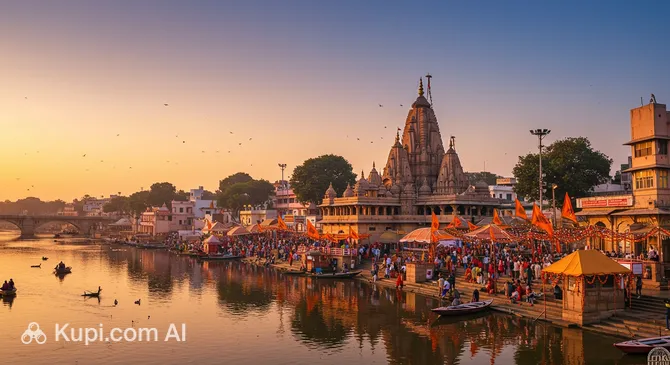
Ujjain is one of the oldest and holiest cities in India, situated on the banks of the sacred Shipra River. Enveloped in an atmosphere of deep spirituality, it is one of the seven sacred cities of Hinduism (Sapta Puri) and attracts pilgrims from all over the world, especially during the famous Kumbh Mela festival, held here every 12 years.
The city is located in the state of Madhya Pradesh on the Malwa Plateau, which accounts for its relatively mild climate. Ujjain has a rich history, once serving as the capital of the ancient Avanti kingdom and a major center of learning and culture.
Ujjain. Illustration.
Source: Kupi.com AI
The main shrine of Ujjain is the Mahakaleshwar Jyotirlinga temple, dedicated to Lord Shiva and one of the twelve Jyotirlingas in India. Also worth visiting are the Kaal Bhairav temple, known for its unique rituals, and the sacred ghats on the Shipra River, such as Ram Ghat, where believers perform ritual ablutions.
A visit to Ujjain is an opportunity to touch ancient traditions, feel the incredible energy of a holy place, and see unique architectural monuments. This city will provide you with unforgettable impressions and a deep immersion into Indian culture.
The weather in Ujjain has distinct seasons. Summer, which lasts roughly from March to May, is hot here, and average maximum temperatures in April and May can reach 37-39°C. From June to September, the monsoon season arrives in Ujjain, bringing frequent rains (especially intense in July and August, when there can be more than 20 rainy days per month) and somewhat more moderate but still warm temperatures, averaging around 25-30°C. The winter months, from December to February, are characterized by mild and mostly dry weather, with average temperatures in the range of 18-21°C and minimal rainfall. Overall, when planning your trip, expect a hot summer with monsoon rains and a comfortable, dry winter. More detailed information and a monthly forecast can be found on the Ujjain Climate page.
Average monthly temperature
Average monthly precipitation
Interesting Facts
Beyond its famous temples and sacred ghats, Ujjain holds many amazing stories and little-known facts that make it even more alluring for curious travelers. Here are just a few that will help you see this ancient city from a new perspective:
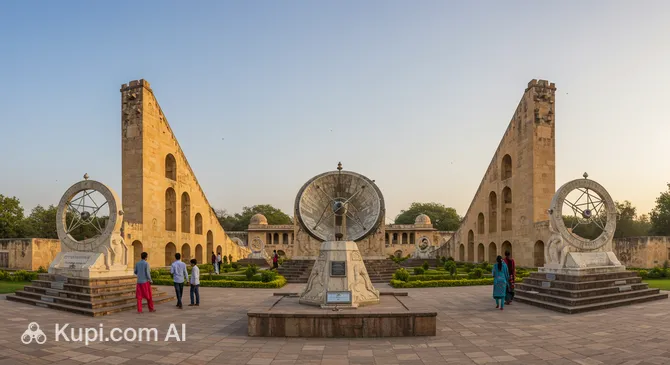
Jantar Mantar, Ujjain. Illustration.
Source: Kupi.com AI
Traveler photos:
Ujjain was historically considered the reference point for Indian astronomers, a sort of "Indian Greenwich." The prime meridian of ancient Indian geography passed right through here. This is evidenced by one of the five ancient observatories, Jantar Mantar, built by Maharaja Jai Singh II in the 18th century for precise astronomical observations.
One of the most unusual traditions in Ujjain is the offering of alcoholic beverages to the deity at the Shri Kaal Bhairav Temple. It is believed to be one of the few places in India where such a practice is officially accepted, attracting many believers and tourists who wish to witness this unique ritual.
The legendary Bhartrihari Caves, located on the banks of the Shipra River, were according to tradition the meditation site of King Bhartrihari, the elder brother of the famous King Vikramaditya. It is said that he spent years here in asceticism after abdicating the throne, and these caves still hold an atmosphere of ancient wisdom.
The sacred Shipra River, on whose banks Ujjain stands, is considered one of the few rivers in India with "self-purifying" properties (kshaya). Belief in its cleansing power is particularly strong during the Kumbh Mela festival, when millions of pilgrims bathe in its waters.
How to Get There
The holy city of Ujjain can be reached in several ways; however, air travel is the most convenient for most tourists, especially those arriving from afar. Although Ujjain does not have its own airport, several airports are located in neighboring cities, from which you can easily reach Ujjain by taxi or bus.
The primary and closest option is Devi Ahilya Bai Holkar Airport (IATA: IDR), located in the city of Indore, about 50 km from Ujjain. This is a major international airport serving many domestic and some international flights. A taxi ride from Indore airport to Ujjain takes about 1.5–2 hours, depending on traffic conditions.
Another significant airport is Raja Bhoj Airport (IATA: BHO) in the city of Bhopal. It is located approximately 160 km from Ujjain. This is also an international airport with a good selection of domestic flights. The journey from Bhopal to Ujjain by car or taxi takes about 4–4.5 hours.
Travelers may also consider flying into Maharana Pratap Airport (IATA: UDR) in Udaipur (about 250 km away) or Vadodara Airport (IATA: BDQ) in Vadodara (about 280 km away), though transfers from these airports will take significantly longer.
For convenience, here is summary information on the main airports used to reach Ujjain:
From any of these airports, Ujjain can be reached by taxi (it is recommended to use pre-paid taxi services at the airport) or by bus. You should also check in advance if your hotel in Ujjain can organize a transfer for you.
In addition to air travel, Ujjain has excellent rail connections with many major cities in India. Ujjain Junction railway station is an important hub. The city is also accessible by road, with regular bus services from neighboring towns and states. The choice of method depends on your starting point and preferences.
Main Attractions
Ujjain, being one of the oldest and holiest cities in India, offers tourists many unique attractions steeped in history and spirituality. Here are some of the key places that are definitely worth visiting in this amazing city:
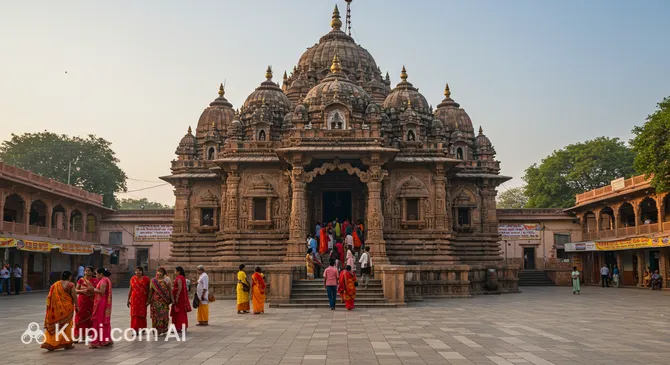
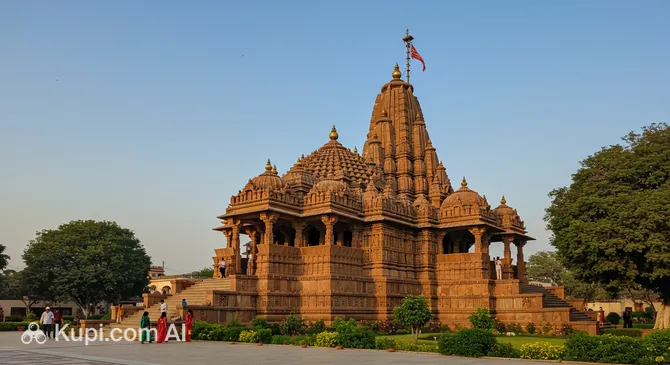
One of the main shrines not only in Ujjain but in all of India is the Shri Mahakaleshwar Jyotirlinga Temple. This is one of the twelve Jyotirlingas, the holiest abodes of Lord Shiva. The uniqueness of this temple lies in the fact that the Shiva Lingam installed here is "Dakshinamukhi," meaning it faces south, which is considered rare and especially auspicious. The temple attracts millions of pilgrims with its ancient architecture and the opportunity to attend the impressive morning Bhasma Aarti ceremony.
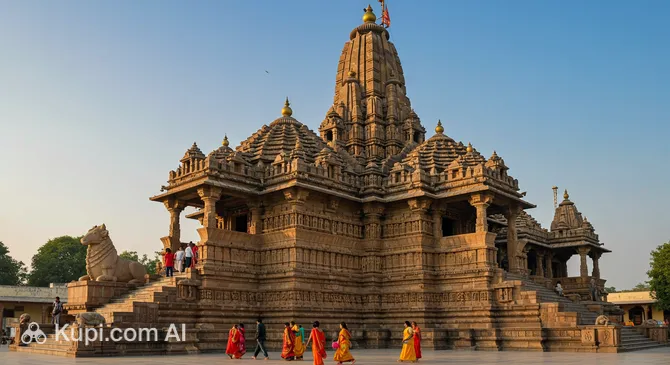
No less revered and intriguing is the Shri Kaal Bhairav Temple. It is dedicated to Kaal Bhairav, a fierce manifestation of Shiva who is considered the guardian of the city. This temple is known far beyond Ujjain thanks to a unique tradition: alcoholic beverages are offered to the deity here. This unusual ritual attracts many believers and curious tourists wishing to witness the ancient practice.
Shri Kaal Bhairav Temple. Illustration.
Source: Kupi.com AI
Traveler photos:
For those interested in science and history, Jantar Mantar is a must-see. This ancient observatory was built in the 18th century by Maharaja Jai Singh II and is one of five such observatories in India. Here you can see massive and surprisingly accurate astronomical instruments designed for observing celestial bodies. A visit to Jantar Mantar allows you to touch the rich scientific heritage of India and understand why Ujjain was historically considered an important center of astronomical knowledge.
Jantar Mantar, Ujjain. Illustration.
Source: Kupi.com AI
Traveler photos:
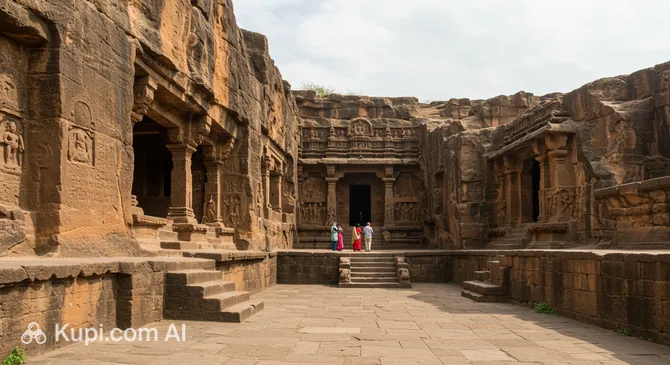
Mystics and lovers of secluded spots should visit the Bhartrihari Caves, located on the picturesque banks of the Shipra River. According to legend, King Bhartrihari—a famous scholar and poet and the brother of the legendary King Vikramaditya—spent many years meditating in these caves after his abdication. The caves have preserved an atmosphere of antiquity and peace, attracting pilgrims and seekers of spiritual enlightenment.
Bhartrihari Caves. Illustration.
Source: Kupi.com AI
Traveler photos:
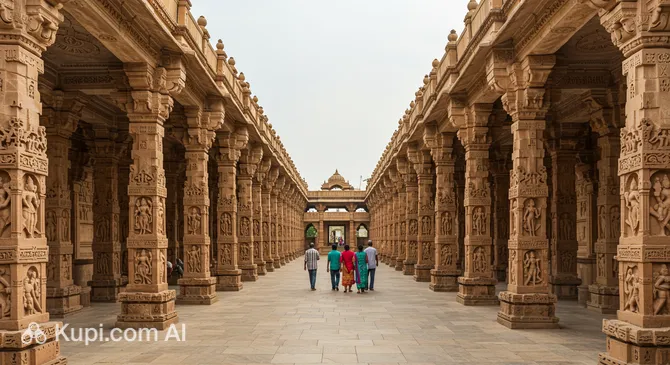
A relatively new but already iconic attraction is Mahakal Lok. This is a large-scale and impressive project to beautify and expand the area adjacent to the Mahakaleshwar temple. It is a majestic corridor decorated with hundreds of statues, bas-reliefs, fountains, and information boards telling stories of various aspects of Lord Shiva's life and deeds. A walk through Mahakal Lok is not only an aesthetic pleasure but also a deep immersion into Hindu mythology.
Mahakal Lok. Illustration.
Source: Kupi.com AI
Traveler photos:
Local Cuisine
The culinary scene of Ujjain, as befits one of the oldest sacred cities in India, offers travelers the authentic flavors of the Malwa region, of which it is a part. The cuisine here is predominantly vegetarian, hearty, and aromatic, with an emphasis on fresh local products and traditional recipes passed down through generations. It is a true paradise for those wanting to experience classic Indian food in its original form.
A must-try is Dal Bafla—perhaps one of the region's most iconic dishes. Imagine wheat dough balls (bafla) baked to a golden crust, served with a thick, aromatic dal (lentil stew) and generously drizzled with ghee (clarified butter). Another local favorite, especially for breakfast, is Poha with Jalebi. Poha is a light dish made from flattened rice cooked with spices, turmeric, and often onions, mustard seeds, and curry leaves; the sweet, crispy jalebis (deep-fried dough spirals soaked in sugar syrup) perfectly complement this savory breakfast. Various types of flatbreads, such as roti and paratha served with vegetable curries (sabji), are also popular.
As for drinks, refreshing Lassi (a sweet or salty yogurt drink) and Chaas (spiced buttermilk) are widespread in Ujjain and are excellent for the hot weather. Street vendors selling fresh sugarcane juice are also a common sight. Regarding alcoholic beverages, due to the religious significance of the city, their public consumption is not very common; however, they are available in some hotels and restaurants geared towards tourists.
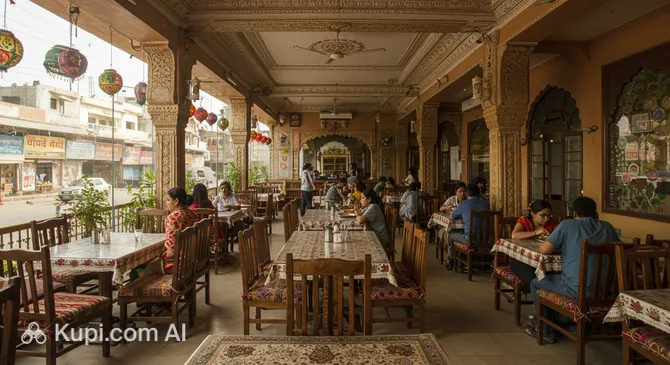
The food culture in Ujjain is diverse. Locals often prefer simple home-cooked meals or snacks from the numerous street stalls and small eateries (dhabas), where you can taste fresh samosas, kachoris, and other local delicacies at very affordable prices. For a more comfortable dinner, tourists can choose from restaurants offering both local and more familiar Indian cuisine. For instance, you could visit places like Shree Ganga to explore local culinary traditions in a restaurant setting. Overall, the gastronomic experience in Ujjain is an immersion into the authentic, predominantly vegetarian cuisine of central India.
Shree Ganga. Illustration.
Source: Kupi.com AI
Traveler photos:
Travel Tips
Planning a trip to sacred Ujjain? Wonderful! To ensure your journey through this ancient Indian city India goes smoothly and leaves only pleasant impressions, we have prepared a few practical tips.
Clothing and Essentials:
Consider the season: in summer (March-May), choose light cotton clothing and a hat; in the monsoon season (June-September), an umbrella and raincoat will be useful; in winter (December-February), light warm clothes are needed. For visiting temples, modest clothing covering shoulders and knees is mandatory (sometimes women may need a headscarf). Don't forget comfortable shoes for long walks, sunscreen, and a universal adapter for electronics.
Transport:
The primary means of transport around the city is the auto-rickshaw. Always agree on the fare in advance or use ride-hailing apps (like Ola or Uber, if available in the region). Taxis can also be hired for more comfortable trips or day excursions. Public buses run through the city but can be crowded and difficult to navigate without knowing the local language. Hiring a car with a driver is often a more convenient option than driving yourself due to the specifics of local traffic.
Finance:
The local currency is the Indian Rupee (INR). You can exchange currency at banks or authorized exchange offices; avoid street money changers. Credit and debit cards are accepted in large hotels and some shops; however, always carry enough cash to pay for rickshaws, market purchases, and temple donations. ATMs are quite common. An average daily budget can be 2000-4000 INR per person (excluding accommodation). Tipping is welcome (around 10% in restaurants if service is not included; small amounts for porters and drivers).
Health and Safety:
Pharmacies (medical stores) are easy to find, but not all are open 24/7; it's recommended to carry a basic first-aid kit. There are government and private clinics in the city. Be sure to take out travel medical insurance. Ujjain is generally considered a safe city, especially in temple areas during the day. Be vigilant in crowded places to avoid pickpockets. Drink only bottled water and be cautious with street food, especially if you have a sensitive stomach. Use mosquito repellent.
Communication:
The main language spoken is Hindi. In tourist areas, hotels, and among young people, many understand and speak English. Learn a few simple Hindi phrases: "Namaste" (Hello/Goodbye), "Dhanyavad" (Thank you), "Yeh kitne ka hai?" (How much does this cost?). A local SIM card (e.g., Airtel, Jio, Vi) can be purchased by presenting your passport and visa. Wi-Fi is available in most hotels and some cafes.
Local Etiquette:
The traditional greeting is "Namaste" with palms folded at the chest. Dress modestly, especially when visiting religious sites. Always remove your shoes before entering temples and private homes. If you want to take photos of locals, especially during rituals, it's best to ask for permission. Maintain silence in temples and show respect to the shrines; it is not customary to point your feet at images of deities or people.
What to Avoid:
Showing disrespect to religious customs and shrines. Do not enter temples with shoes on, do not take photos where it is forbidden, and avoid provocative behavior. You should also refrain from public alcohol consumption, as Ujjain is a holy city. Remember that even if there is a tradition of offering alcohol to the deity at the Shri Kaal Bhairav Temple, this does not mean it's a free-for-all for tourists.
Special Tip for Ujjain:
Check the temple opening hours and times for important rituals in advance. For example, attending the famous morning Bhasma Aarti ceremony at the Mahakaleshwar Temple often requires prior online registration. During major religious festivals like the Kumbh Mela (held every 12 years) or Mahashivaratri, the city attracts huge numbers of pilgrims, so plan your trip and book accommodation well in advance.
We hope these tips help you better prepare for your trip to Ujjain and enjoy its unique atmosphere of spirituality and ancient culture. Safe travels and unforgettable impressions!
Entertainment & Nightlife
Ujjain, as one of India's sacred cities, primarily offers tourists a rich spiritual and cultural program. However, after a busy day of pilgrimage and sightseeing, one can find places for evening relaxation and entertainment in the city, although the nightlife here has its own characteristics and is not as large-scale as in major metropolises.
The main focus of evening entertainment in Ujjain is centered around cozy restaurants where you can enjoy local cuisine and peaceful walks. There are no specialized nightlife districts here, but some establishments stay open late into the evening, offering a pleasant atmosphere for dinner or socializing. The crowd in such places is usually mixed—locals and tourists. The style of establishments varies from traditional Indian to more modern, but a relaxed atmosphere generally prevails. The dress code is typically casual.
If you are looking for more active night entertainment, there are a few specific places to consider. For example, for those who want to dance, Time Headquarters, which positions itself as a nightclub, might be suitable. Some hotels and resorts also offer evening programs or lounge bars to their guests. One such place to spend an evening is the Rudraksh Club & Resort, which can provide appropriate entertainment. For dinner in a pleasant setting, you might consider the restaurant at Anjushree Hotel, which is famous for its cuisine.
Time Headquarters. Illustration.
Source: Kupi.com AI
Traveler photos:
When planning your evening leisure in Ujjain, it is better not to arrive at establishments too late, as many may close earlier than in large cities. As for prices, they are usually moderate but can vary depending on the level of the establishment. For moving around the city at night, it is most convenient to use taxis or auto-rickshaws; it is recommended to agree on the fare in advance or use ride-hailing apps if available. From a safety perspective, as in any other city, it is best to stick to well-lit streets and be attentive to your belongings, especially in crowded areas.
Rudraksh Club & Resort. Illustration.
Source: Kupi.com AI
Traveler photos:
During the day, Ujjain offers many options for cultural enrichment. Besides the famous temples, you can visit museums such as Mahakal Lok, offering an immersion into mythology, or the Triveni Museum with its collection of artifacts. Historical sites like the Bhartrihari Caves are also worth your attention. Although the city lacks major amusement parks, its numerous temple complexes and the embankments of the Shipra River are themselves wonderful places for walks and contemplation.
Anjushree Hotel. Illustration.
Source: Kupi.com AI
Traveler photos:
Parks & Museums
Ujjain, a city with a rich history and spiritual heritage, offers its guests not only pilgrimage to shrines but also opportunities for cultural enrichment in museums and peaceful relaxation in nature. Here you can touch antiquity by studying artifacts or enjoy tranquility on the banks of the sacred river and the quiet of the lakes.
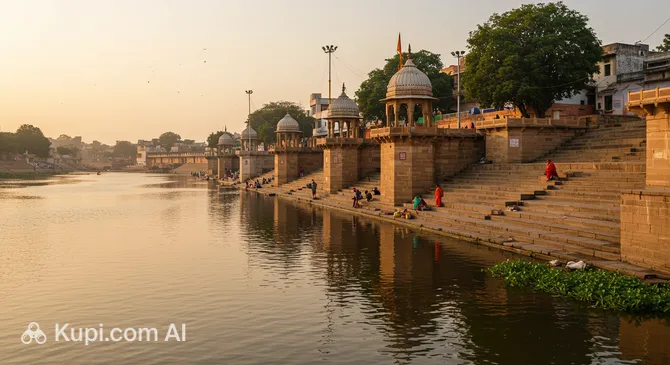
While Ujjain does not abound in expansive parks in the traditional sense, there are places to escape the city bustle. The banks of the sacred Shipra River with its numerous ghats (steps for ritual bathing) are an important public space. This is not only a place for religious ceremonies but also a wonderful area for morning or evening walks to observe local life. Another peaceful spot is Vishnu Sagar Lake, offering silence and tranquility, perfect for a short escape from urban activity. For those looking for a more organized public space in the city center, Indira Gandhi Square can serve as a gathering and resting point.
Shipra River. Illustration.
Source: Kupi.com AI
Traveler photos:
The cultural heritage of Ujjain is carefully preserved and presented in its museums. One of the key places to learn about the region's history is Vikram Kirti Mandir. This cultural center and museum is dedicated to the legendary King Vikramaditya, and here you can see exhibits detailing the glorious past of Ujjain and its significance in the history of India. The Mahakal Lok project, while being a spiritual corridor, also functions as an open-air museum where numerous sculptures, murals, and installations illustrate myths and legends associated with Lord Shiva. No less interesting is the Triveni Museum, which houses archaeological finds, sculptures, and art objects reflecting the centuries-old history and culture of Ujjain and its surroundings.
Vikram Kirti Mandir. Illustration.
Source: Kupi.com AI
Traveler photos:
For those interested in science and ancient knowledge, a visit to Jantar Mantar is mandatory—it is one of the five ancient observatories built by Maharaja Jai Singh II. These massive open-air astronomical instruments allowed for the surprisingly accurate measurement of time, prediction of eclipses, and tracking of celestial movements. Visiting Jantar Mantar is a unique opportunity to touch the scientific thought of ancient India. Additionally, Ujjain is rich in other historical sites. The Bhartrihari Caves, located on the banks of the Shipra River, are shrouded in legends of the sage and poet Bhartrihari, who is believed to have meditated here. Another landmark is Vikramaditya's Singhasan Battisi, ruins associated with the legendary throne of King Vikramaditya and the 32 talking statuettes that told of his wisdom and justice.
Jantar Mantar, Ujjain. Illustration.
Source: Kupi.com AI
Traveler photos:
For an authentic experience, try to visit the ghats of the Shipra River at dawn when the city is just waking up, or in the evening during the Aarti (fire ceremony)—this will allow you to see two completely different faces of the sacred river and feel the special atmosphere of Ujjain. Also, don't miss the chance to peek into small temples and ashrams hidden in the narrow streets of the old city, where you can feel the true spirit of ancient Avantika (the old name for Ujjain).
Getting Around
Getting around Ujjain, a sacred city in India, can be done in several ways, although there is no developed network of subways or trams here. The core of public transport consists of local buses and ubiquitous auto-rickshaws, which are the most popular means of travel for both locals and tourists aiming to visit the numerous temples and shrines.
City buses in Ujjain run along main routes, connecting various parts of the city including major temples, markets, and the railway station. This is the most economical way to get around; however, be prepared for buses to be crowded, especially during peak hours and major religious festivals. Schedules may not always be strict, so it is best to check information about routes and departure times with locals or at bus stops if info is available.
Auto-rickshaws are perhaps the most flexible and convenient way to reach a specific location in Ujjain. They are easy to find in almost any part of the city at any time of day. The key point is to always agree on the fare before starting your journey, as meters, if present, are not always used, and the price may depend on the distance, time of day, and your bargaining skills. In some areas, especially near temples, you can also find cycle-rickshaws for short trips, offering a more leisurely way to see the city.
The payment system for public transport in Ujjain is quite simple and primarily cash-based. On buses, tickets are usually purchased from the conductor during the trip. Specialized transit cards or comprehensive tourist tickets for all types of transport generally do not exist. For auto-rickshaw rides, payment is also made in cash to the driver upon completion of the trip, according to the pre-agreed amount.
Public transport in Ujjain usually starts early in the morning and ends late in the evening, but the intensity of traffic may decrease after dark. Tourists are recommended to carry small bills for fares, as drivers or conductors may not always have change for large banknotes. If you are unsure of a bus route, don't hesitate to ask the conductor or other passengers. For convenience and time-saving when visiting several distant temples, you might consider hiring an auto-rickshaw for several hours or the whole day, after clearly agreeing on the cost and route.
In addition to buses and auto-rickshaws, taxi services are available in Ujjain, which can be ordered by phone or through mobile apps popular in India. This can be a more comfortable, though more expensive, option, especially for trips to the airport or long distances. To explore the central districts and temple complexes, many of which are located fairly close together, walking is a great option that allows for better immersion in the city's atmosphere. Bicycle rental is not a widely available service, but some hotels or guesthouses may offer it for leisurely rides around the neighborhood.
Accommodation
In Ujjain, as a major pilgrimage center, there is a wide range of accommodation options to satisfy the needs of various travelers. Here you can find budget guesthouses and dharamshalas (traditional Indian guesthouses for pilgrims), as well as mid-range hotels and more comfortable hotels and resort complexes. Additionally, apartment rental options are available, though they are less common than hotels.
Many hotels and guesthouses are concentrated in the areas adjacent to the main temples, such as the Shri Mahakaleshwar Jyotirlinga Temple, making them convenient for pilgrims. Accommodations near the railway station and bus stands are also popular for ease of arrival and departure. Some more modern hotels and resorts may be located slightly away from the busiest central streets, offering more peace and space.
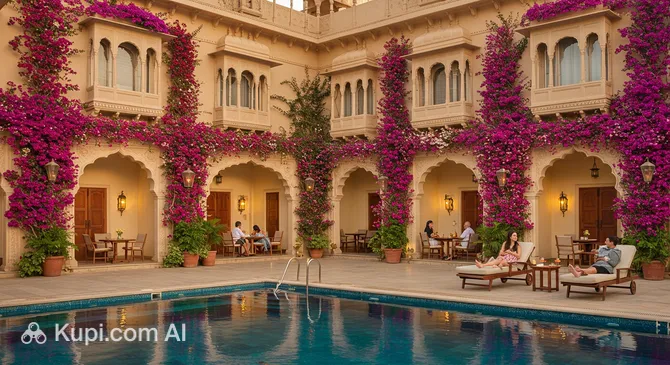
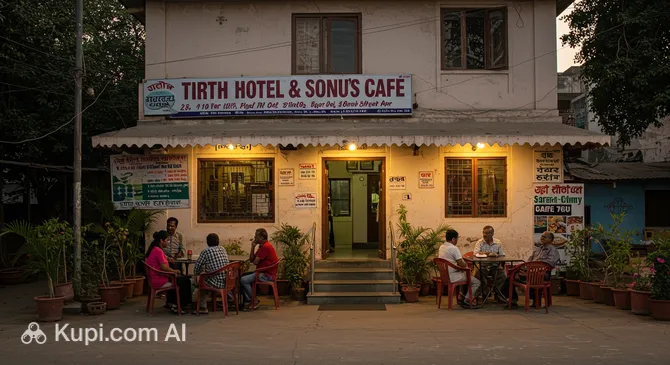
Tirth Hotel & Sonu's Cafe. Illustration.
Source: Kupi.com AI
Traveler photos:
Among the accommodation options, resort hotels offering an expanded range of services stand out. These include Hotel Tirath and Sonu Cafe, which can provide a comfortable stay. Another example is the Rudraksh Club & Resort, known for its level of service and amenities. The price range varies from budget to mid-range and luxury, depending on the level of comfort and services provided.
It is recommended to book accommodation in Ujjain in advance, especially if your trip coincides with major religious festivals such as the Simhastha Kumbh Mela (held every 12 years) or Mahashivaratri, when the city hosts a huge number of pilgrims. During such periods, finding vacant accommodation upon arrival can be difficult. For booking, it is convenient to use popular online platforms or contact hotels directly. Many hotels also accept reservations by phone.
Nearby Cities
For those looking to explore the surrounding area, Ujjain serves as an excellent starting point for day trips to several interesting nearby locations:
City
Population
Distance
Bhainsoda
16 818
15 km
Khokri Kalan
10 600
22 km
Sanwer
17 365
23 km
Kayatha
9 321
24 km
Unhel
18 414
30 km
Indore, the largest city in Madhya Pradesh, attracts visitors with its historical palaces like Rajwada and lively bazaars where you can feel the true flavor of India. A trip to Dewas will be of interest to pilgrims thanks to the temple on Tekri Hill, which offers scenic views, and also allows you to see the industrial aspect of the region.
These and other nearby destinations allow for a deeper acquaintance with the diverse culture and picturesque landscapes of the Madhya Pradesh region. Each of these cities has its own unique atmosphere and attractions, whether they are major industrial centers or quiet historical settlements.
Shopping & Souvenirs
Ujjain, as an ancient and sacred city of India, offers a unique shopping experience that is closely intertwined with its cultural and religious heritage. You won't find huge ultra-modern shopping complexes like in the megacities here, but you can immerse yourself in the atmosphere of traditional Indian markets and purchase authentic goods. The city is famous for its religious paraphernalia, handicrafts, as well as traditional fabrics and clothing.
Main shopping spots in Ujjain are concentrated around the major temple complexes, such as the Shri Mahakaleshwar Jyotirlinga Temple, and on the adjacent streets. These lively areas are full of small shops and stalls offering a wide range of goods. It is also worth paying attention to the city's central streets, where you can find shops with clothing, jewelry, and everyday items.
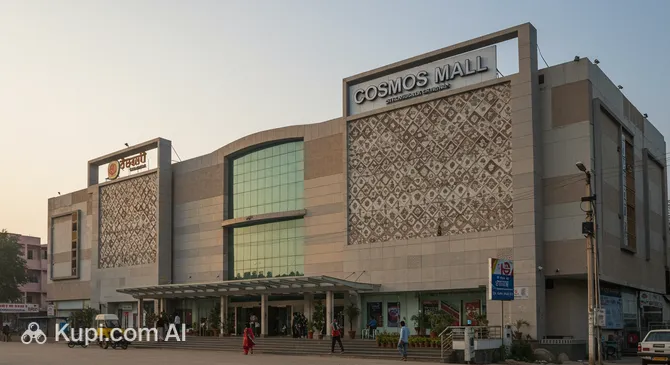
Although Ujjain is better known for its markets, there are also modern shopping centers in the city for those who prefer more organized shopping. For example, you can visit Cosmos Mall, where various shops offering clothing, accessories, and other goods are gathered under one roof. Another place for shopping is Pakeeza Mall, which also offers a diverse range of products.
Cosmos Mall. Illustration.
Source: Kupi.com AI
Traveler photos:
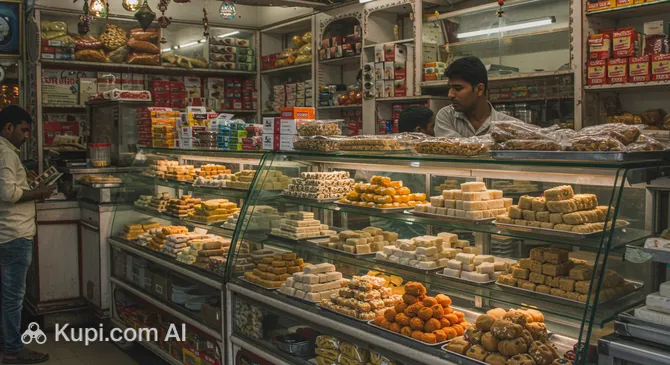
The heart of shopping in Ujjain lies in its colorful markets and bazaars. A special atmosphere reigns here, filled with the scents of spices, incense, and the noise of trading rows. In local markets, you can find fresh fruits and vegetables, traditional sweets, spices, as well as a wide selection of religious goods—from icons and deity figurines to prayer beads and ritual items. Shops with copper, bronze, and wooden products, as well as textile stores, are also popular.
From Ujjain, it is worth bringing back items that reflect its spiritual essence and cultural traditions. Popular souvenirs include:
Religious paraphernalia: images and statuettes of Hindu deities (especially Shiva), sacred texts, prayer beads (rudraksha, tulsi), and incense.
Handicrafts: carved wooden boxes, figurines, and decorative items made of copper and brass.
Traditional fabrics and clothing: colorful sarees, shawls, and kurtis (traditional shirts), often decorated with embroidery or prints. Look out for the fabrics of the Madhya Pradesh region.
Ayurvedic products and natural cosmetics.
Most shops in Ujjain are open from approximately 10:00-11:00 AM until 8:00-9:00 PM, seven days a week, though some smaller stalls may have their own schedules and close for a lunch break. Markets usually start earlier. Regarding payment, cash (Indian Rupees) is the most common method, especially in markets and small shops. In shopping malls and larger stores, bank cards (Visa, Mastercard) are usually accepted, as well as popular digital payment systems in India (UPI). It is recommended to always carry some cash in small denominations.
The possibility of a tax refund (Tax Free) for foreign tourists exists in India, but it is generally applicable to large purchases in authorized stores and is not as widespread as in some other countries. When purchasing expensive items like jewelry or branded clothing, it is worth checking with the seller about the possibility of processing documents for a VAT refund. For most purchases in markets and small souvenir shops, this option is not available.