Support

Tojo Una Una (Tanjung Api)

About the Airport

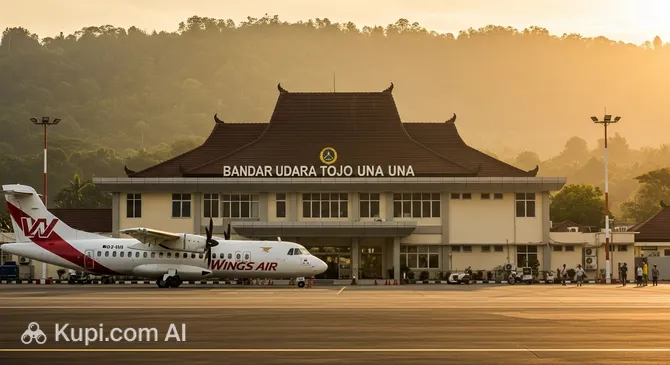
Tojo Una Una (Tanjung Api). Source: Kupi.com Binoculars

Welcome to Tojo Una-Una Airport, better known as Tanjung Api — the main aerial gateway to the treasures of Central Sulawesi. This relatively new and cosy aviation hub is situated in a picturesque location where dense tropical forests meet the sea, serving as a key point for those heading to the legendary Togean Islands. The unique terminal building, with architecture inspired by the rare maleo bird — a symbol of this region — immediately sets travellers in the mood for encounters with wildlife and adventure from the very first minute.

IATA Code OJU
ICAO Code WAFU
City Ampana
Distance to centre 5 km
Status Domestic
Annual Passengers About 30,000 (estimated)
Schedule Check airline websites

Airport Features and Advantages. The main advantage of Tanjung Api is its strategic proximity to the city and the seaport: the journey from the aircraft steps to the pier, from where boats depart to the islands, takes very little time. The airport is renowned for its calm atmosphere and lack of the hustle and bustle typical of major hubs. The compact terminal ensures intuitive navigation and lightning-fast completion of pre-flight formalities. Furthermore, the name "Tanjung Api" (Fire Cape) serves as a reminder of the natural gas phenomenon nearby, adding a special local flavour to the location.

Contact Information

Tanjung Api Airport (OJU) is a small regional aviation hub, so finding detailed direct contact information can be challenging. Basic information and assistance regarding flights are typically provided by the airlines. Here are the key details for travellers:

  • Official Website: Currently, the airport does not have its own website. We recommend checking flight information on the portals of airlines flying to Ampana.
  • Inquiry Phone Number: There is no direct public phone number for the airport. For all enquiries, please contact your airline's call centre.
  • Airport Address: Desa Pusungi, Kecamatan Ampana Tete, Kabupaten Tojo Una-Una, Sulawesi Tengah, Indonesia.
  • Email: A specific email address for passenger enquiries has not been published.
  • Social Media: The airport does not maintain official pages on social networks.
  • Lost Luggage Information: In case of lost or damaged luggage, you must immediately contact your airline representative at the arrival airport.
  • Passenger Support Contacts: Passenger support is provided by airline staff at check-in counters and boarding gates.

How to Get to the Airport

Tojo Una-Una Airport (Tanjung Api, OJU) is located very close to the city of Ampana, making the journey there quite simple and quick. Travellers can choose from several convenient ways to reach the terminal, depending on their budget and preferences.

Taxis and Transfers. This is the most popular and convenient way to get to the airport. Taxis can be found in the city or booked in advance through your hotel. The trip from the centre of Ampana will take approximately 15-20 minutes. The fare is usually fixed, but it is recommended to confirm the price with the driver before starting the journey. Another common option in Indonesia is the motorcycle taxi (ojek), which will cost less but is only suitable for travellers with light luggage.

Public Transport. Direct bus routes to the airport in Ampana are generally absent. Theoretically, one could use local minivans (bemo), but their routes and schedules are not always predictable, and they may not drive directly up to the terminal. This option is more suitable for experienced budget travellers ready for an adventure.

Car Rental. For those who value independence and plan to explore the surroundings, car rental is an excellent solution. In Ampana, you can rent a car either with a driver or without. This allows you to plan your own route and not depend on transport schedules. The airport has a parking area where you can leave the vehicle during your absence.

Recommendations. For maximum comfort, especially if you have a lot of luggage or are travelling with family, it is best to book a transfer or taxi in advance. This saves you from unnecessary hassle and guarantees you arrive at the airport on time. For solo travellers travelling light, an ojek motorcycle taxi will be the fastest and most economical choice.

Terminals and Map

Tojo Una-Una Airport (Tanjung Api) (OJU) is a small and very compact air terminal that serves as the main aerial gateway to the Togean Islands. Its layout is extremely simple and understandable for any traveller.

The airport consists of one passenger terminal, which handles all domestic flights. There is no separation into international and domestic sections, as the airport does not receive flights from abroad. All infrastructure is located in a single building, which completely eliminates the need for transfers between terminals.

The airport map is intuitive: upon entering the building, you immediately find yourself in the general area with check-in counters. After receiving a boarding pass and checking in luggage, passengers pass through the single security checkpoint into a small waiting hall. The arrival area is just as simple, featuring a baggage claim belt and an exit to the city. Getting lost here is practically impossible.

Passing through check-in and security control usually takes very little time due to the low passenger traffic. Long queues here are a rarity. Nevertheless, it is recommended to arrive at the airport generally 1.5–2 hours before departure to complete all formalities without rushing. The main recommendation for navigation is simply to follow the few signs available; all zones are within walking distance of each other.

Airport History

Tojo Una-Una Airport, also known as Tanjung Api, in the city of Ampana, is a relatively young transport hub whose history is inextricably linked with the development of tourism in Central Sulawesi. Its construction was a strategic project by the government of Indonesia, aimed at improving transport accessibility to the famous Togean Islands. The airport was officially opened in 2014, marking a new era for travellers wishing to visit this paradisiacal corner of the world.

The airport received its unusual name, "Tanjung Api", which translates as "Fire Cape", in honour of a unique natural phenomenon located nearby — a place where natural gas seeps out and can ignite. This is one of the interesting facts highlighting the airport's connection with local culture and nature. Initially, the air harbour was designed to accommodate turboprop aircraft, such as the ATR 72, which operate most regional flights in the country.

Since the airport was built from scratch in the 21st century, it was immediately equipped with modern infrastructure meeting safety and comfort standards. Its history is not one of large-scale reconstructions, but of consistent development and increasing operational capacity. Since opening, the main focus has been on expanding the route network and ensuring stable air connections with major cities.

The main achievement and primary goal of creating Tanjung Api Airport was the radical reduction in travel time to the Togean Islands National Park. Whereas previously tourists required several days to reach the islands by sea and land, the arrival of the air gateway reduced the journey to just a few hours. This gave a powerful boost to the local economy and made the Tojo Una-Una region one of the most attractive tourist destinations in Sulawesi.

Services and Facilities

Tojo Una-Una Airport (Tanjung Api) is a small regional airport serving as the main gateway for travellers heading to the Togean Islands. Given its compact size, the range of services is focused on meeting basic passenger needs before departure rather than long-term stays. Here you will find everything necessary for a comfortable wait for your flight.

Dining and Shops. Within the terminal, there are several small kiosks and cafes (warungs) where you can buy light snacks, soft drinks, coffee, and tea. The selection is limited but sufficient for a bite before your flight. There are no large restaurants or duty-free shops here, although you can find locally produced souvenirs.

Waiting Areas and Amenities. The airport features a general waiting hall for all passengers. There are no specialized VIP halls or business lounges here. Wi-Fi access is generally unavailable, so it is recommended to use mobile data. The number of power outlets for charging electronic devices is limited, so it is best to carry a portable power bank.

Financial and Medical Services. There are no bank branches or currency exchange points in the airport building. It is recommended to exchange money in advance in larger cities. ATMs may be available, but their operation is not always stable. A basic medical point is provided at the airport for first aid.

Additional Services. Special services for passengers with children, such as play areas or mother-and-child rooms, are not provided. Passengers with disabilities are advised to notify their airline in advance regarding the need for assistance — airport staff will assist with boarding and disembarking. There are no separate hotels on the airport grounds, but various accommodation options can be found in the nearby city of Ampana. Conference halls and business centres are absent at the airport.

Where to Eat

Tanjung Api Airport (OJU), serving the city of Ampana, is a small regional airport, so the choice of dining establishments here is limited. Nevertheless, passengers can find several simple and authentic options to have a snack or lunch before departure.

All main dining points are located in the main public hall of the airport, before passing security control (landside). Typically, these are a few small family cafes (warungs) offering simple and hearty food. After the security zone (airside), the selection is extremely limited or non-existent, so it is better to eat beforehand.

What is worth trying:

  • Local Cuisine: The menu is based on popular Indonesian dishes such as Nasi Goreng (fried rice with vegetables, chicken, or egg) and Mie Goreng (fried noodles). This is an excellent choice for a hearty and inexpensive lunch.
  • Quick Snacks: In the kiosks, you can buy local snacks, pastries, chips, as well as hot and cold beverages — tea, coffee, and bottled water.

Regarding special dietary needs, it is worth noting that practically all food in Indonesia is Halal. Vegetarians can ask for rice or noodles to be prepared with vegetables only (tanpa daging — without meat). However, finding specially marked vegan or gluten-free dishes here is unlikely.

Prices in establishments at Tanjung Api Airport are very budget-friendly, especially compared to major international hubs. The opening hours of cafes and kiosks are directly tied to the flight schedule: they open a few hours before the first departure and close shortly after the departure of the last aircraft of the day.

Travel Tips

Tanjung Api Airport is your gateway to the amazing world of the Togean Islands, located near the city of Ampana. To ensure your journey through Indonesia starts smoothly, use these tips to help you navigate this small but important transport hub.

Arrival Time and Check-in. Tanjung Api is a compact airport, so there are no queues like in metropolises. Nevertheless, it is recommended to arrive 1.5–2 hours before the departure of a domestic flight. This time is sufficient to calmly complete check-in, drop off luggage, and pass pre-flight security. Have your passport and ticket ready — this will speed up the process.

Seat Selection. If possible, when flying out of Ampana or arriving here, choose a window seat. You may be treated to breathtaking views of the coastline and the scattering of Togean Islands from a bird's-eye view — a wonderful start or end to your adventure.

Hand Luggage. Rules for hand luggage are standard, but compliance is strictly controlled. Remember the restrictions on liquids (no more than 100 ml in one container, packed in a transparent bag), as well as the ban on carrying sharp objects. All power banks and spare lithium batteries must be carried only in hand luggage, and not in checked baggage.

Connecting Passengers and Customs. The airport mainly serves domestic flights, so long layovers here are rare. If you are arriving from another city in Indonesia, you will only need to collect your luggage. Customs control is only undergone by passengers of international flights at the first airport of arrival in the country (for example, in Jakarta or Denpasar). Here, the procedure is limited to standard security screening.

Saving Time and Money.

  • Check in online: Most airlines offer online check-in, which allows you to save time at the airport.
  • Travel light: If possible, limit yourself to hand luggage to avoid waiting for baggage upon arrival.
  • Stock up on essentials: Infrastructure in a small airport may be limited. Bring a bottle for water (it can be filled after security) and a light snack.

What to do if a flight is delayed? Delays at small airports, especially due to weather conditions, are not uncommon. In such a case, remain calm. Ensure your phone is charged (just in case, keep a power bank with you). Contact your airline representative for the latest information. Since waiting facilities at the airport are limited, it is useful to have a book or downloaded films with you to pass the time.

Reached the end of the page?

That means the route is fully explored