Support

Kaimana Airport

About the Airport

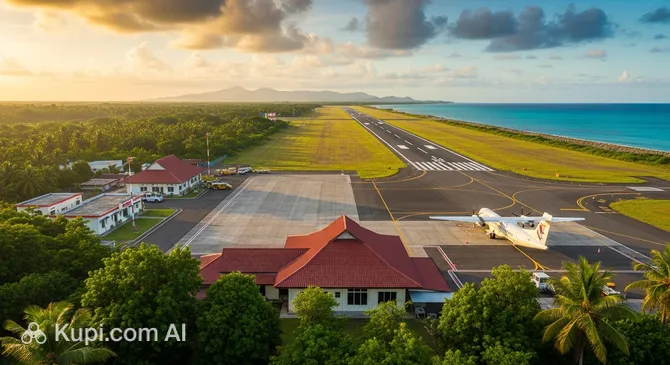
Kaimana Airport. Source: Kupi.com Binoculars

Kaimana Airport, also known as Utarom Airport, is the gateway to one of the most picturesque and pristine corners of Indonesia. Located on the coast, it offers travelers a breathtaking view upon approach: the endless turquoise of the ocean meets the emerald greenery of West Papua's tropical forests here. Following extensive modernization, this transport hub has been transformed, becoming a symbol of the region's development and providing comfortable access to the natural wonders of Triton Bay.

IATA CodeKNG
ICAO Code WASK
City Kaimana
Distance to centre 14 km
Status Domestic
Annual Passengers Around 20,000
ScheduleOnline board

Features and Advantages of the Airport:

The airport's main pride is the new passenger terminal, opened in the mid-2010s. The building stands out with its modern architecture featuring panoramic glazing, which fills the halls with natural light and visually expands the space. The terminal's design is inspired by local nature and resembles the shape of a seashell, harmoniously blending into the surrounding landscape.

Despite its status as a regional airport, Utarom provides a decent level of service. Travelers appreciate it for the absence of queues and the high speed of pre-flight formalities. The extended runway allows for the accommodation of larger aircraft, which has significantly improved the region's transport accessibility, making the journey to this remote land faster and more convenient.

Contact Information

Below is the contact information for Kaimana Airport (KNG). Please note that this is a small regional airport, and some direct contacts may be unavailable. In most cases, for issues related to flights and luggage, it is recommended to contact your airline directly.

  • Official Website: Kaimana Airport (KNG) does not have its own official website. It is managed by the Directorate General of Civil Aviation of Indonesia.
  • Information Desk Phone: There is no direct public phone number for the airport information desk. For flight information, please contact your airline.
  • Airport Address: Jalan Utarom, Kaimana city, West Papua province, Indonesia.
  • Email: A dedicated email address for passenger communication is not provided.
  • Social Media: The airport does not have official social media accounts.
  • Lost Luggage Information: For all questions regarding lost or damaged luggage, please contact the support service of the airline you flew with directly.
  • Passenger Support Contacts: For assistance with booking, flight check-in, or other services, please contact your airline's customer service.

How to Get to the Airport

Getting to Kaimana Airport (KNG) from the city of the same name is quite simple, as it is located very close to the centre. The journey takes little time, and the choice of transport depends on your budget and comfort preferences. The main modes of transport in this part of Indonesia are taxis, motorcycle taxis, and vehicle rentals.

The most popular and convenient way to get to the airport is by taxi or motorcycle taxi (ojek). A car ride from the centre of Kaimana city will take just 10-15 minutes. A motorcycle taxi is an even faster and very budget-friendly option, which is ideal for solo travelers with light luggage. It is extremely important to agree on the fare with the driver in advance, as taximeters are rarely used. Generally, the trip will be inexpensive, but the price may vary.

For those who value maximum comfort, the best solution is a pre-booked transfer. Many hotels and guesthouses offer this service for their guests. This eliminates the need to look for transport on arrival and bargain over the price. Although it will cost slightly more than a regular taxi, you get a guaranteed car arrival at the required time.

Public transport in the classic sense (such as scheduled buses) is not developed here. However, you can use local minibuses known as "bemo". This is not the most predictable option for a trip to the airport, as they depart when full and often make stops along the way, but it is the cheapest way to travel.

If you plan to explore the surroundings before departure, you can consider renting a car or scooter. Most often, a car is rented with a driver, which is convenient for those unfamiliar with local roads. The airport has a small parking area where you can leave personal vehicles while waiting for a flight.

Terminals and Map

Kaimana Airport (KNG) is a small regional airport serving domestic flights. Its infrastructure is simple and functional, making navigation intuitively understandable even for first-time visitors.

The airport operates one passenger terminal, which serves both departing and arriving passengers simultaneously. The terminal building is compact, so it is impossible to get lost here. Departure and arrival zones are in the same structure but have different entrances and exits. The departure zone houses check-in counters for several local airlines, a small waiting lounge, and a security checkpoint. The arrival zone consists of a baggage claim hall, where typically one baggage belt operates.

Since there is only one terminal, the issue of transfers between them is irrelevant — all necessary procedures take place within a single building. The check-in and security screening process usually takes significantly less time than in major airports due to the low passenger flow. Nevertheless, it is recommended to arrive at the airport approximately 1.5-2 hours before departure to complete all formalities without rushing.

For navigation, simply follow the few signs available. The entire path from the terminal entrance to the boarding gate can be walked in a few minutes. Airport staff are generally helpful and ready to assist, even if you do not speak the local language. Overall, the structure of Kaimana Airport is maximally simple and oriented towards quick and convenient service for passengers on regional routes.

Airport History

The history of Utarom Airport (KNG) in Kaimana city is a clear example of how remote corners of the planet become more accessible thanks to infrastructure development. The original airfield was built here in the mid-1970s. At that time, it was merely a modest runway created to ensure communication with the isolated region, mail delivery, and to serve the administrative needs of the Indonesian government.

For decades, the airport remained a small facility capable of accepting only propeller-driven light aircraft, such as the DHC-6 Twin Otter. The journey to Kaimana was long and difficult, which significantly held back the development of tourism despite the region's incredible natural wealth. The airport played an important but strictly utilitarian role, being a vital transport artery for locals rather than a tourist gateway.

Radical changes began in the 2010s as part of a large-scale state programme to modernize transport hubs in the country's eastern provinces. Kaimana Airport became one of the key objects of this programme. The massive reconstruction, culminating in a grand opening in 2015, was truly transformative. The runway was extended and strengthened to 2,000 metres, and a brand new and modern passenger terminal was erected nearby.

The main achievement was that the renovated airport could accommodate popular medium-haul jet aircraft, such as the Boeing 737 and Airbus A320. This was a real breakthrough, opening direct flights from major cities and reducing travel time from several days to a few hours. For travelers, this meant that the gates to Triton Bay — one of the most marine-life-rich places on the planet, often called the "Last Lost Paradise" — were finally flung wide open.

Thus, from a modest strip in the jungle, Kaimana Airport has turned into a modern and strategically important transport hub. Its history symbolizes how investment in infrastructure helps not only to improve the lives of the local population but also to reveal unique natural wonders to the whole world.

Services and Amenities

Kaimana Airport (KNG) is a small regional air station serving as the gateway to the picturesque region of the same name in Indonesia. Given its compact size, the range of services here is basic but sufficient for comfortably waiting for a domestic flight. One should not expect the infrastructure of a major international hub, yet all the essentials for passengers are provided.

Inside the terminal, there are several small cafes and kiosks where you can purchase drinks, light snacks, and travel goods. This is a convenient opportunity to have a bite before departure. The selection of shops is limited, mainly consisting of small souvenir stalls. A general hall is equipped for waiting for boarding. Specialized VIP or business lounges are absent at the airport, which is standard practice for small regional airports.

Access to Wi-Fi at the airport may be limited, so it is better to use mobile data for a stable connection. Power outlets for charging gadgets can be found in the waiting hall, but their number is small, so a portable power bank would be useful. Banking services, including ATMs and currency exchange points, are practically non-existent within the terminal. It is recommended to arrange for cash (Indonesian Rupiah) in advance in Kaimana city.

There is a basic medical point on the airport territory for first aid. Airport staff will provide necessary assistance to passengers with children and travelers with disabilities, but for specialized services (such as escort), it is recommended to contact your airline in advance. There are no hotels, conference rooms, or business centres directly at the airport — the nearest accommodation and business infrastructure options are located in the city.

Where to Eat

When planning a flight through Kaimana Airport, it is important to remember that this is a small regional aviation hub, and the choice of dining establishments reflects this. Instead of large restaurant chains, you will find a few cozy and authentic spots here that allow you to experience local cuisine and grab a quick bite before departure.

In the single terminal of Kaimana Airport, typically in the public area before security control, there are several small cafes or kiosks, known in Indonesia as "warungs". Here, travelers can order simple but hearty dishes. The menu is usually based on classic Indonesian hits: Nasi Goreng (fried rice with vegetables and chicken) and Mie Goreng (fried noodles). This is an excellent option for a full lunch.

For those in a hurry, various snacks are offered: local pastries, sandwiches, and packaged snacks. You can also buy hot coffee, tea, or bottled soft drinks here. The opening hours of these establishments are usually tied to the flight schedule, so they are open during the airport's main hours of activity.

Regarding dietary preferences, specialized vegan or gluten-free menus are unlikely to be found here. However, you can always ask for a vegetarian version of a dish, for example, rice or noodles with vegetables only. The vast majority of food in such establishments is Halal. Prices at Kaimana airport are very democratic and oriented towards locals, making a snack quite affordable for any budget.

Travel Tips

To ensure your journey through Kaimana city airport goes smoothly, use these helpful tips. Kaimana Airport (KNG) is a small regional hub, so orienting yourself here is quite simple. Nevertheless, as with any travel in Indonesia, advance preparation will help avoid unnecessary stress.

Arrival Time and Check-in. For domestic flights, it is recommended to arrive at the airport at least 2 hours before departure. This time is sufficient to check in for the flight and drop off luggage without rushing. Although the airport is small, queues can form during peak hours. If possible, complete online check-in in advance to save time.

Security Control and Seat Selection. Screening procedures are standard, but always keep your boarding pass and ID handy. When choosing a seat on the plane, consider that flights in this region offer stunning views. If you want to enjoy the panorama of islands and turquoise waters, choose a window seat. For greater comfort and freedom of movement, an aisle seat is suitable.

Hand Luggage Rules. In hand luggage, it is prohibited to carry liquids in containers exceeding 100 ml, as well as sharp objects. Power banks and other batteries should only be carried in hand luggage. Be sure to check your airline's rules, as weight and size requirements may differ.

Transfers and Customs. Kaimana Airport mainly serves domestic flights, so international travelers undergo customs and immigration control at their first point of arrival in Indonesia (for example, in Jakarta or Denpasar). If you have a transfer planned in another Indonesian city, allow sufficient time between flights, especially if you need to collect and re-check luggage.

Saving Time and Money. To save money, book a transfer from the airport to the city in advance. The choice of cafes and shops within the airport may be limited, so it makes sense to bring a water bottle (which can be filled after security) and a light snack.

Flight Delays. In this region, flight delays and cancellations, especially due to weather conditions, are not uncommon. Ensure your phone is fully charged and carry a power bank. In case of a delay, contact your airline representative for the latest information. Having travel insurance that covers such instances is also a big plus.

Reached the end of the page?

That means the route is fully explored