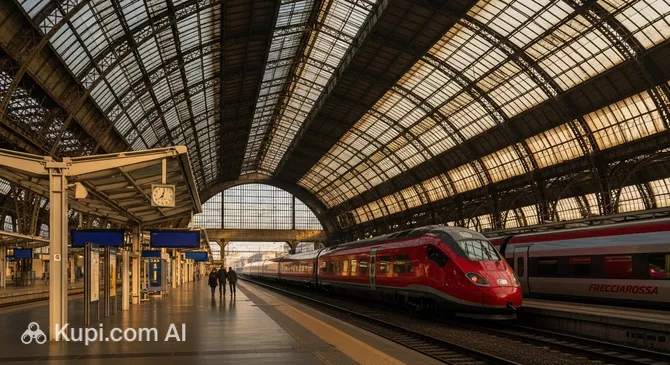
Milano Centrale Station (Milano Centrale) is not just a key transport hub, but also one of the most majestic architectural monuments in Europe. This grandiose building, combining elements of Art Nouveau and Art Deco, welcomes thousands of tourists daily, serving as the main railway gateway to the city and all of Lombardy. Its massive vaults and mosaics turn waiting for a train into a true excursion.
It is important for passengers to know that the station is huge and spans several levels. Trains arrive and depart from the upper floor, known as Piano Binari, which is reached by numerous escalators and travelators from the central atrium. Shops, metro entrances, and taxi stands are located on the lower levels, so please allow 15–20 minutes to move from the entrance to your carriage.
Contact Information
Official website: milanocentrale.it (managed by Grandi Stazioni)
Information desk phone: +39 02 774 043 18 (general information) or 89 20 21 (Trenitalia)
Address: Piazza Duca d'Aosta, 1, 20124 Milano MI, Italy
Opening hours: the station is open approximately from 04:00 to 01:00, though access to trains depends on the schedule.
Luggage storage: the KiPoint service is located on the ground floor (Piano Terra), usually open from 06:00 to 23:00.
Accessibility: the Sala Blu service (RFI Hall) provides assistance to passengers with reduced mobility; it is located on the platform level.
How to Get There
Getting to Milano Centrale Station is very simple, as it is located in a strategically important point of the city.
Public Transport: Two metro lines lead here — M2 (green) and M3 (yellow); the station is called "Centrale FS". Trams No. 5, 9, and 10, along with numerous city buses, also stop directly at the station.
From the Airports: Bus shuttles depart from the station to Malpensa, Linate, and Bergamo (Orio al Serio) airports. The buses are parked on the left and right sides of the station building. The high-speed Malpensa Express train also arrives here.
On Foot and Taxi: A walk from the Duomo will take about 30–40 minutes along the lively shopping street Corso Buenos Aires. A taxi ride from the centre costs on average 10–15 Euros and takes 10–15 minutes, excluding traffic.
Services and Amenities
Centrale station offers a full range of services for travellers. In the vast shopping gallery spanning several levels, you will find clothing boutiques, bookstores, and pharmacies.
For the convenience of passengers, the following are available:
Ticket offices and machines: located on the lower level and in front of the platforms (Trenitalia and Italo).
Waiting lounges: including the exclusive Freccia Club and Italo Club for high-speed train passengers.
Connectivity: free Wi-Fi is available on the premises (registration often required) as well as charging points for gadgets.
Sanitary zones: restrooms are located on the floors (paid service, coin or card accepted).
Banking services: ATMs and currency exchange points are scattered throughout the terminal.
Where to Eat
Dining options at Milan Station are diverse. For a quick snack, numerous cafe-bars such as Segafredo or Moleskine Café are suitable, where you can enjoy an espresso at the counter.
If you have time, visit Mercato Centrale — a large gastronomic space to the side of the station, featuring stalls with the best Italian food: from fresh pasta and pizza to truffles and desserts. The average bill here is higher than in fast food outlets, but the food quality is excellent.
For budget-conscious travellers, there is McDonald’s and Burger King, as well as a Sapori & Dintorni supermarket on the lower level, where you can buy water and sandwiches for the road.
Station History
The history of Milano Centrale Station is one of ambition and prolonged construction. The first stone was laid by King Victor Emmanuel III back in 1906, but construction was delayed due to World War I and the economic crisis.
The project by architect Ulisse Stacchini underwent changes with the rise of Mussolini, who wanted to make the station a symbol of the regime's power. As a result, the building, opened in 1931, turned out monumental, mixing Liberty, Art Deco, and Rationalist styles. In recent decades, the station has undergone massive renovation, transforming into a modern hub while preserving its historical appearance.
Passenger Tips
Arrival: Arrive at least 20–30 minutes before departure. Turnstiles are now installed before the platform exits (Gates), where staff check for tickets.
Safety: As with any major station, you need to watch your belongings carefully here. Beware of pickpockets in the crowd and unauthorized "helpers" near ticket machines.
Tickets: If you have a paper ticket for a regional train, do not forget to validate it in the green or yellow validators before boarding the train. Electronic tickets do not need to be validated.
Navigation: Watch the information boards closely: sometimes the platform number (Binario) is announced 10 minutes before the train arrives. Platforms numbered 1–3 and 22–24 may be located slightly away from the central hall.