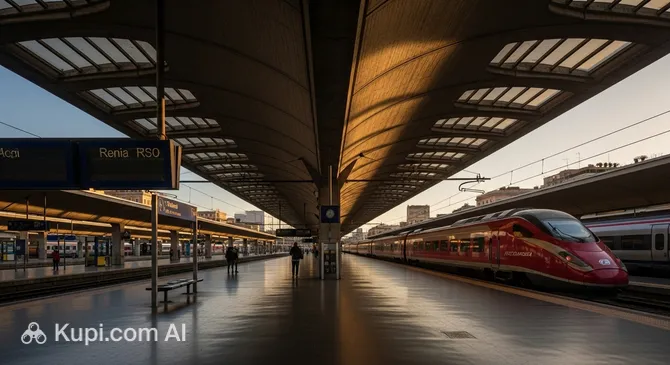
Roma Termini Station is the main transport heart of Rome and one of the largest railway hubs in Europe. Every day, hundreds of thousands of passengers pass through its halls, departing both to other cities in Italy on high-speed trains and on suburban trips. The station is named after the nearby ancient Baths of Diocletian and impresses with its modernist architecture, especially the famous canopy known as the "Dinosaur".
It is important for passengers to know that the station is huge. It has 29 platforms, and the walk to some of them (especially 1-2 and 25-29) can take up to 10–15 minutes on foot from the main entrance. The main hall with ticket counters and shops is called Forum Termini. On the underground level, there is an interchange hub for two lines of the Rome Metro (A and B), making navigation around the city extremely convenient.
Contact Information
Official Website: www.romatermini.com (Grandi Stazioni portal)
Information Phone: +39 06 44101 (general RFI contact)
Address: Piazza dei Cinquecento, 1, 00185 Roma RM, Italy
Opening Hours: the station is open daily from 04:30 to 01:30 (closed at night for cleaning and security)
Luggage Storage: KiPoint service is located at platform 24 level (paid)
Accessibility: The Sala Blu service (Blue Hall) for assisting passengers with reduced mobility is located on platform 1
How to Get There
Getting to Roma Termini station is very simple, as it is the central intersection point of most city routes. The fastest way is to use the Metro: lines A (orange) and B (blue) intersect here. The metro station has direct exits into the station building.
In front of the main entrance on Piazza dei Cinquecento, there is a huge bus terminal where dozens of city routes arrive, as well as tram lines 5 and 14. If you are travelling from Fiumicino airport, the Leonardo Express train will take you directly here in 32 minutes. Shuttle buses run here from Ciampino airport.
You can walk from many landmarks in the historic centre. For example, a walk from the Colosseum will take about 20 minutes, and from the Basilica of Santa Maria Maggiore — only 5–7 minutes.
Services and Amenities
Roma Termini station offers a full range of services for travellers. The main atrium and ticket hall house both staffed counters and numerous self-service machines (Trenitalia and Italo tickets). Seating areas are provided for waiting for trains, although specialized waiting lounges are available primarily for business class passengers or loyalty card holders.
Wi-Fi is available throughout the station (free for a limited time or unlimited upon registration). For charging gadgets, it is better to have your own power bank, as power outlets are difficult to find. On the lower floor and in the platform area, there are paid restrooms (usually requires a 1 Euro coin or card).
Special attention is paid to passengers with reduced mobility: the Sala Blu service organises escort and boarding. Also on the premises, there is a pharmacy, a post office, currency exchange points, car rental, and luggage storage.
Where to Eat
It is impossible to stay hungry at Roma Termini station. For a quick snack and coffee on the go, numerous cafes such as McDonald's, Chef Express, and classic Italian bars are located on the ground and underground levels. The average bill for a coffee and croissant will be around 3–5 Euros.
If you have time for a full lunch, go up to the mezzanine level to the Terrazza Termini food court, where you can eat with a view of the tracks. However, the real gastronomic gem is the Mercato Centrale (Central Market), located in the wing on the Via Giolitti side. Here you will find corners with the best Roman pizza, pasta, truffles, and wine. It is the ideal place to experience quality cuisine before departure.
Station History
The history of Rome's main station began back in 1863, when Pope Pius IX opened the first temporary station. However, the modern look of Roma Termini began to take shape only in the late 1930s under the project of architect Angiolo Mazzoni. Construction was interrupted by World War II and completed only by 1950 by a group of architects led by Eugenio Montuori.
It was then that the famous frontal facade with a wave-like canopy appeared, which Romans affectionately nicknamed the "Dinosaur". This architectural element became a symbol of post-war modernism in Italy. In 2000, for the Church Jubilee, the station underwent a massive reconstruction, turning into a modern shopping and transport complex.
Passenger Tips
Arrive at the station in advance, at least 20–30 minutes before departure. Before accessing the platforms, there are turnstiles (gates) where staff check for tickets. Watch the information boards carefully: the platform number is often announced 10–15 minutes before the train's arrival.
Pay special attention to safety. Roma Termini, like any major station, attracts pickpockets. Keep your belongings with you and do not leave them unattended for a single second, especially in the crowd when boarding.
If you have a regional paper ticket, do not forget to validate it in the green or yellow machines before boarding the train to avoid a large fine. The station closes at night, so you should not plan to sleep in the waiting hall — the police will ask you to leave the building.