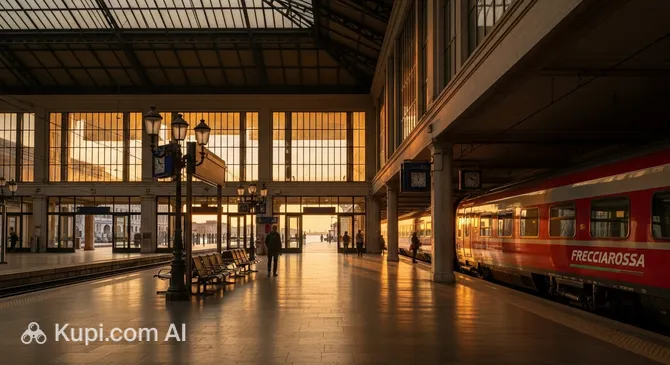
Venezia Santa Lucia Station is a unique gateway to one of the most romantic cities in the world. It is the only railway station located directly in the historic centre of Venice, right on the banks of the Grand Canal. Upon exiting the station building, passengers immediately step into the atmosphere of the city on water, bypassing the industrial zones typical of major metropolises.
The station building is an example of modern architecture which, despite the contrast, blends harmoniously with the city's ancient ensemble. Thousands of tourists arrive here daily, making this place lively at any time of day.
Important to know: The station is a terminus. The main exit leads directly to the steps by the water and vaporetto stops. If you have heavy luggage, use the side exit on the right, where there is a gentle ramp. Please be attentive: many trains stop first at Venezia Mestre station (on the mainland) — do not disembark there if your destination is the historic centre.
Contact Information
Official website: www.veneziasantalucia.it (managed by Grandi Stazioni)
Information desk: Available at the FrecciaClub offices or Trenitalia ticket counters in the main hall.
Address: Fondamenta Santa Lucia, 30121 Venezia VE, Italy.
Opening hours: The station is open daily from 04:17 to 01:00. The building closes at night for cleaning and security purposes.
Luggage storage: Located on Platform 1 (KiPoint service), usually operates from 06:00 to 23:00.
Accessibility: The Sala Blu service (assistance for passengers with reduced mobility) is available; the office is located near Platform 14.
How to Get There
There are several ways to reach Santa Lucia station, but please remember that there is no car traffic at the entrance itself.
Vaporetto (Water Bus): The Ferrovia stop is located right in front of the exit. This is the most popular mode of transport. Lines 1 and 2 connect the station with St. Mark's Square and the Rialto Bridge.
On foot: From Piazzale Roma (the only place in Venice accessible by buses and taxis), you can walk there in 5–10 minutes via the modern Constitution Bridge (Ponte della Costituzione).
Water taxi: Private boats dock at special piers in front of the station. This is the fastest, albeit the most premium, way to reach your hotel.
Services and Amenities
The station offers a wide range of services for a comfortable wait and travel preparation:
Tickets: Trenitalia and Italo ticket counters, as well as numerous self-service machines (Biglietteria), are located in the main hall.
Waiting lounges: Comfortable Freccia Club and Italo Club lounges are available for business class passengers. General waiting areas are located opposite the platforms.
Luggage: Paid luggage storage (Deposito Bagagli) is found near Platform 1.
Facilities: Clean paid restrooms (usually 1 Euro), free Wi-Fi (registration required), currency exchange points, ATMs, and a post office.
Shopping: The station gallery features clothing stores, cosmetics shops, bookstores, souvenir kiosks, and a pharmacy.
Dining Options
It is difficult to stay hungry within the station and its immediate vicinity, though one should keep the tourist nature of the area in mind.
Inside the station, there are several coffee shops and fast-food outlets where you can grab a sandwich, pizza, or enjoy an espresso before departure. This is convenient for a quick snack, with an average bill of 10–15 Euros.
If time permits, it is better to exit the station and walk along Rio Terà Lista di Spagna street (to the left of the exit). Many trattorias are located there. A tip: the further you walk from the station into the Cannaregio district, the more authentic and reasonably priced the dining options will be.
Station History
The history of the station is inextricably linked to the changes in Venice's appearance during the 19th and 20th centuries. The construction of the railway bridge across the lagoon began in the 1840s under Austrian rule, forever changing the city's centuries-old isolation.
To build a proper station in 1860, the Church of Santa Lucia and a convent had to be demolished, after which the station received its current name. The relics of the saint were transferred to the nearby church of San Geremia.
The modern building in the Rationalist style was only completed in 1952, designed by architects Angiolo Mazzoni and Virgilio Vallot. Its wide, low façade made of Istrian stone is adorned with a winged lion — the symbol of Venice.
Travel Tips
A few tips for passengers departing from Santa Lucia Station:
Ticket Validation: If you have a paper ticket for a regional train (Regionale) without a reserved seat, you must validate it in the green or yellow machines before boarding to avoid a significant fine.
Luggage and Bridges: Venice is full of steps. If your hotel is far, use the services of porters (portabagagli) at the station to avoid carrying suitcases over bridges by hand.
Safety: The station is a very crowded place. Keep an eye on your belongings, especially in the crowd when exiting to the vaporetto and near ticket machines.
Arrival: Arrive at least 20–30 minutes before departure. The platforms are long, and walking to the correct carriage may take some time.