Support

San Pedro

About the Airport

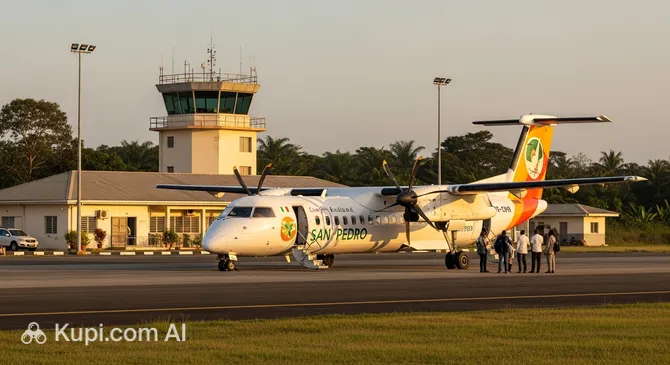
San Pedro. Illustration.
Source: Kupi.com AI

San Pedro Airport is the primary aerial gateway to the southwestern part of Côte d'Ivoire, granting travelers access to picturesque beaches and the economic heart of the region. This recently modernized air hub has become a symbol of the country's transport infrastructure renewal, offering guests a contemporary level of comfort. For tourists, it is the ideal starting point, allowing them to skip the long drive and transport themselves from bustling Abidjan to the Atlantic coast in just one hour.

PropertyValue
IATA CodeSPY
ICAO CodeDISP
CitySan Pedro
CountryIvory Coast
TimezoneAfrica/Abidjan
Top AirlinesAir Cote d'Ivoire
ScheduleOnline Timetable

Airport Features and Advantages:

  • New Terminal: In early 2024, specifically for the Africa Cup of Nations, a renovated passenger terminal was opened. It is equipped with modern check-in systems and waiting areas, significantly enhancing the comfort level for arriving guests.
  • Convenient Location: The airport is located just a few minutes' drive from the city centre and the port zone. This allows tourists to reach hotels and beaches almost instantly after landing.
  • Speed and Comfort: The flight from Abidjan takes only about an hour, which is an excellent alternative to a 5–6 hour journey by car or bus.
  • Tourism Hub: The airport serves as a convenient base for visiting not only San Pedro itself but also nearby resort areas, such as Grand-Béréby, known for their stunning lagoons and eco-tourism.

Contact Information

To contact San Pedro Airport (SPY) and obtain real-time flight information, you may use the following details. Please note that the airport is managed by the state company SODEXAM, so some official inquiries are processed through their centralized channels, while questions regarding tickets and baggage are best resolved directly with the operating carrier.

  • Official Airport Website (Operator): www.sodexam.com ("Nos Aéroports" section)
  • Information Desk / Administration Phone: +225 27 21 58 62 94 (SODEXAM Head Office) or +225 27 34 71 14 35 (Local Technical Hub)
  • Airline Contacts (For Passengers): +225 27 34 71 01 97 (Air Côte d'Ivoire Office in San Pedro)
  • Airport Address: Aéroport de San Pédro, Route de l'Aéroport, San-Pédro, Côte d'Ivoire (approximately 2–3 km west of the city centre)
  • Email: service.commercial@sodexam.ci (General Inquiries), metsanpedro@sodexam.ci (Airport Administration)
  • Social Media: SODEXAM Operator Facebook Page (latest news and updates)
  • Lost & Found Information: There is no centralized "Lost & Found" service in the terminal. It is recommended to contact your airline's check-in counter or call +225 07 78 11 69 76 (Air Côte d'Ivoire Mobile Support in San Pedro).

How to Get to the Airport

Thanks to the city's compactness and the strategic location of the air harbour, getting to San Pedro Airport is effortless. The terminal is located just 3–4 kilometres from the city centre, making the trip quick and tireless. However, given the specifics of the regional transport system, travellers should plan their route in advance.

Taxi and Transfer

This is the most popular and convenient method of transport for tourists. In San Pedro, as in many cities in Côte d'Ivoire, taxis are easily recognizable by their distinctive orange colour. The taxi stand is usually located right at the exit of the arrivals terminal.

  • Cost: A trip to the city centre or coastal hotels usually costs between 1,000 and 2,000 XOF (West African CFA Francs).
  • Important: Meters are rarely used in taxis. Be sure to agree on the price with the driver before getting into the car. Bargaining is appropriate and even expected.
  • Hotel Transfers: Many large hotels and resorts in the region (for example, in the beach area) offer free or paid shuttle services. It is recommended to clarify this when booking your room, as it is the safest and most comfortable option, especially if you arrive on an evening flight.

Public Transport

There is no public transport in the European sense (metro, regular city buses with a strict schedule) in San Pedro. Locals use shared taxis called "gbakas" or "woro-woro", but they rarely enter the airport territory directly and are not adapted for carrying passengers with bulky luggage. For tourists, this option is considered difficult and not the safest, so it is better to opt for an official taxi.

Car Rental

If you plan an independent journey along the coast and surroundings (for example, a trip to Grand-Béréby), renting a car is an excellent solution. Rental agencies do not always have counters right in the arrivals hall, so it is better to book a car in advance to be delivered for your flight. It is recommended to choose SUVs (4x4), as the quality of roads outside the main highways can be unpredictable.

Airport Parking

An open parking zone is equipped in front of the terminal. It is suitable for both short stops (passenger drop-off/pick-up) and long-term parking. The parking is guarded, but leaving valuables inside the vehicle is not recommended. There is usually plenty of space; advance booking is not required.

Travel Time

The journey from the city centre to the airport takes only 5–10 minutes by car in light traffic. During peak hours, the time may increase slightly, but traffic jams here are rarely as severe as in Abidjan.

Other Regional Airports

If your itinerary involves complex travel across West Africa, it is useful to know about other nearby air hubs. The nearest major international hub is Félix-Houphouët-Boigny International Airport in Abidjan, located approximately 308 km away. It receives the majority of international flights and serves as the main transfer point for flights to San Pedro.

For domestic flights within the country, Bouaké Airport (374 km) and Korhogo Airport in the north (527 km) also operate. In the western part of the country lies Odienné Airport (539 km). If you are planning a cross-border trip, the nearest foreign hub is Roberts International Airport in Liberia, which is about 442 km away.

Terminals and Map

San Pedro Airport (SPY) is distinguished by its compactness and intuitive layout, which is an undoubted advantage for tourists unaccustomed to the hustle of giant aviation hubs. All the infrastructure of the air harbour is concentrated in a single complex, reducing the risk of getting lost to zero and making navigation maximally comfortable.

Terminal Structure

The airport features one main passenger terminal that serves both departing and arriving flights. The building is single-story, and all necessary services are within walking distance of each other. Following a large-scale reconstruction completed by early 2024, the terminal received a modern design, an improved air conditioning system, and updated waiting areas.

The internal space of the terminal is zoned as follows:

  • Departure Zone (Départs): Located to the left of the main entrance. Here you will find airline check-in counters (mainly Air Côte d'Ivoire) and baggage screening points. The process of dropping off luggage and receiving a boarding pass is quick due to low passenger traffic.
  • Waiting Hall (Salle d'embarquement): After passing security control, passengers enter the airside zone. This is a spacious room with seating, equipped with information screens. Boarding (gate access) takes place directly onto the tarmac, from where passengers walk to the aircraft.
  • Arrival Zone (Arrivées): Located in the right part of the building (when viewed from the airfield) or has a separate entrance from the tarmac. The baggage claim belt is located here. The procedure for retrieving luggage usually takes 10–15 minutes after the aircraft engines stop.
  • VIP Lounge: For passengers valuing enhanced comfort or travelling in business class, the terminal provides a separate VIP lounge with soft furnishings and refreshments.

Features and Services

Despite its modest size, the renovated terminal offers a basic set of amenities necessary for a traveller. In the public area and the departure hall, small kiosks operate where one can purchase water, snacks, or local souvenirs. It is important to note the presence of modern restrooms, adapted also for citizens with reduced mobility.

Processing Times

The main advantage of San Pedro Airport is the absence of long queues. However, to avoid stress, it is recommended to adhere to the following timeframes:

  • Arrive at the airport 1.5 – 2 hours before departure, especially if you have checked baggage.
  • Check-in usually closes 30–40 minutes before departure.
  • Passing pre-flight security (hand luggage scanning and personal screening) takes on average 5–10 minutes.

Navigation Recommendations

Transfers between terminals are non-existent here as they are unnecessary. Upon exiting the arrival zone, you immediately find yourself on the forecourt where taxis and greeters wait. If you are flying with a connection and your next flight is operated by a different airline or requires re-registration, you will have to collect your luggage, exit to the general hall, and undergo the check-in procedure again at the departure counter.

Airport History

The history of San Pedro Airport (SPY) mirrors the economic development of the entire southwestern region of Côte d'Ivoire. Unlike capital airports that emerged as diplomatic hubs, this air harbour was born out of purely practical necessity and remained the "workhorse" of the industrial sector for a long time.

Birth of the Economy's "Second Lung"

The airport owes its existence to the government's grand plan in the 1960s–1970s to develop the wild southwestern coast. Until the late 60s, there were only dense forests and a small fishing village here. The decision to build the deep-water port of San Pedro required the creation of reliable transport infrastructure for engineers, officials, and investors. The airport opened in the early 1970s, almost simultaneously with the launch of the port, becoming a crucial link in the export chain for timber and cocoa.

Key Stages of Development

For a long time, the airport was a modest regional airfield with basic infrastructure oriented towards small propeller aircraft.

  • 1970s–1990s: The formative period. The airport serviced mainly charter flights and small aircraft of the national airline, transporting employees of port services and agro-industrial companies.
  • 2000s–2010s: The airport maintained regular connections with Abidjan, but its capabilities were limited by the length of the runway and an outdated terminal. Tourist flow during this period was minimal.
  • 2020–2024: The era of "Great Modernization". The government launched a large-scale programme to reconstruct regional airports, and San Pedro became one of the priority projects.

A New Chapter: Reconstruction for the Cup of Nations

A turning point in the recent history of the airport was Côte d'Ivoire's preparation to host the 2023 Africa Cup of Nations (which actually took place in early 2024). San Pedro was selected as one of the host cities for the tournament, necessitating a radical update of the air gates.

Impressive results were achieved during the massive reconstruction:

  • The runway was completely renewed and extended, allowing for the reception of medium-haul jet liners like the Airbus A319 and A320.
  • A new, modern passenger terminal was built and commissioned, capable of processing hundreds of passengers per hour.
  • Modern navigation equipment was installed, allowing flights to be conducted at night and in difficult weather conditions.

Interesting Facts

  • Construction Speed Record: The final phase of modernization, transforming a provincial airfield into a modern transport hub, was completed in record time — less than two years.
  • Strategic Role: Historically, the airport was called the "Cocoa Road," as it was through here that international traders arrived in the region to close deals for the export of the country's main wealth.
  • Symbol of Decentralization: The development of San Pedro Airport became a symbol that the economic and tourist life of the country is no longer concentrated exclusively in Abidjan.

Services and Amenities

San Pedro Airport (SPY) is a compact regional hub that, following recent reconstruction, offers passengers a necessary set of basic services. Although there are no endless rows of duty-free shops or entertainment centres typical of international hubs, the updated terminal ensures a comfortable wait for departure in coolness and tranquillity.

Restaurants, Cafés, and Shops

There are no large chain restaurants in the terminal, but travellers will not go hungry. Small café-bars and kiosks operate in the public zone and the departure zone. Here you can order coffee, soft drinks, fresh pastries, or sandwiches before your flight. The assortment is small, but the products are always fresh.

Regarding shopping, the airport has several outlets offering souvenirs. This is an excellent place to buy last-minute gifts: items from local artisans, traditional textiles, or famous Ivorian chocolate and cocoa products.

Waiting Lounges and VIP Service

For passengers valuing privacy and enhanced comfort, the airport provides a VIP Lounge (Salon VIP). It is available to business class passengers, as well as holders of certain loyalty cards or for a separate fee (check conditions at the registration counter). The lounge is equipped with comfortable soft furniture, air conditioning, a TV, and offers an extended selection of drinks and snacks. It is the ideal place to rest from the bustle before a flight.

Connectivity and Electronics

Free Wi-Fi is available in the updated terminal building. However, given potential network interruptions in the region, it is recommended to have a SIM card with mobile data as a backup. For those needing to charge gadgets, modern charging stations with sockets and USB ports are installed in the waiting halls, which is particularly relevant for business travellers.

Financial Services

An ATM is installed in the public zone of the airport (arrival/departure hall), working with major international cards (Visa/Mastercard). It dispenses local currency — the West African CFA Franc (XOF). Full-service currency exchange points with a wide selection of foreign currencies may not be available in the terminal itself, so it is recommended to exchange large sums in advance at city banks or at Abidjan airport before flying to San Pedro.

Medical Services and Safety

A first aid post is equipped in the terminal, where qualified medical personnel are on duty, ready to assist in case of illness. Security services and police also operate at the airport around the clock.

Services for Passengers with Reduced Mobility

The new terminal was designed taking international accessibility standards into account. The building entrance and boarding gates are equipped with ramps, and specially adapted restrooms are available inside. Airport staff are trained to assist passengers with reduced mobility during check-in and boarding. If you require a wheelchair or assistance, it is strongly recommended to notify the airline (usually Air Côte d'Ivoire) when purchasing the ticket or at least 48 hours before departure.

Passengers with Children

There are no specialized playrooms in the airport, but the spacious and uncrowded waiting hall allows for comfortable accommodation with a child. Toilets are equipped with changing areas. Thanks to the airport's compactness, all procedures pass quickly, sparing parents from long standing in queues with children.

Hotels and Accommodation

There are no hotels on the airport territory itself, and there is no acute need for them, as the city is very close. Most travellers stay in hotels in San Pedro or coastal resort areas.

  • City Centre Hotels: Located just a 5–10 minute taxi ride away. Suitable for business trips.
  • Resort Hotels (Lodges & Resorts): Located a bit further, along the coastline. Many of them provide their own transfer to/from the airport upon request.

Business Services

A separate business centre or conference rooms are not provided in the terminal building. For short negotiations or work with documents, passengers usually use the quiet zone of the VIP lounge. If you require full conference service, it is better to use the infrastructure of major city hotels, such as Hotel Enotel or Sophia Hotel, located nearby.
Where to Eat

At San Pedro Airport (SPY), the selection of dining establishments corresponds to its status as a small regional hub. You will not find large international chain restaurants or extensive food courts here. The dining infrastructure is designed so that passengers can grab a quick bite before a short flight to Abidjan, rather than for having full meals.

Main Dining Zones and Location

All food outlets are concentrated in the single airport terminal. Navigation is extremely simple, as the zones are within a few steps of each other.

  • Public Zone (Landside): In the main hall, next to the check-in counters, a small cafeteria-kiosk usually operates. This is a convenient place for greeters or passengers who have arrived at the airport early. Here you can drink coffee, buy a bottle of water, or sweet pastries.
  • Departure Zone (Airside): After passing security control, passengers enter the waiting hall where a snack bar is located. This is the main dining point for travellers. The bar offers drinks and light snacks right up until boarding.
  • VIP Lounge: A separate lounge is available for business class passengers, where the selection of snacks and beverages (including hot drinks) is slightly wider, and service is personalized.

Menu: From Snacks to Local Specialities

Since the flight time to Abidjan is only about an hour, the airport menu is oriented towards a "grab-and-go" format. Full hot meals (soups, complex side dishes) are generally not served here.

  • For a Quick Snack: The assortment always includes fresh sandwiches (with chicken, tuna, or ham), croissants, chocolate bars, and chips.
  • Local Flavour: We recommend trying local meat pies (pâtés) or Ivorian-style baguette sandwiches. Regarding drinks, you might find refreshing options like natural juices (such as bissap or ginger juice) if available, as well as local beer brands (like Bock or Flag).
  • Coffee and Drinks: You will be offered classic black coffee, tea, as well as a wide selection of bottled soda and mineral water.

Dietary Needs (Halal, Vegan, Gluten-Free)

Given the limited assortment, finding a specialized menu for people with strict dietary restrictions can be difficult. Passengers are advised to consider the following nuances:

  • Halal: Côte d'Ivoire is a country with a significant Muslim population, so practically all meat products (chicken, beef) in catering establishments are Halal by default. Pork is served extremely rarely and is usually clearly marked.
  • Vegetarians: The choice is limited. Meat-free pastries, cheese sandwiches (check ingredients), nuts, and fruit juices are usually available.
  • Vegans and Gluten-Free: Finding suitable dishes will be problematic. Most snacks contain bread or dough. If you have a strict diet or allergies, it is strongly recommended to bring food with you from the city.

Prices and Payment

Prices at San Pedro Airport are slightly higher than in the city but remain affordable by international standards. Payment is made in West African CFA Francs (XOF). Cards are not always accepted, so it is better to have cash on hand.

  • Average Check: A light snack with a drink will cost approximately 2,000 – 4,500 XOF (about 3–7 Euros).
  • Bottle of water: ~500–1000 XOF.
  • Sandwich or pastry: ~1500–2500 XOF.
  • Coffee: ~1000–1500 XOF.

Opening Hours

Dining establishments in the terminal do not operate around the clock. Their schedule is strictly tied to the flight schedule. Cafés open approximately 1.5–2 hours before the first morning departure (usually around 06:30–07:00) and close shortly after the departure of the last evening flight. At night, when there are no flights, the terminal and food outlets are closed.

Recommendations for Tourists

If you wish to have a full lunch or dinner before your flight, it is better to do so in the city of San Pedro itself. In the waterfront area or the city centre, there are many excellent restaurants (Maquis) offering the freshest seafood and grilled dishes. It is worth arriving at the airport fed, counting only on a cup of coffee or a light snack before boarding the plane.

Travel Tips

Travelling through San Pedro Airport (SPY) usually proceeds calmly and without unnecessary stress thanks to its compactness and recent modernization. However, to ensure your trip to the Azure Coast of Côte d'Ivoire or your return to the capital goes as smoothly as possible, it is worth considering a number of local features and rules.

Optimal Arrival Time

Despite the airport being small, one should not disregard time. Check-in and baggage drop-off happen quickly here, but delays can occur at security screening.

  • Golden Rule: Arrive at the airport 1.5–2 hours before departure. This gives you a buffer for unforeseen circumstances on the road or thorough security checks.
  • Deadline: Remember that check-in counters usually close strictly 40 minutes before the flight departure. Being late even by 5 minutes may lead to being denied boarding, as passenger lists are submitted to security services in advance.

Check-in and Security Control

Procedures in San Pedro are standard for international norms but have an African flair.

  • Documents: Keep your passport and tickets handy. Even on domestic flights (for example, to Abidjan), identity checks are strictly performed by the police. It is strongly recommended to carry your Yellow Fever Vaccination Certificate (the "Yellow Card"), as it may be checked even for flights within the country.
  • Screening: Be prepared for a manual baggage search if the scanner raises suspicions. Shoes are often requested to be removed. Treat requests from security staff with respect and calmness — politeness opens all doors here.
  • Electronic Check-in: Although Air Côte d'Ivoire offers online check-in, in San Pedro, you are often asked to approach the counter to receive a paper boarding pass and weigh your hand luggage.

Seat Selection: Best Views

The flight between San Pedro and Abidjan is essentially an aerial excursion along the Gulf of Guinea. To enjoy the views, choose your seat correctly:

  • Flight to San Pedro (from Abidjan): Sit by the window on the left side (Row A). You will be flying west, and the ocean will be to your left.
  • Flight from San Pedro (to Abidjan): Choose seats on the right side (Row F) to observe the coastline, lagoons, and endless beaches.
  • Aircraft Type: Flights are often operated by turboprop Bombardier Q400s. Note that in rows located under the wing (approximately rows 7 to 14), the view may be partially obstructed by the engine and landing gear.

Hand Luggage: Do's and Don'ts

Carry-on rules are standard, but there are nuances regarding local souvenirs.

  • Allowed: Personal items, electronics, documents. Power banks (external batteries) must be in hand luggage only; they are prohibited in checked baggage due to fire risk.
  • Prohibited: Any sharp or cutting objects (manicure scissors, penknives). Liquids over 100 ml may be confiscated, although control is sometimes softer on domestic flights.
  • Special Attention: If you are carrying souvenirs — wooden statues, masks, or handmade local knives — they must be checked in. In hand luggage, massive wooden items can be classified as blunt force weapons.
  • Food: It is not recommended to carry strong-smelling foods (such as fresh fish or certain types of local fruit) in the cabin to avoid inconveniencing other passengers.

Tips for Connecting Passengers

San Pedro Airport is most often the starting point of a route with a transfer in Abidjan (ABJ) to an international flight.

  • Baggage: Be sure to clarify at the check-in counter in San Pedro whether your baggage will be checked through to your final destination. Often, when changing airlines or having a long layover in Abidjan, baggage needs to be collected and re-checked.
  • Time Buffer: Flights from San Pedro are sometimes delayed. If you have an international departure from Abidjan, allow for a connection time of at least 3–4 hours to avoid risk.

Customs Control

Since most flights are domestic, there is no full customs control with declarations here. However, police may check baggage contents for prohibited items (rare flora and fauna, unprocessed precious stones, etc.).

Saving Time and Money

  • Taxi: Do not agree to the first price named by the driver. Negotiate politely but confidently. Knowing a couple of phrases in French will help lower the price.
  • Dining: Food and drinks in the airport cost more than in the city. If you want to save money, have a snack in the city before leaving.
  • Cash: Have small bills (500, 1000, 2000 XOF) with you. Taxi drivers and small kiosks often do not have change for large bills (10,000 XOF).

What to Do in Case of Flight Delay

Tropical weather conditions (heavy rains) or technical reasons can cause delays.

  • Monitor Information: Announcements are made via PA system (in French and English); display screens are not always updated promptly. It is best to ask airline staff directly about flight status.
  • Comfort: If the delay is long, try to take a seat in the waiting hall where the air conditioning works well, or, if possible, pay for access to the VIP lounge for a more comfortable wait.
  • Connectivity: Ensure your phone is charged. Sockets exist, but their number is limited, and they may be occupied.

Reached the end of the page?

That means the route is fully explored