Source: Kupi.com AI
| Characteristic | Value |
|---|---|
| IATA code | JJM |
| ICAO code | HKMK |
| City | Meru |
| Country | Kenya |
| Time zone | Africa/Nairobi |
| Schedule | Online timetable |
| Characteristic | Value |
|---|---|
| IATA code | JJM |
| ICAO code | HKMK |
| City | Meru |
| Country | Kenya |
| Time zone | Africa/Nairobi |
| Schedule | Online timetable |
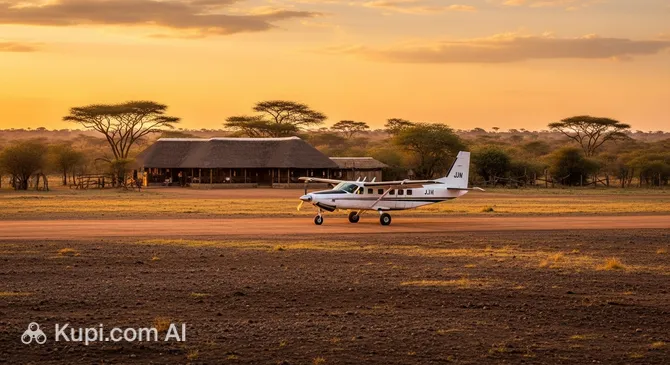
Mulika Lodge Airport is a small airstrip serving mainly tourists heading to Meru National Park. Due to its small size and specific nature, it lacks many of the contact services found at major airports. For information, it is recommended to contact the representatives of the airlines operating charter flights or the park administration.
There are several ways to get to Mulika Lodge Airport (JJM), which serves as the aerial gateway to the famous Meru National Park. The most convenient and popular option for tourists is a pre-booked transfer or taxi. Most safari lodges and hotels in the vicinity of Meru offer airport pick-up services. The journey from the city centre to the airport, located within the park, takes approximately 2-3 hours depending on road conditions. Although this is the most expensive method, it guarantees comfort and safety.
A more budget-friendly, yet more adventurous method is to use public transport. Local shared taxis, known as matatus, run from the town of Meru towards the national park. However, please note that they usually only take you to the main park gates, from where you will need to negotiate further transport to the airport itself. This option is suitable for experienced travellers ready for unpredictable schedules and a local experience.
For those who value independence, renting a car is an excellent solution. Many travellers arriving at Jomo Kenyatta International Airport in Nairobi rent a car right there to drive to the park themselves. This gives you freedom of movement throughout Kenya and the ability to plan your own route. It is recommended to choose an SUV (4x4), as the roads within the park and on the approaches to it can be unpaved, especially during the rainy season.
Mulika Lodge Airport is essentially an airstrip for small charter and safari planes, so there is no organised commercial parking here as found in large airports. If you are arriving in your own or a rented car, the issue of parking is best resolved in advance with the administration of your lodge or the hosting party. It is worth noting that many travellers arrive here via domestic flights from other airports, such as Wilson Airport in Nairobi or Nanyuki Airport, which eliminates the need for a long overland journey.
Mulika Lodge Airport (JJM) is a small regional airfield serving primarily safari tourists heading to Meru National Park. Its structure differs significantly from large international airports, making it simple and convenient to navigate.
In fact, the airport has just one small terminal — a compact, functional building that serves both arriving and departing passengers simultaneously. There is no complex layout, multitude of boarding gates, or long corridors here. The arrival and departure zones are generally located in one common hall where the check-in desk and waiting area are situated. It is practically impossible to get lost here.
Check-in and security procedures at Mulika Lodge airfield are very fast. Due to the low passenger flow and limited number of flights, mostly on light aircraft, you will not have to stand in long queues. The entire process from arriving at the airport to boarding the plane usually takes no more than 30-40 minutes. Security screening here is also simplified compared to major hubs.
The main recommendation for travellers is not to worry about navigation. All services are located in one place and are intuitive. Simply follow the instructions of the airline staff or representatives of your lodge. The compactness and simplicity of this airfield are its advantages, allowing you to start or end your amazing journey through the Kenyan savannah without unnecessary stress.
Mulika Lodge Airport (JJM) is essentially not a major transport hub, but a small airfield (airstrip) whose history is inextricably linked with the development of tourism in Meru National Park. Unlike large international airports, its history does not abound with dates of massive reconstructions or passenger traffic records, but it is unique in its own way.
The main task of the airfield since its inception has been to ensure quick and convenient access for tourists arriving for safaris in one of the most picturesque parks in Kenya. It was built to serve guests staying at lodges within the park, primarily Mulika Lodge, after which it is named. Its development has always kept pace with the growing popularity of the park itself. As the tourist flow increased, the airstrip was maintained and modernised to receive small charter and private aircraft, which are the main mode of transport for safari tours.
Instead of loud historical events, the history of this airfield is thousands of stories of travellers for whom the introduction to the wildlife of Meru began right here. An interesting fact lies in the landing process itself: landing at Mulika Lodge airfield is already part of the adventure. Passengers can see the savannah and herds of animals from the air and feel complete immersion in the atmosphere of the national park even before their feet touch the ground.
Mulika Lodge Airport (JJM) is a small airfield that serves as the main aerial gateway for tourists arriving in Meru National Park. It is important to understand that its infrastructure is minimal and designed to meet the basic needs of passengers on small charter and scheduled flights. The range of services here differs significantly from what large international airports offer.
Restaurants, Cafes, and Shops. There are no full-service restaurants or Duty-Free shops on the airfield premises. Passengers can expect at most a small kiosk selling drinks and light snacks. It is recommended to have a supply of water and food with you.
Waiting Areas and Amenities. A simple waiting room is equipped for passengers where one can comfortably wait for their flight. VIP halls or business class lounges are absent here. As for modern amenities, finding Wi-Fi or public charging stations for gadgets is likely impossible. It is better to ensure your devices are charged in advance.
Financial and Medical Services. There are no bank branches, ATMs, or currency exchange points on the airfield territory. All financial transactions should be conducted in advance in larger settlements. Medical assistance is limited to the possibility of providing basic first aid. A specialised medical centre is absent.
Services for Passengers with Special Needs. Special facilities for passengers with children (such as mother and child rooms) or for people with disabilities are not provided. If you require special assistance during boarding or disembarking, you must arrange this in advance with your airline or tour operator.
Hotels and Business Services. The airport is located directly within the national park and serves nearby safari lodges and campsites, including Mulika Lodge. Thus, accommodation options are in close proximity, but not on the territory of the airfield itself. Conference rooms and business centres are absent here, as the facility is entirely oriented towards tourism.
When planning a trip through Mulika Lodge Airport (JJM), it is important to understand that this is a small airstrip serving mainly Meru National Park, not a large international airport. Consequently, the infrastructure here is minimal, and the choice of dining establishments is very limited.
Typically, there are no full-service restaurants, cafes, or dining lounges in the airport building. Passengers may have access to a small kiosk or counter selling basic bottled drinks (water, soda) and packaged snacks such as chips, biscuits, or nuts. Occasionally, hot tea or coffee may be found.
Specialised meals, including vegetarian, Halal, or gluten-free options, are practically impossible to find here. The opening hours of the sole point of sale, if it exists, are strictly tied to the schedule of the few flights, which are usually operated during daylight hours.
Our Recommendation: We strongly advise eating a substantial meal before leaving for Mulika Lodge Airport. If you have specific dietary preferences, require Halal food, or are travelling with children, it is best to bring food and drinks with you. Do not count on the possibility of a full lunch or even a quick but filling snack on site.
Mulika Lodge Airport is essentially an airstrip serving guests of the eponymous lodge and other camps in Meru National Park. Flying here is part of a true safari adventure. To ensure your journey through Kenya goes smoothly, make use of our tips.
Arrival Time and Check-in. Mulika Lodge Airport handles small charter and scheduled flights. There is no bustle of large aviation hubs here. We recommend arriving approximately 1.5 hours before departure. This time is sufficient to leisurely pass through check-in, which usually consists of a simple document check and luggage weighing at the airline counter. Keep your passport and ticket handy.
Choosing a Seat on the Plane. Flights to Meru and its surroundings are often operated on small aircraft like the Cessna Caravan. Seats are usually not booked in advance, and seating occurs on a first-come, first-served basis. Try to take a window seat — the bird's-eye views of the savannah and mountains are simply mesmerising. The pilot might even point out herds of animals below!
Luggage Specifics. This is a critically important point for safari flights. Most airlines set strict weight limits for luggage — usually 15 kg per person, including hand luggage. Furthermore, only soft bags without a rigid frame are accepted, as they are easier to stow in the small cargo hold. Liquids in hand luggage must be in containers up to 100 ml and packed in a transparent bag. Sharp and cutting objects are prohibited.
Transfers and Customs Control. Mulika Lodge is not a transit hub. Flights here are usually the final point of your air journey before starting a safari. If you have a further flight planned to another airstrip, it will be organised by the same airline or your tour operator. You will go through all international customs and immigration control at the first airport of arrival in Kenya (for example, in Nairobi).
Saving Time and Money. Book flight tickets in advance, especially during the high season. The main way to save is to travel light. Excess baggage on safari flights is charged at very high rates, and sometimes it may simply not be accepted on board. Keep electronic copies of documents on your phone or a cloud service.
In Case of Flight Delay. The weather in the region can be unpredictable and affect the schedule. If your flight is delayed, first contact the airline representative or your tour operator. The staff at Mulika Lodge will also be able to assist with information and organising a comfortable wait.
Have you reached the end of the page?
So the route has been studied inside and out