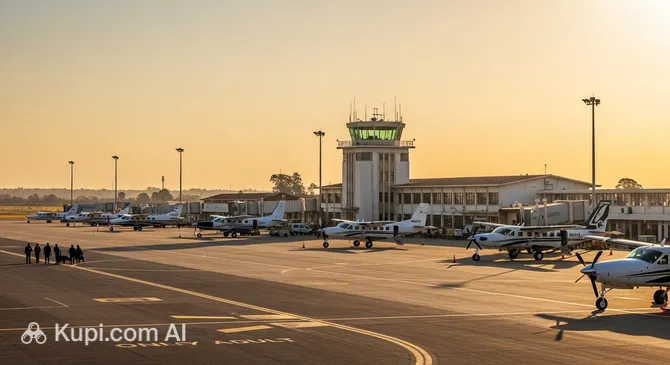
Source: Kupi.com AI
| Characteristic | Value |
|---|---|
| IATA code | WIL |
| ICAO code | HKNW |
| City | Nairobi |
| Country | Kenya |
| Time zone | Africa/Nairobi |
| Popular airlines | FLEX FLIGHT APS |
| Schedule | Online timetable |
| Characteristic | Value |
|---|---|
| IATA code | WIL |
| ICAO code | HKNW |
| City | Nairobi |
| Country | Kenya |
| Time zone | Africa/Nairobi |
| Popular airlines | FLEX FLIGHT APS |
| Schedule | Online timetable |
For the most up-to-date information regarding the operations of Wilson Airport, its services, and contacts, it is recommended to refer to the official sources of the Kenya Airports Authority (KAA), the airport's management company. Below are the main contact details.
Wilson Airport is located quite close to the centre of Nairobi, making it very accessible. This airport is a key hub for domestic flights across Kenya, especially for charter flights on safari. You can get to it in several ways, the choice of which depends on your budget, time, and comfort preferences.
Taxis, Online Services, and Transfers. This is the most popular and convenient way to get to Wilson Airport. A trip from Nairobi's central business district usually takes 15 to 30 minutes, however, during peak hours, this time can increase significantly due to heavy traffic. Ride-hailing apps such as Uber and Bolt operate actively in the city, offering reasonable prices. The cost of the trip will be approximately 500–1000 Kenyan Shillings (KES). You can also use official taxi services or pre-book a hotel transfer, which is especially convenient if you have a lot of luggage.
Public Transport (Matatu). For the most budget-conscious and adventurous travellers, there is the option of travelling by "matatu" — local minibuses. This is the cheapest method, with the fare costing only 50–100 KES. The airport is located on Langata Road, and many matatus pass by it heading towards Ongata Rongai or Kiserian (for example, routes 125/126). The stop is located right at the airport entrance. Please note that matatus are often overcrowded, and figuring out the routes without the help of locals can be challenging.
Car Rental and Parking. If you have rented a car, driving to Wilson Airport is straightforward — simply follow the signs on Langata Road. However, be prepared for Nairobi's famous traffic. There is paid parking on the airport grounds where you can leave your car for both short and long periods. During peak hours, the number of available spaces may be limited, so arrive with a little extra time.
Wilson Airport (WIL) is primarily a hub for domestic flights within Kenya, particularly for safari flights, so its structure differs significantly from large international airports. It is compact, and navigating it presents no difficulties.
Structure and Terminals
Formally, Wilson Airport does not have a division into several large terminals like, for instance, Jomo Kenyatta Airport. In essence, it is one main passenger building, which is divided into several sections and halls serving different airlines. Major local carriers, such as Safarilink and AirKenya, have their own dedicated check-in areas and waiting lounges, which can be considered sort of mini-terminals. This is the main thing to know: look not for a terminal number, but for your airline's signboard.
Departure and Arrival Zones
The airport layout is very simple. The Departure Zone consists of check-in counters, a security screening point, and a general waiting hall. Some airlines have their own, more comfortable lounges for passengers. After boarding is announced, passengers walk to the aircraft parked on the apron. The Arrival Zone is even simpler: passengers also walk from the plane to the building where the baggage claim belt and the exit to the city are located. Since the airport mainly services small aircraft, the process is very quick.
Time for Procedures and Navigation
Passing through check-in and security at Wilson Airport takes much less time than at large airports. As a rule, it is sufficient to arrive 1–1.5 hours before departure. Navigation is intuitively understandable — all signs and indicators lead from the entrance to the check-in counters and further to the boarding gates. You can move between different airline sections on foot in a couple of minutes.
Recommendations:
The history of Wilson Airport begins in 1929 when it was founded as Nairobi Aerodrome. It was one of the first airports in East Africa, laying the foundation for the development of aviation in Kenya. The airport received its current name in 1962 in honour of Florence Kerr Wilson, a courageous female pilot who founded the country's first airline in 1929. This gesture immortalised her contribution to the region's aviation history.
During World War II, the aerodrome played a strategic role and was used by the Royal Air Force (RAF) for military operations in the region. After the war, the airport returned to civil use and began to develop rapidly. It became the main hub for domestic and regional flights, especially for tourists heading on safari. It is from here that unforgettable journeys to the famous national parks in the vicinity of Nairobi and across the country began and continue to begin.
In subsequent decades, Wilson Airport was repeatedly modernised to meet the growing passenger flow and modern safety requirements. Runways were reconstructed, and terminal infrastructure was updated. Today, Wilson Airport is considered one of the busiest in Africa in terms of the number of take-offs and landings of light aircraft. It primarily serves charter and scheduled flights to national parks, as well as to neighbouring countries.
Several interesting facts are connected with Wilson Airport. For example, it served as the backdrop for many scenes in the famous film "Out of Africa", conveying the atmosphere of the era when aviation was born on the continent. Furthermore, it is often called the "Gateway to Safari Parks", as the vast majority of tourist flights to the Masai Mara, Amboseli, and other reserves depart from here. This makes it not just a transport hub, but an integral part of adventure tourism in Kenya.
Wilson Airport (WIL), despite its relatively small size compared to Jomo Kenyatta International Airport, offers passengers all the necessary services for a comfortable wait for their flight. It is focused mainly on domestic flights and safari tours, so the infrastructure here is compact and functional.
Within the terminal territory, you will find several cafes and small restaurants where you can have a snack, drink coffee, or enjoy soft drinks. The menu usually includes sandwiches, pastries, and local cuisine. There are also souvenir stalls and shops where you can purchase travel essentials, African crafts, and gifts.
For a more comfortable wait, the airport has several waiting lounges, including VIP lounges offering a secluded atmosphere, snacks, and beverages. Passengers have access to free Wi-Fi, and charging stations for mobile devices can be found in the waiting areas. To address financial matters, ATMs and currency exchange points are provided, although it is recommended to exchange large sums in the city in advance.
A medical point operates at the airport to provide first aid. For passengers with small children, mother and child rooms are equipped. Travellers with reduced mobility are provided with the necessary assistance when moving around the terminal, but it is better to inform the airline of such needs in advance. There are no hotels directly on the airport grounds, however, in the immediate vicinity, in Nairobi, there are many accommodation options to suit every taste and budget. For business travellers, conference rooms are available in nearby hotels.
Wilson Airport, serving mainly domestic flights across Kenya, offers passengers several convenient options for a snack or a full meal. Although the selection here is not as large as in international airports, you certainly won't go hungry. Most establishments are located in the main terminal area, accessible before passing security control (landside).
For those looking for a quick and high-quality snack, an excellent choice would be a cafe from the Java House chain. This popular establishment in Nairobi offers excellent coffee grown in Kenya, fresh pastries, sandwiches, salads, and light hot dishes. It is the ideal place to have a cup of cappuccino before departure. Operating hours usually coincide with the flight schedule — from early morning until evening.
If you have more time and want to enjoy a full lunch in a unique atmosphere, pay attention to the restaurant at the Aero Club of East Africa, located in the immediate vicinity of the terminal. This place with a rich history offers a more extensive menu, including European and local cuisine. Here you can have a leisurely lunch while watching planes take off and land. Prices here are above average, but the atmosphere is worth it.
Regarding special dietary needs, finding separate menus for vegans or gluten-free dishes can be difficult. However, in most cafes, you can find vegetarian options, for example, vegetable sandwiches or salads. It is recommended to check the ingredients with the staff before ordering. After passing security control (airside), the choice is usually limited to small kiosks with drinks and packaged snacks, so it is better to eat beforehand.
Travelling through Wilson Airport, one of the busiest airports in Africa by flight volume, requires a little preparation. It serves mainly domestic and regional flights, including popular safari destinations. To ensure your journey from Nairobi goes smoothly, follow these tips.
Arrival Time and Check-in: Despite Wilson being smaller than Jomo Kenyatta International Airport, it can get quite crowded, especially in the morning hours. It is recommended to arrive at the airport at least 1.5-2 hours before a domestic flight. Check-in and security procedures here are simpler than in major hubs, but queues can form quickly. Keep your passport and ticket handy to speed up the process.
Hand Luggage and Baggage: This is one of the most important points for those departing from Wilson, especially on safari. Many flights are operated on small aircraft with very strict restrictions on luggage weight and size. It is often required to transport belongings in soft bags (without a rigid frame), and the total weight of luggage, including hand luggage, must not exceed 15 kg. Standard rules for hand luggage also apply: liquids in containers up to 100 ml and no sharp objects.
Seat Selection and Transfers: If your flight is heading to national parks such as Masai Mara or Amboseli, try to get a window seat. From the heights, breathtaking views of the Great Rift Valley and even Mount Kilimanjaro open up in clear weather. Passengers with transfers, especially those moving between Wilson and Jomo Kenyatta International Airport (NBO), should allow at least 3-4 hours for the journey due to unpredictable traffic in Nairobi.
Customs Control: Since the airport also serves some international regional flights (for example, to Tanzania), a customs service operates here. If you are arriving from another country, be prepared to present your passport with a visa (if necessary) and declare goods. For domestic flights within Kenya, there is no need to pass customs control.
Saving Time and Money: To save time, complete online check-in if possible. To save money, book a taxi through mobile apps (Uber, Bolt), as prices may be lower than those of drivers at the airport. You can also bring a light snack and water with you, as the choice of food in the small terminal is limited, and prices are above average.
In Case of Flight Delay: Delays, especially to safari destinations, can happen due to weather conditions. Ensure you have your airline's contact details. The airport has small cafes and waiting areas, but amenities are limited. Have a book, a charged power bank, or downloaded movies with you to pass the time. Having travel insurance will also help in unforeseen situations.
Have you reached the end of the page?
So the route has been studied inside and out