Support

Christmas Island Airport

About the Airport

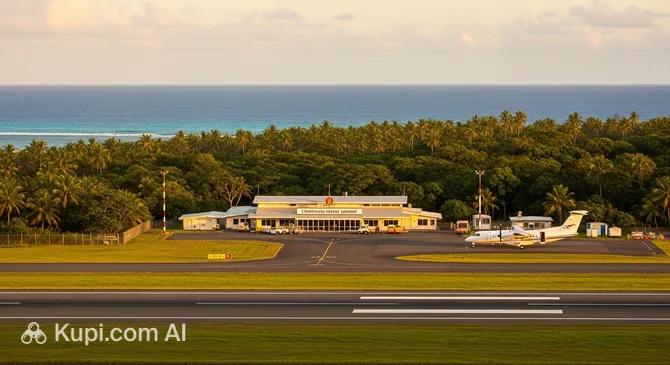
Cassidy Airport, also known as Christmas Island Airport (Christmas), is not merely a runway, but a gateway to one of the most remote and fascinating corners of the planet. Upon landing here, you leave the bustle of the wider world behind and take your first step onto the land of the world's largest coral atoll, part of the Republic of Kiribati. This small but strategically vital airport serves as the main access point for eco-tourists, fishermen, and researchers eager to explore the unique nature of this Pacific paradise.

Christmas Island Airport. Source: Kupi.com Binoculars
IATA CodeCXI
ICAO Code PLCH
City Kiritimati
Distance to Centre Approximately 10 km to the main settlement of London
Status International
Annual Passengers Several thousand (exact figures vary)
Popular Airlines Fiji Airways, Air Kiribati
ScheduleOnline board

The main feature of Cassidy Airport is its unique location. It is the sole aerial route to the Kiritimati Atoll, world-renowned for its bonefish sport fishing opportunities and incredible diversity of seabirds. This makes it not just a transport hub, but the starting point for unforgettable adventures.

The airport itself is a modest and compact building, which is, in fact, its virtue. There are no long queues or complex navigation here. Procedures are completed quickly, and just minutes after landing, you can feel the warm tropical breeze. The atmosphere is extremely simple and hospitable, allowing you to immediately immerse yourself in the unhurried rhythm of island life. The airport primarily serves flights from Fiji, acting as a vital link between the atoll and the rest of the world.

Contact Information

  • Official Airport Website: Cassidy Airport (CXI) does not have its own dedicated web resource. Reference information can be found on the official portal of the Ministry of Information, Communications, Transport and Tourism Development of Kiribati (MICTTD).
  • Help Desk Phone: +686 81 125 (Airport Administration on Kiritimati Island).
  • Airport Address: Cassidy International Airport, Banana, Kiritimati (Christmas Island), Republic of Kiribati.
  • Email: Direct addresses for passengers change frequently; it is recommended to use the contact forms of the Civil Aviation Authority of Kiribati.
  • Social Media: There are no official accounts for the airport itself. Current regional news is published on the pages of the Kiribati National Tourism Office.
  • Lost Luggage Information: You should contact the representatives of the airline that operated the flight (regular flights are operated by Fiji Airways) directly, or the duty officer in the terminal.
  • Support Service Contacts: Questions can be addressed to the head office of the Airport Authority of Kiribati in Tarawa by phone at +686 26 003.

How to Get to the Airport

The transport infrastructure on Christmas Island (Kiritimati) has unique features due to its remoteness and island lifestyle. Cassidy Airport (CXI) is located near the settlement of Banana, and there are several ways to reach it, though one should not expect the variety typical of major metropolises. When planning your trip, it is important to remember that transport schedules are often tied to the single weekly international flight.

Transfer from Hotels and Tourist Lodges

This is the most reliable and common way to get to the airport. Since most tourists arrive on the island for fishing or eco-tourism and stay in specialised lodges, the hosting party almost always organises meet-and-greet and drop-off services.

  • Features: The transfer is usually included in the cost of accommodation or the service package. Drivers know the flight times precisely and bring passengers with sufficient time to complete check-in.
  • Recommendation: Clarify this issue in advance when booking accommodation. Finding transport on your own on the day of departure can be problematic.

Car Rental

For those who prefer independence, transport rental is possible. However, there are no international rental brand counters here.

  • Where to rent: A vehicle (most often a pickup truck or minivan) can be rented through local guest houses or small private offices in the main settlements — London (Ronton) or Tabwakea.
  • Cost: Prices range from 50 to 80 Australian Dollars (AUD) per day. Fuel is paid separately.
  • Roads: The main road connecting the settlements of London, Banana, and Poland is paved, but many turnoffs are unpaved roads made of coral sand.

Taxi and Private Transport

There is no official taxi service with meters on the island. Local residents with private cars or minibuses fulfill the role of taxis.

  • How to find: A car must be ordered in advance by phone or through your hotel receptionist. Hailing a car from the roadside on the way to the airport is practically impossible due to low traffic.
  • Cost: The price is negotiable. A trip from the main settlement, London, to the airport will cost approximately 20–40 AUD.

Public Transport

The public transport system is poorly developed and is represented mainly by small private buses and converted trucks running between villages.

  • Schedule: There is no strict schedule; transport departs as it fills up or during peak hours (morning/evening).
  • Convenience: This option is not recommended for trips to the airport, as there is a high risk of missing your flight.

Airport Parking

The parking zone in front of the terminal is an open area. It is not guarded, but the crime rate on the island is low.

  • Cost: Parking is free of charge.
  • Spaces: There are usually enough spaces, as the flow of cars is small and occurs only on days when planes arrive.

Travel Time

Distances on the island are small, and traffic jams do not exist. Estimated travel time to Cassidy Airport:

  • From the settlement of Banana: 5 minutes.
  • From the settlement of Tabwakea: about 15–20 minutes.
  • From the settlement of London (Ronton): approximately 20–25 minutes.
  • From the settlement of Poland: about 1.5–2 hours (due to distance and road quality).

Terminals and Map

Christmas Island Airport (CXI) is an example of a compact and functional aviation hub where everything is designed for passenger convenience. Do not expect a complex structure with multiple terminals here: the airport consists of one small terminal that handles absolutely all flights — both arrivals and departures. Its main task is to ensure the island's connection with the outside world, and it copes with this perfectly, offering travellers a simple and clear organisation.

The internal layout of the terminal is extremely logical. Essentially, it is a single building divided into several functional zones. Immediately at the entrance, you will find check-in counters, followed by the security screening point. The departure and arrival zones are in immediate proximity to each other, so the issue of transferring between terminals is irrelevant here — everything is located within a few dozen steps. such a simple scheme makes navigation intuitively clear even for those visiting for the first time.

Thanks to the airport's small size and the limited number of flights, all pre-flight formalities usually take a minimum amount of time. The check-in and security screening process is significantly faster than in major international hubs. Despite this, it is recommended to arrive at the airport in advance to check in luggage without haste and wait for boarding. The absence of bustle allows you to start or end your journey in a calm and relaxed atmosphere.

The main advice for navigation at Christmas Island Airport is not to worry. It is practically impossible to get lost here. All key infrastructure is located in one hall, making this airport one of the most simple and convenient for travellers. Its compactness is not a disadvantage, but rather an advantage, allowing you to avoid the stress inherent in large aviation complexes and immediately immerse yourself in the peaceful atmosphere of the island.

Airport History

The history of Cassidy Airport (CXI) is a fascinating journey from a strategic military facility of the Second World War era to the sole air harbour connecting one of the planet's most remote atolls with the outside world. Unlike many civil airports built to develop tourism, this airfield emerged due to global historical upheavals.

Military Birth and World War II

The airport was built in 1941–1942 by the US Army Corps of Engineers. In those years, when the Second World War engulfed the Pacific Ocean, Christmas Atoll (Kiritimati) became a critically important point for refuelling and transit of military aircraft flying between Hawaii and the South Pacific (including Bora Bora and Australia). Initially, the airfield was purely utilitarian and consisted of a reinforced runway capable of accepting heavy transport aircraft and bombers.

Era of Tests and the "Cold War"

After the end of World War II, the airfield was not abandoned. In the late 1950s and early 1960s, it found a "second life" as a base for nuclear testing. The United Kingdom (Operation Grapple), and subsequently the USA (Operation Dominic), used the airport's infrastructure to deliver equipment and personnel, and to monitor atmospheric tests. During this period, the airport saw perhaps the most intensive traffic in its history, receiving dozens of military flights daily.

Transition to Civil Aviation

With the independence of the Republic of Kiribati and the conclusion of military programmes, the airport transitioned to civil use. For a long time, it remained a modest regional hub with minimal infrastructure. The remoteness of the island and the impact of salty ocean air created constant challenges in maintaining the quality of the runway. However, it was this airport that opened unique opportunities for fly-fishing to the world, attracting enthusiasts from across the globe.

Modern Upgrades

An important stage in recent history was the reconstruction carried out in the 2010s and continuing with the support of international funds. The runway surface was renewed, and navigation equipment was modernised, allowing for the stable reception of jet liners such as the Boeing 737. This is vital for the island, as air travel is the only fast method for delivering medicine and mail.

Interesting Facts from the Airport's History:

  • A Hero's Name: The airport is named after American Lieutenant Wilfred Casady, whose plane crashed on the island during World War II. Although the surname is spelled Casady, the spelling Cassidy has become established in the airport's official name.
  • Geography of the Name: The airport is located in immediate proximity to a village with the colourful name of Banana. Tourists often joke that they are flying not to a city, but straight to the "bananas".
  • Time Travel: Due to its proximity to the International Date Line, Cassidy (CXI) is one of the first airports in the world where the new calendar day begins. Flights departing from here to the east (for example, to Honolulu) technically land "yesterday", travelling back to the previous day.
  • Space Connection: There is also a space chapter in the airport's history. The island and airfield infrastructure were used by the European Space Agency (ESA) to service a tracking station for Ariane rocket launches.

Services and Facilities

Christmas Island Airport (CXI) is a small and functional airport serving as the main aerial gateway to this remote island. The range of services here is focused on meeting the key needs of travellers, so one should not expect the infrastructure of a major international hub. The environment in the terminal is generally calm and aligns with the unhurried pace of island life.

Inside the terminal, there is a general waiting hall. Dining and shopping options are modest: usually, a small cafe or kiosk is operating, where you can purchase beverages, light snacks, and sandwiches. It is important to note that it is open primarily during hours tied to flight arrivals and departures. There are no Duty Free shops, souvenir stalls, or restaurants in the airport. VIP lounges are also absent.

Access to Wi-Fi at the airport may be limited or provided on a paid basis, so it is better not to rely on a stable and fast connection. The number of power outlets for charging gadgets is also small — it is recommended to bring a portable power bank. There are no bank branches, ATMs, or currency exchange points within the terminal building. All financial matters should be settled before arriving on the island or by using banking services in the main settlement.

The terminal is adapted for passengers with reduced mobility, but it is extremely important to notify the airline in advance when booking your ticket regarding the need for special assistance or a wheelchair. Standard restrooms are available for families with children, but there are no specialised mother-and-child rooms or play areas. Medical assistance is limited to first aid provided by airport staff; for serious cases, one must visit the hospital on the island.

There are no hotels on the airport territory or within walking distance. All accommodation options, including hotels and lodges, are located in the settlements on the island, which can be reached by taxi or rental car in a few minutes. Business services, such as conference rooms or business centres, are not provided at Christmas Island Airport.

Where to Eat

When planning a trip through Christmas Island Airport (CXI), it is important to understand that this is a small regional airport with basic infrastructure. Dining options here are quite modest and correspond to the size and passenger flow of the airport. Instead of a wide variety of restaurants and cafes found in major international hubs, travellers have access to one main food outlet.

In the airport's single terminal, a small cafe or kiosk usually operates. Here, passengers can find essentials for a quick bite before departure. The assortment typically consists of sandwiches, pastries, crisps, chocolate, as well as hot drinks such as coffee and tea, and various cold beverages. Sometimes simple hot snacks can be found on the menu. This is an excellent option if you need to grab something on the go without counting on a full lunch.

It is worth noting that the operating hours of this establishment are directly linked to the flight schedule. Usually, it opens a few hours before departure and closes shortly after the plane takes off. The cafe is located in the main terminal area, accessible to all passengers. Prices may be slightly higher than in establishments on the island itself, which is common practice for remote airports.

Choices for passengers with special dietary requirements (vegetarian, gluten-free, etc.) will likely be extremely limited or non-existent. Therefore, if you adhere to a specific diet or wish to have a full meal, it is strongly recommended to do so at one of the establishments in the island's main settlement, London, before travelling to the airport, or simply bring food with you. Please note that Halal options may not be explicitly marked.

Traveller Tips

Travelling through Cassidy Airport (CXI) is a unique experience that differs from the usual bustle of major international hubs. Since air connections with Kiritimati Island are limited (usually one flight per week), the airport's operation has its own specifics. Here are some useful tips to help make your departure or arrival as comfortable as possible.

Arrival Time and Check-in

Despite the tiny size of the terminal, it is recommended to arrive at the airport at least 2.5–3 hours before departure. The check-in process often takes place in "manual" mode and can drag on. Since the entire island departs on the same flight, queues form quickly. It is important to have printed copies of tickets and itinerary receipts with you: mobile internet in the airport zone may work unstably, and downloading documents from a phone at the last moment is not always successful.

Choosing a Seat on the Plane

Flying over the Pacific Ocean is a visual adventure in itself. When checking in online or at the counter, try to choose a Window seat. Upon approaching the island or taking off, a breathtaking view opens up of turquoise lagoons, coral reefs, and the huge internal lakes of the atoll. This is the best opportunity to take panoramic photos of the largest atoll in the world.

Hand Luggage and Baggage

Rules for carrying liquids and prohibited items here correspond to international standards, especially considering that flights often proceed to Honolulu (USA) or Nadi (Fiji). It is prohibited to carry any fishing hooks, fishing line reels, and tools in hand luggage. If you have flown in for fishing (which most tourists do), ensure that all tackle is securely packed in checked luggage to avoid confiscation at security.

Customs Control and Biosecurity

Kiribati strictly protects its ecosystem. On departure, customs may check for the export of rare shells or corals — this is prohibited without a special permit. On arrival, strict phytosanitary control is in effect. Your fishing equipment and footwear must be perfectly clean, without traces of soil or plant seeds from other countries, to avoid introducing invasive species.

Tips for Transit Passengers

Cassidy Airport is typically the final or starting point of a route, rather than a transit hub. However, if you have a complex itinerary with a connection in Fiji or Hawaii, remember: luggage is often not checked through to the final destination if the flight is operated by different airlines. Clarify this point at the check-in counter so as not to lose your suitcases.

Saving Time and Money

There are practically no shops or cafes in the terminal in the usual sense. The assortment in the small kiosk may be meagre, and prices inflated. We advise taking an empty water bottle with you (you can fill it after security screening if there is a water cooler) and snacks. Also, be sure to have cash (Australian Dollars) with you, as payment terminals may not work.

What to Do in Case of Flight Delay

This is the most important point for travellers to Kiritimati. Since flights are operated, as a rule, once a week, any technical fault or bad weather can delay you on the island for a whole day or even until the following week. Having comprehensive travel insurance that covers accommodation costs and ticket replacement in case of flight cancellation is not just a recommendation here, but a necessity. If the flight is delayed, remain in the terminal zone and listen to announcements from airline representatives, as there may be no information display boards.

Airports in nearby cities

Reached the end of the page?

That means the route is fully explored