Support

Bonriki Airport

About the Airport

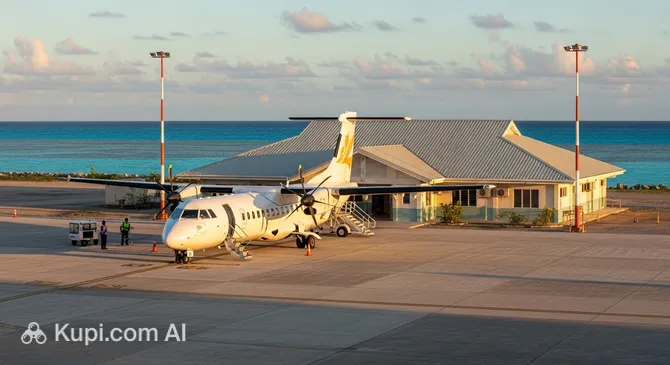
Bonriki Airport. Source: Kupi.com Binoculars

Bonriki Airport is more than just a transport hub; it is a true gateway to a lost world amidst the boundless Pacific Ocean. The air harbour welcomes travellers with a salty sea breeze and incredible views of the turquoise lagoon, which reveal themselves even before the landing gear touches the runway. Here, on a narrow strip of land on the atoll, begins your introduction to the unique culture and pristine nature of Kiribati.

AirportBonriki Airport
IATATRW
ICAONGTA
CityTarawa
TimezonePacific/Tarawa
ScheduleOnline board

Scenic Location. The airport runway is laid literally between the ocean and the lagoon, occupying a significant part of the Bonriki islet. Landing here turns into a breathtaking aerial excursion, allowing you to appreciate the scale and beauty of the atoll from a bird's-eye view.

Intimate Atmosphere. Forget the hustle of giant hubs: here reigns the calm and measured pace typical of island life. The compact size of the terminal makes navigation elementary, and the absence of long queues allows you to go through all formalities without unnecessary stress.

Authentic Welcome. The airport staff is distinguished by traditional Kiribati hospitality and friendliness. From the first minutes of your stay, you will feel the special rhythm of the islanders' life, where time flows a little differently, setting the mood for a relaxing holiday.

Contact Information

Finding direct contacts for small regional airports like Bonriki can be challenging. The main information and management are handled by the Ministry of Transport of Kiribati. Below are the most current contact details that could be found:

  • Official Website: The airport does not have a direct website. Official information is published on the website of the Ministry of Information, Communications and Transport: www.mict.gov.ki.
  • Inquiry Service Phone: +686 75021136. Please note that this is the Ministry of Transport number, not a dedicated airport inquiry line.
  • Airport Address: Bonriki, South Tarawa, Kiribati.
  • Email: For official enquiries, you can use the ministry email: secretary@mict.gov.ki. It is advisable to specify "Bonriki Airport" in the subject line.
  • Social Media: There are currently no verified official social media pages for the airport.
  • Lost Luggage Information: For all issues related to lost or damaged luggage, you must contact the representative of your airline directly.
  • Passenger Support Contacts: To resolve issues related to tickets, check-in, or flight schedules, please contact your airline.

How to Get to the Airport

Bonriki Airport (TRW) is the main air gateway of Kiribati, located in the eastern part of the Tarawa atoll. Since most hotels and administrative centres, such as Bairiki and Betio, are located in the western part, it is important to plan your route to the airport in advance. The distance from the central districts to the airport is about 30 kilometres, and the trip can take from 45 minutes to one and a half hours depending on the chosen transport and traffic conditions.

Public Transport is the most budget-friendly way to move around the atoll. The main mode of transport is private minibuses that ply the main road connecting different parts of South Tarawa. They do not have a strict schedule — they depart as they fill up and stop on demand. This is an excellent option for travellers without large luggage who wish to save money. A bus ride will cost just a few Australian dollars but may take over an hour due to frequent stops. There is no railway service or metro in Kiribati.

Taxis and Private Transfers offer a more comfortable and faster way to get to the airport. Taxis can be found in major settlements, but their number is limited. It is strongly recommended to agree on the fare in advance, as taximeters are rarely used. The estimated cost of a trip from Bairiki to Bonriki Airport may be 20-40 Australian dollars. Many hotels also offer a transfer service for their guests, which is a reliable, albeit more expensive, option. Such a transfer must be booked in advance.

Car Rental provides maximum freedom of movement. Several local companies offer cars for rent, however, the fleet is limited, so it is better to book a car in advance, especially during the tourist season. This option is convenient if you plan to explore the atoll on your own. Keep in mind that traffic on the main road can be chaotic, and the condition of some secondary roads leaves much to be desired. An international driving permit may be required for rental.

Parking at the Airport in Bonriki is quite simple. Typically, this is a small open lot next to the terminal. Here you can leave a car for both a short and a long time. Usually, parking is free or requires a nominal fee. Given the size of the airport, finding a spot will not be difficult.

Regardless of the chosen method, the main advice is to leave for the airport with plenty of time to spare. The only main road on the atoll can be congested, especially during peak hours, which can lead to unexpected delays. Ensure you have cash in Australian dollars (AUD), especially for paying for the bus or taxi.

Terminals and Map

Bonriki International Airport (TRW) represents the main air gateway of the island nation of Kiribati. Its structure is extremely simple and understandable for any traveller. The airport consists of one small terminal that serves both international and domestic flights. Thanks to its compact size, it is practically impossible to get lost here, and navigation is intuitive.

The terminal is a single-storey building, functionally divided into two main zones: departures and arrivals. The airport layout is very simple: after entering, you immediately find yourself in the general area where the check-in counters are located. The departure zone includes a small waiting hall, passport control, and customs inspection. The arrival zone consists of an immigration control point, a baggage claim area, and customs. There are no transfers between terminals, as all operations are concentrated in one building.

Check-in and screening procedures at Bonriki Airport generally do not take much time due to low passenger traffic. However, considering that many processes may be performed manually, and the airport comes to life only in the hours before departure, it is recommended to arrive for international flights well in advance — approximately 2-3 hours. This time will be sufficient to go through all formalities without rushing.

The main recommendation for navigation is to follow basic signs or simply the flow of other passengers. All infrastructure is within direct line of sight. Note that amenities at the airport are minimal and correspond to its size. Do not expect large Duty Free shops or a variety of cafes here. The airport effectively performs its main function — receiving and sending passengers to the country's capital, Tarawa.

History of the Airport

The history of Bonriki International Airport (TRW) is inextricably linked with key events of World War II in the Pacific region. The airfield was built in December 1943 by US Navy construction battalions, known as "Seabees", shortly after the fierce battle for Tarawa. Initially, it was named "Mullinix Field" and served as an important strategic airbase for American troops in their further operations against Japan.

After the end of the war, the military airfield was transferred to civil authorities and became the main airport for the British colony of the Gilbert and Ellice Islands. This marked a new stage in its development, transforming it from a military facility into a key transport hub connecting remote islands with the outside world. With the proclamation of independence of the Republic of Kiribati in 1979, Bonriki Airport received its modern status as the country's main international gateway.

Over the decades, the airport has undergone various stages of modernisation to meet changing aviation requirements. Works were carried out to improve the runway and terminal infrastructure to ensure the reception of more modern aircraft and service the growing number of passengers. Although Bonriki Airport has not set world records for passenger traffic, its main achievement has always been the reliable provision of vital connections for one of the most geographically isolated nations in the world.

One of the most interesting facts is that the legacy of World War II is still felt in the vicinity of the airport. Travellers and historians can find remains of military fortifications and equipment on the atoll. Thus, Bonriki Airport is not just a transport facility, but a living historical monument that played a decisive role in the fate of this Pacific state.

Services and Amenities

Bonriki Airport (TRW) is the main international airport of Kiribati, and in line with the country's scale, it offers a basic set of services for passengers. It is important to understand that this is a small air terminal, so amenities here are quite modest and not comparable to major international hubs.

Restaurants, Shops, and Lounges

At Bonriki Airport, you will find a very limited selection of establishments. Usually, there is a small kiosk or cafe where you can buy light snacks, soft drinks, and possibly local souvenirs. There are no full-service restaurants or large Duty Free shops here. Specialised VIP lounges or business class lounges are absent at the airport.

Communication and Financial Services

Access to Wi-Fi at the airport may be limited or paid. The number of sockets for charging electronic devices is also small, so it is recommended to bring a portable charger (power bank) with you. A currency exchange point or ATM may operate in the terminal building, but their working hours are often tied to the flight schedule. It is more reliable to exchange money in advance in the capital.

Other Services

  • Medical Assistance: Basic first aid services are available at the airport. In emergency cases, staff will call an ambulance.
  • For Passengers with Children and Limited Mobility: Specialised mother and child rooms are absent. Passengers with limited mobility are provided with assistance during boarding and disembarking, but for this, it is necessary to notify your airline in advance about the need for accompaniment.
  • Business Services and Hotels: There are no conference rooms or business centres in the airport itself. There are also no hotels on the terminal territory. The nearest hotels and motels are located in various parts of the Tarawa atoll, a few minutes' drive from the airport.

In general, Bonriki Airport serves as the functional air gateway of the country, ensuring the arrival and departure of flights. Passengers should be prepared for a basic level of comfort and plan the resolution of key issues, such as currency exchange or dining, in advance.

Where to Eat

Bonriki Airport (TRW) is a small and compact airport, so dining options here are quite modest but allow you to experience local flavour. Do not expect a food court with global chains here, however, it is quite possible to have a snack before departure.

In the main hall of the airport, in the public area (before passing security control), a small cafe or kiosk usually operates. This is the main and, typically, the only place where you can buy food and drinks. Travellers are offered simple but hearty dishes reflecting local cuisine: most often this is fish with rice, chicken, as well as various snacks, sandwiches, and pastries. This is an excellent option for both a quick snack and a simple but wholesome meal.

The selection of specialised dishes, such as vegetarian, vegan, or gluten-free, is likely to be absent. Passengers with strict dietary restrictions are strongly recommended to carry their own snacks to avoid inconvenience.

The opening hours of the local cafeteria depend directly on the flight schedule. Usually, it opens a few hours before the departure of international flights and closes after the aircraft departs. Prices for food and beverages here are moderate, especially in comparison with major international airports.

Travel Tips

Travelling through Bonriki International Airport is your first step to getting to know the amazing country of Kiribati. To make the start of your adventure in the city of Tarawa as comfortable as possible, use our tips. We recommend arriving at the airport at least 2-3 hours before the departure of an international flight. Despite the modest size of the terminal, processes can take time, and it is better to have some in reserve.

Registration and security control procedures at Bonriki Airport are quite standard but may proceed slower than in major hubs. Ensure that all your documents — passport, visa (if required), and ticket — are at hand. To speed up screening, remove electronics and containers with liquids from your hand luggage in advance. Remember that liquids in containers with a volume of no more than 100 ml, packed in a transparent bag, are allowed in hand luggage. Sharp objects and flammable substances are strictly prohibited.

When choosing a seat on the plane, give preference to a window seat to enjoy breathtaking views of the atoll during takeoff or landing. This is an unforgettable spectacle! If you have a transfer, be prepared for the fact that you will most likely need to collect your luggage and check it in again for the next flight, as Bonriki is not a major transit hub. Clarify this point with your airline in advance.

Customs control in Kiribati pays special attention to biosecurity. Be sure to declare all food products, plants, seeds, and products of animal origin. Honest completion of the declaration will help avoid fines and delays. To save time, fill out all migration and customs forms while still on the plane. To save money, bring a light snack and an empty reusable water bottle, which can be filled after passing security control, as the selection at the airport may be limited.

In case of a flight delay, remain calm. Waiting options at Bonriki Airport are limited, so having a book, a charged power bank, or downloaded films will help pass the time. Airline representatives are your main source of information. Contact them for updates on flight status and possible assistance options, such as providing vouchers for food or beverages.

Airports in nearby cities

Reached the end of the page?

That means the route is fully explored