Support

Gunsan Airport

About the Airport

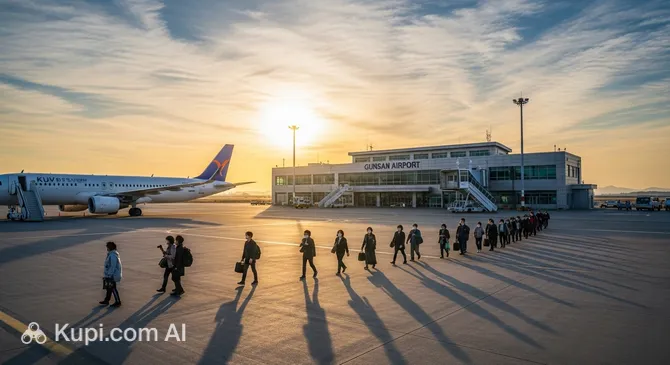
Gunsan Airport. Source: Kupi.com Binoculars

Gunsan Airport (KUV) is a welcoming air gateway to the picturesque Jeollabuk-do province, allowing you to begin your journey without the unnecessary bustle and noise of capital hubs. Located near the coast of the Yellow Sea, this compact aviation hub serves as an ideal starting point for exploring the region's historical heritage and the famous Saemangeum Seawall. Thanks to its intimate atmosphere and lack of huge queues, arrival and departure here become the easiest and most carefree part of your Korean adventure.

IATA Code KUV
ICAO Code RKJK
City Gunsan
Distance to Centre Approx. 12 km
Status Domestic
Annual Passengers ~410,000 (2023 data)
Schedule Daily flights (primarily to Jeju)

Features and Advantages of the Airport

Despite its modest size, Gunsan Airport possesses a number of advantages highly appreciated by experienced tourists and locals:

  • High Speed of Service: Thanks to low passenger traffic and a compact terminal, completing all pre-flight formalities (check-in and security screening) takes on average only 10–15 minutes. This allows you to spend less time waiting compared to large international airports.
  • Convenient Parking: A spacious parking zone is located right opposite the terminal. Unlike many busy aviation hubs, it is easy to find a free space here, and parking tariffs remain quite reasonable.
  • Strategic Location: The airport is located in close proximity to the industrial complex and popular tourist zones, including the Gogunsan Archipelago, making it convenient for both business trips and seaside leisure.
  • Intuitive Navigation: It is impossible to get lost here. The entire path from the building entrance to the boarding gate is clear at first glance and does not require long walks through endless corridors.

Contact Information

To contact representatives of Gunsan Airport, or to receive up-to-date information about flights and services, you may use the following contacts:

  • Official Website: The most complete and fresh information can be found on the airport's official page on the Korea Airports Corporation (KAC) portal: www.airport.co.kr/gunsan
  • Information Desk Phone: For information regarding airport operations and flight schedules, please call: +82-63-469-8300.
  • Airport Address: 64 Oksseo-ro, Oksseo-myeon, Gunsan-si, Jeollabuk-do, South Korea.
  • Email: The airport does not provide a public email for general inquiries. It is recommended to use the feedback form on the official website or contact them by phone.
  • Social Media: You can follow news and updates on the official social media pages of the managing company, Korea Airports Corporation.
  • Lost Luggage Information: In case of loss or damage to luggage, you must first contact your airline's office at the airport. Airport Lost and Found phone: +82-63-469-8353.
  • Passenger Support Contacts: For all general questions related to your stay at the airport, please contact the main information desk phone number.

How to Get to the Airport

Reaching Gunsan Airport (KUV), located near the city of Gunsan, is possible via several methods. This airport, serving both civil and military flights, has convenient transport connections with the city centre and its surroundings, making the trip to the air harbour quick and simple for travellers in South Korea.

Public Transport is the most budget-friendly option. City buses regularly run to the airport, connecting it with key points in Gunsan, including the bus terminal and railway station. The fare is very affordable and usually costs around 1,300-1,500 KRW. Although the journey may take a little more time, the bus is an excellent choice for economical tourists. There is no direct rail or metro connection to the airport, so the bus remains the main mode of public transport.

Taxi or Pre-booked Transfer is the most comfortable and fastest way to reach the terminal. A taxi ride from the city centre usually takes about 20-30 minutes depending on traffic conditions, and the cost varies from 15,000 to 20,000 KRW. This is an ideal option for those travelling with a large amount of luggage or those who value their time. You can hail a taxi on the street or book one via local apps.

Car Rental provides maximum flexibility, especially if you plan to explore not only Gunsan but also neighbouring regions. Several rental company counters can be found at the airport. For those arriving at the airport in their own or a rented vehicle, parking with zones for short-term and long-term stays is provided. This is convenient if you are seeing someone off or leaving your car for the duration of your trip.

The choice of transport depends on your priorities: bus for economy, taxi for speed and comfort, or a rental car for independence. For longer flights or finding alternative routes, it is worth considering other air harbours in the region, such as Gwangju Airport (KWJ) or the larger Cheongju Airport (CJJ), which can be reached by ground transport.

Terminals and Map

Gunsan Airport (KUV) is a small regional airport distinguished by its compactness and simplicity. It features just one passenger terminal serving all domestic flights. Thanks to this, orienting yourself here is extremely easy, even if you are in South Korea for the first time.

The terminal layout is intuitively clear. All key zones—check-in counters, security screening area, a small departure lounge, and baggage claim area—are located in one building a short distance from each other. Since there is only one terminal, there is no issue of transferring between buildings, which significantly saves time and reduces stress for travellers.

Departure and arrival zones are logically separated but located in close proximity. Upon entering the terminal, you will immediately see the check-in counters. After checking in and dropping off luggage, you proceed to security screening, after which you enter a small waiting hall. Registration and screening procedures usually proceed very quickly thanks to low passenger traffic. Typically, this takes no more than 15-20 minutes. Nevertheless, it is recommended to arrive at the airport 60-90 minutes before departure to complete all formalities without rushing.

The main recommendation for navigation at Gunsan Airport is simply to follow the signs. All navigation is duplicated in English, and getting lost in the compact space is practically impossible. This is an ideal airport for those who value speed and the absence of the hustle characteristic of large aviation hubs.

Airport History

The history of Gunsan Airport (KUV) is closely intertwined with key events of the 20th century in South Korea. Its story begins in 1938, when an airbase was built here during the Japanese rule. Initially, the facility had a strictly military purpose and played an important role in the regional strategy of that time. This military foundation defined the unique character of the airport for decades to come.

After historical events in the mid-20th century, the airport acquired new strategic importance. It became one of the key airbases jointly used by the Republic of Korea Air Force and the United States. It is this status—a dual-use airport—that is its main feature. For many years, the primary development and modernisation of infrastructure, including runways and navigation systems, were dictated by military needs.

The civil chapter in the airport's history began significantly later, when a need arose for passenger air transport for the region. To service civil flights, a separate terminal was built, allowing Gunsan Airport to become the air gateway for Jeollabuk-do province. Major reconstructions of the civil sector were aimed at creating comfortable conditions for passengers and launching domestic flights, primarily to the popular Jeju Island.

One of the most interesting facts is related to its name. In international and military nomenclature, it often figures as Kunsan Air Base, while the civil name is Gunsan Airport. This distinction reflects its dual nature. Today, the airport continues to successfully combine two important functions: ensuring national security and providing civil aviation services, being a unique example of such symbiosis in the country.

Services and Amenities

Gunsan Airport (KUV), serving the city of Gunsan and adjacent regions of South Korea, represents a small but functional terminal that shares its runway with a US military airbase. Despite its modest size, the airport offers passengers a basic set of services for a comfortable wait before their flight.

Dining and Shopping. Inside the terminal, you will find a few small cafes and eateries where you can have a snack or drink coffee before departure. The assortment mainly consists of Korean cuisine dishes and standard beverages. There is also a convenience store where you can purchase snacks, drinks, and souvenirs.

Waiting Lounges and Amenities. The airport is equipped with general waiting halls with a sufficient number of seats. There are no specialised VIP lounges here, but the general atmosphere in the terminal is quite calm. For passenger convenience, free Wi-Fi and charging stations for electronic devices are available throughout the building.

Financial and Other Services. ATMs are installed in the terminal where you can withdraw cash in local currency. Currency exchange points may be absent as the airport mainly serves domestic flights. For emergencies, a medical point is provided, ready to render first aid.

Services for Special Categories of Passengers. For travellers with small children, a nursing room is equipped where you can feed and change a baby in a quiet environment. Passengers with reduced mobility can count on staff assistance, and the terminal itself is equipped with ramps and specially fitted restrooms to ensure a barrier-free environment.

Accommodation and Business Services. There are no hotels directly on the territory of Gunsan Airport; however, many accommodation options can be found in the city of Gunsan itself, which is easily accessible by taxi or bus. Specialised conference halls or business centres are absent at the airport, which corresponds to its status as a small regional hub.

Where to Eat

When planning a flight through Gunsan Airport (KUV), it is important to consider that this is a small regional airport, and the choice of dining establishments here is quite limited. Unlike large international hubs, you will not find a wide variety of restaurants here. All the few options for a snack are concentrated in the single passenger terminal, typically in the public zone before passing security control.

The main option for passengers is a small café or snack bar. Here you can purchase basic beverages, such as coffee, tea, and bottled water, as well as light snacks. The assortment usually includes packaged sandwiches, pastries, chips, and sweets. Sometimes in such places, you can also find popular Korean street food dishes, for example, instant ramen or gimbap (rice rolls). This is a good option for a quick snack if there is little time left before departure.

For a full lunch or dinner, it is recommended to eat beforehand in the city of Gunsan, as there are no restaurants with hot à la carte meals in the airport. Passengers with specific dietary needs (vegetarians, vegans, those requiring Halal food, or people with gluten intolerance) should be especially careful: finding suitable dishes at the airport can be extremely difficult. The best solution would be to bring food with you. Prices in the local café are generally moderate for an airport, and operating hours are tied to the flight schedule—the establishment opens before the first departures and closes after the last aircraft departs.

Travel Tips

Travelling through the airport of Gunsan city can be simple and convenient if you know a few nuances. To avoid rushing, arrive at the airport in advance: 1.5-2 hours before the departure of a domestic flight will be quite sufficient. Considering that this is a joint-base airport (civil and military), the schedule may be subject to changes, so always check the status of your flight in advance.

Registration and security control procedures here usually proceed faster than in the large hubs of South Korea. To save time, use online check-in if your airline provides such an option. When choosing a seat on the plane, note that window seats will offer you beautiful views of the coast during takeoff or landing, while aisle seats ensure more freedom of movement during the flight.

Hand luggage rules are standard: liquids are permitted in containers up to 100 ml, packed in one transparent bag. Sharp objects, weapons, and flammable substances are prohibited. Always check with the rules of the specific airline, as there may be additional restrictions on weight and dimensions.

Gunsan Airport is not a major transit hub, so transfers here are rare. If you have a connection with a self-transfer, allow sufficient time for baggage claim and re-registration. Customs control is undergone only by passengers of international (usually charter) flights; it is not required for domestic flights.

To save money, bring an empty water bottle with you, which can be filled after passing security, and light snacks. The choice of cafes in a small airport may be limited. Also, consider the possibility of booking a taxi in advance or studying the bus schedule to avoid overpaying for transport upon arrival.

In case of a flight delay or cancellation, first contact your airline representative for information on further actions and possible compensation. Monitor updates on information boards. Although amenities in the terminal may be basic, you will be able to find seating areas and possibly a small café.

Reached the end of the page?

That means the route is fully explored