Support

Gimpo International Airport

Airports in the city

About the Airport

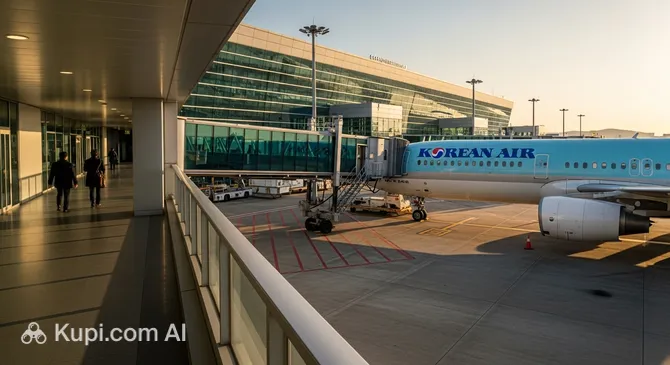
Gimpo International Airport. Source: Kupi.com Binoculars

Gimpo International Airport is not merely a transport hub, but a true veteran of Korean aviation. Despite the emergence of its giant "neighbor" in Incheon, it has retained its special status and significance. Located much closer to the historical and business center of Seoul, it serves as the ideal "city gateway" for those who value every minute and prefer quick flights to neighboring countries or travels across South Korea. A more intimate and calm atmosphere reigns here, allowing you to begin your acquaintance with the Land of the Morning Calm without unnecessary hustle and long transfers.

IATA Code GMP
ICAO Code RKSS
City Seoul
Distance to center ~15 km
Status International / Domestic
Annual Passengers ~23 million (2023-2024)
Schedule Available on online board

Features and advantages of Gimpo Airport:

Gimpo's main trump card is its location. You can reach the city center in just 20–30 minutes by metro or taxi, making it a favorite among business travelers and those who do not wish to spend an hour commuting from Incheon. The airport is connected to the city by three subway lines (including the AREX express), ensuring incredible transport accessibility.

The airport's infrastructure will surprise even sophisticated tourists. Directly from the terminal, you can access the massive entertainment complex, Lotte Mall Gimpo Airport. This is not just a duty-free shop, but a full-fledged shopping city with department stores, a cinema, a supermarket, and the Sky Park green zone, where you can spend quality time before your flight.

Gimpo is renowned for its speed and efficiency. Check-in and security procedures here usually take much less time than in major international hubs. It is the primary node for domestic flights, particularly to the popular Jeju Island — the busiest air route in the world.

Contact Information

For your convenience, we have compiled the main contact information for Gimpo Airport.

  • Official Website: www.airport.co.kr/gimpoeng (English version available). Here you will find the most up-to-date information on flights, services, and airport regulations.
  • Information Desk Phone: +82-2-2660-2114 or 1661-2626 (for calls within South Korea). Staff can help navigate general inquiries.
  • Address: 112 Haneul-gil, Gangseo-gu, Seoul, Republic of Korea.
  • Email: A direct email address for general inquiries is not published. To contact the administration, it is recommended to use the feedback form in the "Voice of Customer" section on the official website.
  • Social Media: The airport and the managing company, Korea Airports Corporation (KAC), maintain pages on social networks. Links to official accounts can be found on their website.
  • Lost and Found Information: If you have lost items in the terminal, contact the Lost and Found center. If your checked baggage has not arrived or is damaged, you must contact your airline's representative at the airport immediately.
  • Passenger Support Contacts: For all questions, you can approach the information desks located in the arrival and departure halls, or call the main information service.

How to Get to the Airport

Gimpo Airport (GMP) is the second-largest airport in Seoul, located significantly closer to the city center than the main international hub, Incheon. It primarily serves domestic flights within South Korea, as well as select international destinations in Asia. Thanks to a developed transport system, you can reach the airport quickly via several convenient methods.

Public Transport is the most popular and reliable way to get to Gimpo Airport. You have several options:

  • Metro: This is the fastest and most economical way to avoid city traffic. The "Gimpo International Airport" station is a hub served by multiple lines simultaneously: Line 5 and Line 9, which directly connect the airport with various districts of Seoul. Line 9 also offers express trains for a faster journey.
  • AREX (Airport Railroad Express): The "All-Stop Train" connects Gimpo Airport with Seoul Station and Incheon International Airport, which is particularly convenient for transit passengers.
  • Buses: Numerous city buses run to Gimpo from different parts of the city. This is the cheapest, though not the fastest, option. A more comfortable alternative is the Limousine Buses, which follow express routes from major hotels and transport hubs.

Taxi and Transfer. A taxi ride from central Seoul will take approximately 40-60 minutes depending on traffic conditions and will cost significantly more than public transport. This is a convenient option if you have a lot of luggage. For maximum comfort and a fixed price, you can pre-book a private transfer, where the driver will meet you at a designated location.

Car Rental and Parking. If you prefer to drive yourself, you can rent a car from one of the rental companies in the city or directly at the airport. For those arriving in their own vehicle, Gimpo Airport provides both short-term and long-term parking located opposite the terminals. The cost depends on the duration of parking.

In general, the metro is the optimal choice in terms of price, speed, and predictability. The journey from the city center takes about 30-50 minutes. However, if you value comfort and are traveling with a significant amount of luggage, a taxi or pre-booked transfer would be an excellent solution.

Terminals and Map

Gimpo Airport (GMP) is the second-largest airport in Seoul, distinguished by its compactness and convenient navigation. It consists of two main terminals: International and Domestic. Their separation by function makes orientation within the airport simple and intuitive.

The International Terminal serves flights to nearby countries such as Japan, China, and Taiwan. The Domestic Terminal, as the name suggests, is designed for flights within South Korea, primarily to popular destinations like Jeju Island and Busan. The terminals are located in separate buildings but are in close proximity to each other. A free shuttle bus runs between them, although you can also walk in 5–7 minutes via a covered walkway, which also houses the metro station.

The airport layout is logical: departure zones are traditionally located on the upper floors, and arrival zones on the lower floors. Each terminal has its own check-in counters and security checkpoints, while the international terminal also includes passport control. Navigation presents no difficulties thanks to numerous signs in Korean, English, Chinese, and Japanese. Information desks are always ready to assist passengers.

Check-in and security procedures at Gimpo are significantly faster than at the giant Incheon Airport. For domestic flights, it is recommended to arrive 1-1.5 hours before departure, and for international flights — 2-2.5 hours prior. This time is generally sufficient to complete all formalities without rushing, enjoy a coffee, and reach the boarding gate.

The main advice when flying from Gimpo is to check carefully and in advance which terminal your flight departs from: Domestic or International. This will help avoid unnecessary hassle and save time. The convenient location of the metro station, shared by both terminals, makes the airport easily accessible from any point in Seoul.

Airport History

The history of Gimpo Airport (GMP) is rich in events and closely intertwined with the development of Seoul and all of South Korea. Its story began in 1939, when a runway was built on this site for military needs. After World War II, the airfield was significantly improved, and in 1958 it received international airport status, becoming the main aerial gateway of the capital.

The airport's heyday came in the second half of the 20th century. During this period, it continuously expanded to cope with growing passenger traffic, reflecting the country's rapid economic development. A crucial stage in its history was the preparation for the 1988 Summer Olympic Games in Seoul. For this event, a new international terminal was built at Gimpo and the infrastructure was modernized, allowing it to welcome thousands of athletes and guests from around the world.

A turning point in Gimpo's history was 2001, when the new Incheon International Airport was opened. Most international flights were transferred there, and Gimpo changed its status. It was reoriented to serve domestic flights within the country, as well as short international routes to cities in Japan, China, and Taiwan. This decision helped decongest the airspace over the capital and made travel within the country more convenient.

Following the change in status, the airport underwent several stages of renovation to meet new objectives. Terminals were updated, and navigation and transport accessibility were improved. Today, Gimpo is a modern and efficient transport hub valued for its proximity to central Seoul. Interesting fact: before the opening of Incheon, Gimpo Airport was among the busiest airports in Asia by passenger traffic.

Services and Amenities

Gimpo Airport (GMP) offers passengers a full range of services and amenities to make waiting for a flight as comfortable and productive as possible. Here, every traveler will find everything they need, from various restaurants to business lounges.

For those feeling hungry or looking to shop, the airport features numerous restaurants and cafes offering both Korean and international cuisine, as well as coffee shops and fast-food outlets. The terminals house duty-free shops where you can purchase perfumes, cosmetics, souvenirs, and electronics. There are also pharmacies and convenience stores.

Staying connected is easy thanks to free Wi-Fi available throughout the airport. Numerous stands and power outlets are provided for charging electronic devices. Passengers wishing to relax in a quieter environment can utilize the VIP lounges, which offer snacks, beverages, and a cozy atmosphere.

For financial matters, the airport has bank branches, ATMs, and currency exchange counters. In case of feeling unwell, you can visit the medical center or first aid stations operating within the terminals.

Gimpo Airport is well-equipped for passengers with children. Facilities include nursing rooms with changing tables and feeding areas, as well as play zones where little ones can entertain themselves before the flight. For passengers with reduced mobility, a barrier-free environment has been created: ramps, elevators, specially equipped restrooms, and parking spaces. Assistance services can also be requested.

For business travelers and those who need to work, the airport has business centers and conference rooms equipped with everything necessary for meetings. If you have a long layover or an early flight, several hotels are located right next to the airport, such as the Lotte City Hotel Gimpo Airport, offering comfortable accommodation.

Where to Eat

At Gimpo Airport (GMP), you will find plenty of options for a snack or a full meal capable of satisfying any taste and budget. Most establishments are located in the public area (landside), before passing through passport control, so it is best to plan your meal in advance.

The main dining zones are concentrated in food courts on the upper floors of both the Domestic and International Terminals. Here, a wide selection of establishments is presented: from traditional Korean restaurants where you can enjoy dishes such as bibimbap, bulgogi, or spicy kimchi-jjigae soup one last time, to spots serving Japanese, Chinese, and Western cuisine. Prices in the food courts are moderate: a full meal will cost approximately 10,000–20,000 won.

For those in a hurry, numerous cafes (e.g., Paris Baguette, Dunkin' Donuts) and chain coffee shops are ideal for grabbing sandwiches, pastries, and coffee. They are located both in the public area and in the departure zone (airside). Additionally, both terminals have 24-hour convenience stores (GS25, CU) offering ready-made meals, kimbap, ramen, and beverages — an excellent option for a budget-friendly and quick snack.

Passengers with specific dietary requirements should study the menu carefully. Vegetarian dishes can be found in many Korean restaurants — it is often possible to order bibimbap without meat or vegetable soups. However, vegan options, as well as Halal and gluten-free dishes, are less commonly found, so it is best to clarify details with restaurant staff. Most establishments open early in the morning and operate until late evening, aligning with the flight schedule.

Travel Tips

To ensure your journey through Gimpo Airport in Seoul goes as smoothly as possible, follow these tips. Although Gimpo is smaller than its giant neighbor Incheon, proper preparation will help save time and reduce stress.

When to arrive at the airport? For international flights, which from Gimpo primarily fly to Japan, China, and Taiwan, it is recommended to arrive 2–2.5 hours before departure. If you have a domestic flight within South Korea, arriving 1.5 hours in advance will be sufficient. The airport is efficient, but queues are still possible during peak hours.

Check-in and Security Control. To speed up the process, use the kiosks for self-check-in and baggage drop. Be prepared at the security checkpoint in advance: remove laptops and other large gadgets from your bags, and pack all liquids up to 100 ml in a single transparent bag. The staff works quickly and professionally, so the procedure usually does not take much time.

Choosing a seat on the plane. This depends on your preferences. Seats by the window will give you the opportunity to take beautiful photos during takeoff or landing. Seats by the aisle are convenient if you want to stretch your legs or plan to get up frequently. Passengers rushing for a transfer should choose seats in the front of the cabin for a quick exit.

Hand luggage: what is allowed and prohibited. Standard international rules apply. All liquids, gels, and aerosols must be in containers of no more than 100 ml and packed in a transparent bag with a volume of up to 1 liter. Sharp objects, weapons, and flammable substances are prohibited. Also, pay attention to restrictions on exporting certain food products.

Tips for transit passengers. Gimpo is a very convenient hub for connections, especially between domestic flights. The terminals are located close by, and navigation is clear. If you are transferring from an international flight to a domestic one, be sure to check with your airline whether you need to collect and re-check your baggage.

Customs Control. Upon arrival in South Korea, if you have no goods to declare, follow the "Green Channel". If you are carrying something that may require duty payment (for example, goods exceeding the established limit), or are simply unsure, choose the "Red Channel". Honesty will help avoid unnecessary problems and fines.

How to save time and money. The easiest way to save time is to complete online check-in for your flight. To save money, travel to and from the airport by metro — the station is directly connected to the terminals. Food prices in the public area of the airport are generally lower than in the departure zone after passport control.

What to do if your flight is delayed? First, contact your airline's counter for the latest information. For long delays, you may be provided with meal vouchers. Gimpo Airport has many shops, cafes, and comfortable rest areas where you can pass the time while waiting for your flight. Free Wi-Fi will help you stay connected.

Reached the end of the page?

That means the route is fully explored