Support

Ulsan Airport

About the Airport

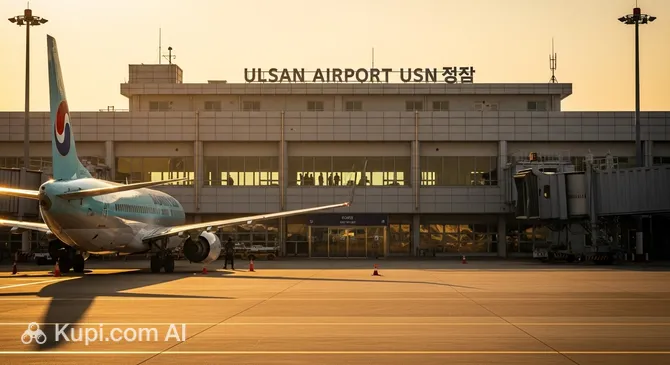
Ulsan Airport. Source: Kupi.com Binoculars

Ulsan Airport is a compact and cosy gateway to the industrial heart of South Korea. Unlike bustling international hubs, an atmosphere of calm and high efficiency prevails here, allowing travellers to begin their acquaintance with the city without unnecessary hassle. Located in close proximity to major business districts and industrial giants, this aviation hub serves as an ideal starting point for both business travellers and those wishing to quickly reach the famous Yeongnam Alps.

IATA Code USN
ICAO Code RKPU
City Ulsan
Distance to Centre 8 km
Status Domestic
Annual Passengers approx. 380,500 (2023)
Schedule Flight Schedule

Airport Features and Advantages:

  • Convenient Location: The airport is located within the city limits, allowing you to reach the centre and major hotels in just 15–20 minutes by taxi or bus.
  • Compactness and Speed: Thanks to the small size of the terminal, check-in and baggage claim procedures are lightning-fast, which is especially valuable after a flight.
  • Transport Accessibility: A well-established public transport network, including express buses, connects the terminal not only with the centre of Ulsan but also with the KTX railway station.
  • Waiting Comfort: Despite its status as a regional airport, it has everything necessary: cosy cafes, mini-markets, and clean rest areas.

Contact Information

For your convenience, we have compiled the main contact information for Ulsan Airport (USN), which may be needed when planning your trip.

  • Official Website: Up-to-date schedules, flight status, and a list of services are available on the airport's official website, which is part of the Korea Airports Corporation (KAC) portal: www.airport.co.kr/ulsan/main.do. The site is available in Korean and English.
  • Inquiry Service Phone: For information, you can call the unified KAC call centre at +82-1661-2626. The information desk phone number directly at the airport is: +82-52-288-8612.
  • Airport Address: 1103 Sanup-ro, Buk-gu, Ulsan, Republic of Korea.
  • Email: A specific email address for general inquiries is not published. To contact the administration, it is recommended to use the feedback form on the official website.
  • Social Media: Ulsan Airport does not have separate official pages. Important announcements are published on the general resources of the Korea Airports Corporation.
  • Lost Luggage Information: For items lost within the terminal building, please contact the Lost and Found office at +82-52-288-8615. If your luggage was lost during the flight, you must contact your airline's representative directly.
  • Passenger Support Contacts: For immediate assistance and consultations, please contact the inquiry service by phone or the staff at the information desks within the airport terminal.

Getting to the Airport

Getting to Ulsan Airport (USN) is straightforward thanks to the city's well-developed transport system. The most budget-friendly method is city and limousine buses, which run regularly between the airport and key points in the city. Routes cover major districts, including train stations and business centres. A bus journey will take approximately 40–60 minutes depending on your location and traffic conditions. This is an excellent choice for economical travellers.

For those who value comfort and time, a taxi is the optimal solution. A car can easily be found in any part of the city or ordered via an app. The journey from the centre to the airport will take about 20–30 minutes, traffic permitting. The cost will be significantly higher than the bus, but the convenience, especially if you are travelling with large luggage or family, fully justifies it. You can also pre-book a private transfer so that a driver meets you at a designated location.

If you plan to actively travel around South Korea and its surroundings, it is worth considering car rental. Several rental company counters are available at Ulsan Airport. It is recommended to book a car online in advance to guarantee the availability of the desired model and secure a more favourable rate. For those arriving at the airport in their own vehicle, convenient parking with zones for short-term and long-term stays is provided.

When planning your trip, it is also useful to know about alternative air hubs in the region. Depending on your final destination, other airports may be convenient. Nearby options include Pohang Airport (KPO), located approximately 44 km away, the major Gimhae International Airport (PUS) in Busan (about 59 km), and Daegu International Airport (TAE), which is about 71 km away. Also within a radius of 150 km are Sacheon Airport (HIN) and Tsushima Airport (TSJ).

Terminals and Map

Ulsan Airport (USN) is a compact and convenient aviation hub, serving primarily domestic flights within South Korea. Its structure is extremely simple and intuitive, making it ideal for travellers who value speed and a lack of hassle. The airport consists of one two-storey passenger terminal, which consolidates all service zones, eliminating the need to transfer between buildings.

Navigation within the terminal is logical and simple. The Ground Floor is entirely dedicated to the arrivals area and flight check-in. Here you will find airline counters, the baggage claim hall, and exits to bus stops and the taxi rank. The Second Floor is the departure zone. After check-in, passengers proceed upstairs, pass through security control, and enter the airside area with a waiting lounge and boarding gates.

Thanks to the low passenger traffic and efficient organisation, all pre-flight formalities are completed very quickly. Check-in and security screening rarely take more than 20-30 minutes. Nevertheless, it is recommended to arrive at the airport 1–1.5 hours before departure to check in luggage and go through all procedures without rushing. Getting lost in the terminal is practically impossible — simply follow the clear signs in Korean and English.

Airport History

Ulsan Airport (USN) began operations in 1970, becoming a key element of infrastructure for one of the main industrial centres of South Korea. Its creation was directly linked to the rapid economic growth of the city of Ulsan and the need to provide fast and convenient transport links for business circles and specialists working at local industrial giants.

Initially, it was a small airfield with basic infrastructure. However, as the city grew and passenger traffic increased, the need for expansion arose. A significant stage in the airport's development was the mid-1990s. In 1995, a new, more modern and spacious passenger terminal was opened, capable of handling a significantly larger number of flights and passengers. This reconstruction improved the quality of service and met the growing standards of air travel.

In subsequent years, the airport continued to modernise. Works were carried out to lengthen and strengthen the runway, allowing for the accommodation of larger aircraft. Although the advent of high-speed KTX trains shifted some passenger traffic to rail transport, Ulsan Airport retains its importance as a strategic facility serving domestic flights, primarily to Seoul and Jeju Island.

Interestingly, the history of the airport is inextricably linked with the city's industrial heritage. It did not set records for transport volume on a national scale, but its main merit lies in reliably ensuring transport accessibility for the country's largest industrial complex. Efficiency and strategic importance for business have always been the calling card of this compact regional airport.

Services and Amenities

Ulsan Airport (USN), despite its relatively small size, offers passengers all necessary services for a comfortable wait for their flight. In the terminal, you will find several cafes and restaurants where you can have a snack or drink coffee, as well as convenience stores and souvenir shops to buy last-minute gifts.

Comfortable halls are provided for waiting at the airport. While there may not be luxurious VIP lounges like in major international hubs, the general rest areas are well-equipped. Free Wi-Fi is available throughout the terminal, and numerous charging stations for electronic devices will allow you to stay connected. For travellers requiring financial services, ATMs and currency exchange points are in operation.

Ulsan Airport caters to all categories of passengers. For travellers with small children, special mother and child rooms are equipped, where you can feed and change your baby in a quiet environment. Passengers with reduced mobility are provided with all necessary assistance: ramps, specially equipped toilets, and staff assistance during boarding and disembarking. In case of necessity, you can contact the medical point for first aid.

If you need to stay overnight near the airport, several hotels of various price categories are located a few minutes' drive away. For business travellers who need to work, conditions are created in the terminal, although specialised conference rooms may not be available. Comfortable seating and internet access allow you to address work matters directly in the waiting hall.

Dining

Ulsan Airport (USN) is a small regional airport, so the choice of dining establishments here is more modest than in large international hubs. Nevertheless, passengers can find several convenient options to have a snack before departure. Most cafes and restaurants are located in the public area before passing security control.

Full Meals

For those wishing to have a substantial meal, there is a restaurant in the airport offering Korean cuisine. Here you can try classic dishes such as Bibimbap (rice with vegetables and meat), Bulgogi (grilled marinated beef), or various types of soups and ramen. This is a great opportunity to enjoy the authentic flavours of South Korea before departure. Prices are generally moderate and comparable to the city average.

Quick Snacks and Coffee

If time is limited, several cafes are at your service. Here you can order coffee, tea, pastries, sandwiches, and desserts. Additionally, the airport has a convenience store selling ready-made snacks such as Gimbap (Korean rolls), Samgak Gimbap (rice triangles), instant noodles, chips, and beverages. This is the quickest and most budget-friendly way to grab a bite.

Special Dietary Needs

Specialised establishments for vegetarians, vegans, or people with gluten intolerance are likely not available at the airport. However, in the Korean restaurant, you can ask for Bibimbap to be prepared without meat. Travellers with strict dietary restrictions or those requiring Halal options are recommended to carry their own snacks. Opening hours of establishments are usually tied to the flight schedule, so they may be closed late in the evening or at night.

Travel Tips

To ensure your journey through Ulsan Airport goes as comfortably as possible, it is important to consider its specifics. The air hub primarily serves domestic flights within South Korea, so for most flights, it is sufficient to arrive 1.5–2 hours before departure. If your flight is one of the rare international ones (e.g., a charter), be sure to check the recommended arrival time with your airline to avoid rushing.

Save time by using online check-in, which usually opens 24 hours before departure. Kiosks for self-check-in and baggage drop are also installed in the terminal. The security screening procedure here is standard and proceeds quite quickly. Be prepared to remove liquids in containers up to 100 ml (packed in a transparent bag) and large electronic devices, such as laptops, from your hand luggage for separate scanning.

When choosing a seat on the plane, be guided by your preferences: by the window, scenic views of the South Korean coast await you, while by the aisle, you have the ability to stand up freely without disturbing neighbours. Pay special attention to hand luggage rules: all external batteries (power banks) and lithium batteries are permitted for carriage only in the aircraft cabin. Knives, scissors, and other sharp objects are prohibited in hand luggage.

If you have a transfer in Ulsan, follow the "Transit" signs. Since most flights are domestic, the transfer usually does not take much time. Customs control and filling out declarations are necessary only for passengers arriving on international flights. If you are flying from another city in Korea, you do not need to go through these procedures. For those flying from abroad, it is important to remember the strict rules on importing plant and animal products.

A few tips for budget travellers: book a transfer from the airport in advance or use city buses — this is significantly cheaper than a taxi. To avoid excess baggage fees, weigh your luggage at home. Although bank cards are accepted almost everywhere in the airport, it is worth carrying some cash in Korean Won for small purchases in the city.

In case of a flight delay or cancellation, the first thing to do is contact your airline's representative counter. All up-to-date information will be displayed on the departure boards. Depending on the length of the delay, the airline may offer vouchers for food or beverages. Be sure to keep all receipts related to unforeseen expenses for a subsequent compensation claim.

Reached the end of the page?

That means the route is fully explored