Source: Kupi.com AI
| Characteristic | Value |
|---|---|
| IATA code | RSU |
| ICAO code | RKJY |
| City | Yeosu |
| Country | Korea, Republic Of |
| Time zone | Asia/Seoul |
| Popular airlines | Asiana Airlines, Korean Air |
| Schedule | Online timetable |
| Characteristic | Value |
|---|---|
| IATA code | RSU |
| ICAO code | RKJY |
| City | Yeosu |
| Country | Korea, Republic Of |
| Time zone | Asia/Seoul |
| Popular airlines | Asiana Airlines, Korean Air |
| Schedule | Online timetable |
Getting to Yeosu Airport from the city centre of Yeosu and its surroundings can be done in several ways, allowing travellers to choose the most suitable option depending on budget, time, and preferences. The airport is located relatively close to the city, so the journey will not take much time.
Public Transport. The most economical method is city buses. Several routes connect the airport with key points in the city, including the central bus terminal and the Yeosu-Expo railway station. A bus trip will take approximately 40–50 minutes. This is an excellent choice for solo travellers with light luggage looking to save money. It is important to note that there is no direct rail or metro connection to the airport; one must reach the nearest KTX station by bus or taxi.
Taxi and Private Transfer. The fastest and most convenient way to reach the airport is by taxi. The trip from the city centre will take about 20–30 minutes depending on traffic conditions. The fare usually costs around 20,000–30,000 KRW. A taxi is an ideal option for families, small groups, or travellers with bulky luggage. For maximum comfort, you can pre-book a private transfer that will meet you at a specified location at the appointed time.
Car Rental and Parking. If you plan to actively explore South Korea, renting a car will be the best solution, providing complete freedom of movement. There are representatives of major rental companies at Yeosu Airport. Do not forget that an International Driving Permit is required to rent a car. For those arriving at the airport in their own or rented vehicle, convenient parking with zones for short-term and long-term stays is provided.
Although Yeosu Airport is excellent for domestic flights, for a wider choice of international destinations, one might consider other air hubs in the region. For example, Gwangju Airport is located approximately 80 km away, while the region's largest Gimhae International Airport in Busan, though further away, offers numerous flights around the world.
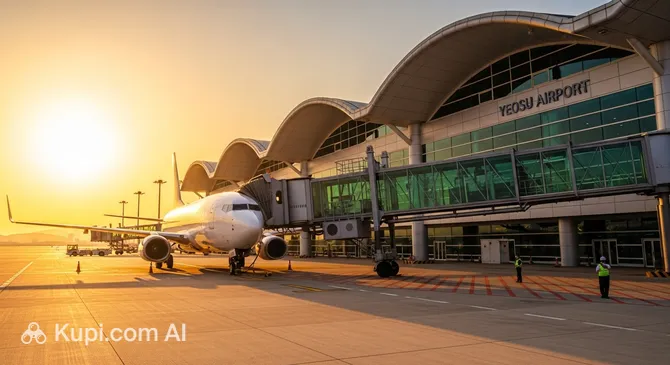
Yeosu Airport (RSU) is a small and modern regional airport characterized by a simple and clear structure. It operates one passenger terminal, serving both domestic departures and arrivals. Such compactness makes it extremely convenient for passengers, eliminating the need for complex movements and long walks.
The terminal layout is intuitive. On the first floor, you will find check-in counters, the baggage claim area for arriving passengers, and exits to the city. Going up to the second floor, you enter the departure zone, where the security checkpoint and boarding gates are located. Thanks to the airport's small size, all key points—from the entrance to the gate—are within walking distance of each other. Navigation is facilitated by clear signs in Korean and English.
Since there is only one terminal in the airport, there are no transfers between zones. The departure zone and arrival zone are clearly separated by floors, which minimizes confusion. After completing check-in on the first floor, passengers immediately proceed to the second floor to pass through security and await their flight. Arriving passengers, having collected their luggage on the first floor, can leave the airport building without delay.
One of the main advantages of Yeosu Airport is the speed of completing all pre-flight procedures. Check-in and security screening usually take no more than 20-30 minutes even during peak hours. Nevertheless, it is recommended to arrive at the airport about an hour to an hour and a half before departure to check in luggage and pass all formalities without haste. This time is more than sufficient for a relaxed wait for boarding in the cozy departure lounge.
No special knowledge is required to navigate the airport—simply follow the signs. The compact size of the terminal makes it ideal for travellers who value their time and dislike the stress associated with huge airport complexes. It is an excellent starting point for exploring the city of Yeosu and its picturesque surroundings.
The history of Yeosu Airport (RSU) is a story of development and transformation, closely linked to the growth of the eponymous city and the entire region. The air harbour was first opened in 1972. Initially, it served to ensure transport accessibility for the large Yeocheon industrial complex and the cities of Yeosu and Suncheon, playing an important role in the economic life of South Korea.
A key moment in the airport's history was the early 2000s. Due to growing passenger traffic and preparations for hosting the World Expo 2012, a decision was made to build a new, more modern terminal. An important fact: the airport was not just reconstructed, but actually moved to a new location. The new Yeosu Airport opened its doors in 2004, offering passengers improved infrastructure and the capability to accept larger aircraft.
The peak of fame for the airport came in 2012, when the city hosted the World Expo. During this period, Yeosu Airport became the main aerial gateway for thousands of international and local visitors, successfully handling the colossal load. This event forever inscribed it in history as an important facility that contributed to the success of one of the most significant international events in the country's history.
Today, Yeosu Airport continues to play a strategic role in the region's transport system. It serves primarily domestic flights, ensuring fast and convenient connections with key cities such as Seoul and Jeju Island. Having journeyed from a modest regional airfield to a modern air harbour, Yeosu Airport has become a symbol of the dynamic development of Korea's southern coast.
Yeosu Airport (RSU), serving the picturesque southern region of South Korea, is a modern and functional terminal. Despite its compact dimensions, it offers passengers all key services for a comfortable start or end to their journey.
Before departure, you can have a snack at a small restaurant or café serving local cuisine, as well as enjoy a coffee. A convenience store operates in the terminal, where you can purchase beverages, light snacks, and souvenirs to remember your trip by.
Throughout the airport, free Wi-Fi is available for passengers, allowing you to stay connected or pass the time online. To charge gadgets, special zones with power outlets and USB ports are provided in the waiting halls. There are no separate VIP lounges in the airport, but the general waiting areas are spacious and comfortable.
For travellers with children, a nursery is equipped where you can take care of your baby in a quiet environment. The airport is fully adapted for passengers with reduced mobility: there are ramps, elevators, and specially equipped restrooms, ensuring a barrier-free environment.
Financial services at the airport are represented by ATMs. It is worth noting that currency exchange may not be available at small domestic airports, so it is better to take care of this in advance. In case of feeling unwell, you can visit the medical point for first aid.
There are no hotels or business centres within the airport building. The nearest hotels are located in the city of Yeosu itself and its surroundings. For business meetings or conferences, it is also recommended to utilize the infrastructure of city hotels.
Yeosu Airport (RSU) is a compact regional aviation hub, so the choice of dining establishments here is quite modest, yet it allows for a comfortable snack before departure. Do not expect a large food court like in major international airports; however, you will not go hungry.
The main dining point is located in the public zone (landside), before passing security control. Usually, this is a small café or restaurant where passengers can drink coffee, tea, soft drinks, and order simple dishes. The menu typically includes sandwiches, pastries, and basic Korean snacks, such as gimbap. This is an ideal place to pass time while waiting for check-in or to meet arriving passengers.
After passing security control, in the "airside" departure zone, the choice is extremely limited. There may be a small kiosk with beverages and snacks or only vending machines. Therefore, if you plan to have a full meal, it is better to do so before passing through the inspection.
Although it is difficult to find the famous dishes of the Jeollanam-do region, for which Yeosu is renowned, inside the airport, pay attention to packaged local delicacies in the shop or café. These could be sweets, seaweed crisps, or other snacks that make for excellent edible souvenirs from South Korea.
Passengers with specific dietary needs (vegetarians, vegans, as well as those looking for halal or gluten-free dishes) will find it difficult to find suitable options. It is recommended to eat beforehand in the city or bring food with you. Prices at the airport are traditionally slightly higher than in the city, and the operating hours of establishments depend directly on the flight schedule—they open before the first departure and close after the last one.
Thus, for a quick snack or a cup of coffee, the café in the main area of the airport is quite suitable. If you are counting on a hearty lunch or dinner, the best solution would be to visit one of the numerous establishments in the city itself before travelling to the airport.
When planning a trip through the airport of Yeosu city in South Korea, use these tips to make your journey as comfortable as possible. Yeosu Airport serves primarily domestic flights, so it is relatively small and easy to navigate. It is recommended to arrive 1.5-2 hours before a domestic flight departure. This time will be sufficient to calmly pass check-in and security control. To save time, check in for your flight online and save the boarding pass on your mobile device.
Passing security control usually does not take much time. To speed up the process, prepare liquids in advance (in containers up to 100 ml, packed in a transparent bag with a volume of up to 1 litre) and remove laptops and other large electronics from your carry-on luggage. It is prohibited to take sharp objects, flammable substances, and weapons in carry-on luggage. When choosing a seat on a plane flying from or to Yeosu, prefer a window seat—you may be treated to scenic views of the rugged coastline and numerous islands.
If you have a connecting flight, pay attention to the following point, especially if you are flying to Yeosu from another country. You will pass all immigration and customs formalities at the first airport of arrival in South Korea (for example, at Incheon in Seoul). After that, your flight to Yeosu will be considered domestic, and upon arrival, you will not need to pass control again. Nevertheless, always check with your airline whether you need to collect and re-check your luggage at the transfer airport.
In case of a flight delay or cancellation, contact your airline's counter first. Its representatives will provide current information and explain your rights, which may include the provision of beverages, meals, or even hotel accommodation depending on the length of the delay. To save money, bring an empty water bottle with you, which can be filled at drinking fountains after passing security control, and consider the possibility of getting to or from the city by public transport—this is often cheaper than a taxi.
Have you reached the end of the page?
So the route has been studied inside and out