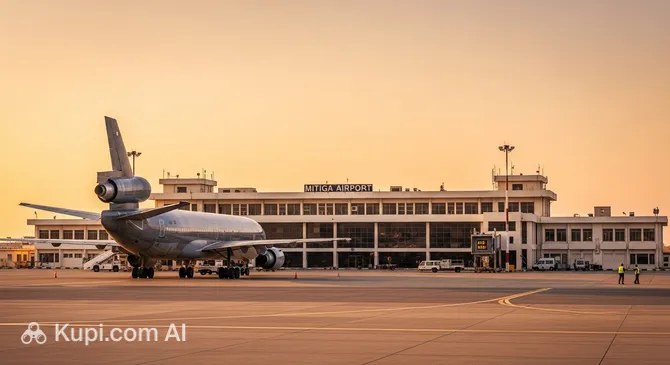
Source: Kupi.com AI
| Characteristic | Value |
|---|---|
| IATA code | MJI |
| ICAO code | HLLM |
| City | Tripoli |
| Country | Libyan Arab Jamahiriya |
| Time zone | Africa/Tripoli |
| Popular airlines | WorldTicket by GO7, UZ, Turkish Airlines, FQ, YL |
| Schedule | Live departures board |
| Characteristic | Value |
|---|---|
| IATA code | MJI |
| ICAO code | HLLM |
| City | Tripoli |
| Country | Libyan Arab Jamahiriya |
| Time zone | Africa/Tripoli |
| Popular airlines | WorldTicket by GO7, UZ, Turkish Airlines, FQ, YL |
| Schedule | Live departures board |
Finding current and verified contact information for Mitiga Airport can be challenging, as official data frequently changes. It is recommended to verify details through your airline before travelling. Below are the most accessible contacts available at the moment.
You can get to Mitiga Airport from the city centre of Tripoli in several ways. The choice of the best option depends on your budget, time, and comfort preferences. The airport is located relatively close to the central part of the capital of Libya, making the journey quick and convenient.
Taxi and Private Transfer — the most popular and reliable way to get to the airport. The journey from the city centre usually takes from 20 to 40 minutes depending on traffic conditions. The estimated cost of the trip is 25-50 Libyan Dinars. It is extremely important to agree on the price with the driver before starting the trip, as not all cars are equipped with meters. For greater peace of mind, you can pre-book a transfer through your hotel. This is a particularly convenient option if you have a lot of luggage.
Car Rental provides maximum freedom of movement if you plan to drive around the city or its surroundings extensively. This option is suitable for experienced drivers who feel confident behind the wheel in local traffic conditions. At Mitiga Airport, there is parking where you can leave a car for both short and long terms. Although renting is more expensive than a single taxi ride, it can be beneficial for longer stays.
Public Transport in the form of buses also circulates around the city, however, for tourists, this method can be difficult. Routes and schedules are not always obvious, and the level of comfort may not be high. This option is the most budget-friendly but requires more time and readiness for the specifics of the local transport system. There are no trains or metro services in Tripoli.
Mitiga International Airport (MJI) is currently the main air gateway for Tripoli and all of Libya. Its structure is quite simple and intuitive for travellers, as the airport consists of one main passenger terminal which serves all international and domestic flights. Such a compact organisation significantly simplifies navigation and minimises the risk of getting lost.
The terminal layout is standard for most small and medium-sized airports. On the ground floor, check-in counters and the arrival area with baggage claim belts are usually located. After check-in, passengers proceed to the upper floor, where passport control and security screening zones leading to the departure hall are situated. Arrival and departure zones are clearly separated, and since everything is in one building, transfers between them are not required.
Registration and screening procedures at Mitiga Airport are standard, but their duration can vary depending on flight volume. It is recommended to arrive at the airport well in advance — at least 3 hours before the departure of an international flight. This will provide a sufficient time buffer to calmly pass all formalities, even in the event of potential queues.
To navigate the terminal, it is sufficient to follow the standard signs in English and Arabic. Given the building's compact dimensions, finding the necessary check-in counter, boarding gate, or baggage claim area will not be difficult. The main tip is simply to follow the step-by-step process: check-in, passport control, security screening, and boarding gate. Airport staff are also ready to assist in case questions arise.
The history of Mitiga International Airport (MJI) in Tripoli is unique and closely intertwined with key events of the 20th century. Its origins lie in military aviation: it was founded in 1923 as the Mellaha Air Base by Italian forces. For nearly two decades, the facility was used exclusively for military purposes.
During World War II, the airfield held strategic importance. In the post-war period, it was transferred to the United States and became known as Wheelus Air Base. During the Cold War era, it was one of the largest and most important US Air Force facilities outside the country, serving as a key logistics and training centre in the Mediterranean.
A significant turn in the airport's history occurred in 1970, when the base was transferred to the control of the government of Libya and renamed Okba Ben Nafi in honour of the Arab general. For a long time, it continued to function as a military facility, this time for the Libyan Air Force.
Its transformation into the capital's main civil airport occurred in recent history. After the main Tripoli International Airport (TIP) ceased handling civil flights, an acute need arose for an alternative air gateway. The Okba Ben Nafi base was reconstructed and modernised to receive passenger aircraft, receiving its modern name — Mitiga International Airport. Today, it functions as the capital's main aviation hub, serving the majority of international and domestic flights.
Mitiga Airport (MJI) offers passengers a range of essential services to make waiting for a flight comfortable. In the terminal, you will find several cafes and snack bars where you can have a bite to eat or drink coffee before departure. Shops are also open, including a Duty Free zone where you can purchase souvenirs, perfumes, and other goods.
For comfortable waiting, the airport provides general lounges as well as a VIP lounge for passengers preferring a higher level of convenience. Access to such lounges is usually available for an additional fee or for business class passengers. Generally, Wi-Fi is available throughout the terminal, and special stations are equipped for charging gadgets.
Currency exchange points and ATMs function at the airport, allowing you to easily resolve financial matters upon arrival or before departure. In case of need, there is a medical point in the terminal building, ready to provide first aid.
For travellers with children, mother and child rooms may be provided. Passengers with reduced mobility are provided with the necessary assistance during boarding and disembarking, and the airport infrastructure is adapted to their needs. It is recommended to notify the airline in advance regarding the need for special assistance.
Although there are no hotels directly on the premises of Mitiga Airport, various accommodation options can easily be found in the nearby city of Tripoli. Specialised business centres or conference rooms within the airport itself are generally absent, so for business meetings, it is better to use the infrastructure of city hotels.
At Mitiga International Airport (MJI), passengers have access to basic dining options that help pass the time comfortably while waiting for a flight. The selection of establishments here is not as extensive as in major international hubs, but it is quite sufficient for a snack or a coffee. These are mainly small cafes and snack bars offering simple and familiar food.
Most establishments are located in the public zone (landside), before passing passport control. Here you can find cafes serving sandwiches, pastries, and beverages. After passing security control, in the departure zone (airside), the choice is usually more limited, but generally, there is at least one point where you can buy water, coffee, and light snacks. If you are looking for an opportunity to try something local, pay attention to traditional Libyan tea with mint or strong coffee — this is a great way to experience the local culture of hospitality. For a quick snack, sandwiches or local pastries are suitable, and for a more substantial wait, you can settle into one of the cafes in the main hall.
Regarding special dietary needs, it is important to note that most dishes comply with Halal standards. However, finding vegetarian, vegan, or gluten-free options may be difficult. It is recommended to arrange suitable snacks in advance if you have strict dietary restrictions. Prices at the airport are generally moderate. The opening hours of establishments are mostly tied to the flight schedule, especially in the departure zone, so they are open to serve passengers of departing and arriving aircraft.
Travelling through Mitiga Airport in Tripoli, the capital of Libya, will be easier and more comfortable if you follow a few useful tips. Knowing the basic rules and procedures will help you avoid stress and save time.
Arrival time at the airport. To avoid rushing, arrive at the airport well in advance. For international flights, it is recommended to arrive at least 2.5-3 hours before departure, and for domestic flights, 1.5-2 hours will be sufficient. This buffer will allow you to calmly pass all stages of check-in and control.
Check-in and Screening. Prepare all necessary documents in advance: passport, visa (if required), and ticket. Complete online check-in if your airline provides such an option. During security screening, be ready to remove electronic devices and containers with liquids from your hand luggage for separate inspection. This is a standard procedure that speeds up the process for all passengers.
Seat Selection. If you wish to choose a specific seat, do so during ticket purchase or online check-in. Window seats (window seat) are ideal for those who love watching take-offs and landings, while aisle seats (aisle seat) provide more freedom to move around the cabin.
Hand Luggage Rules. Always pack your most valuable items in your hand luggage: documents, money, electronics, jewellery, and necessary medication. Remember the universal rule for liquids: the volume of each container must not exceed 100 ml, and all of them must be packed in one transparent bag. Sharp and cutting objects must be checked in with your luggage.
Tips for Transfer Passengers. If you have a connecting flight, check with the airline in advance whether your luggage will be automatically transferred to the next flight or if you need to collect it and check it in again. Leave a sufficient time interval between flights — at least 1.5-2 hours.
Customs Control. When entering or leaving the country, be prepared to present your passport and possibly answer questions from a customs officer regarding the purpose of your trip. If you are carrying goods subject to declaration, fill out the appropriate form in advance to speed up the process.
How to Save Time and Money. Use online check-in to avoid standing in line at the counter. Take an empty water bottle with you, which can be filled after passing security, and light snacks — this will help avoid extra expenses at airport cafes.
What to Do in Case of Flight Delay. In the event of a flight delay or cancellation, immediately contact a representative of your airline. Depending on the length of the delay, you may be entitled to drinks, meals, and in some cases — hotel accommodation. Remain calm and check information at the air carrier's counter or on the departure boards.

Reached the bottom of the page?
Looks like you know this route inside out
We use cookies and services to collect user information. This is essential for the functioning of the site and for marketing purposes. You can find out more in .
Where travelers fly most — pick a route and check prices