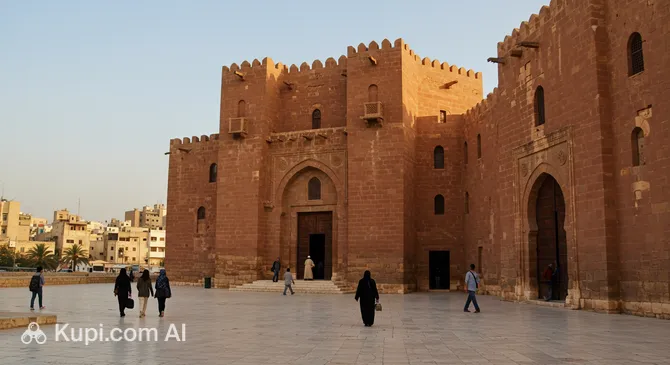
On the picturesque waterfront of Tripoli rises a majestic citadel—the Red Castle Museum, also known as Assaraya Al-Hamra. This historic fortress is the main symbol of the Libyan capital and its most important cultural center. The castle earned its recognizable name from the characteristic red-ochre color of its walls, painted back at the beginning of the 16th century.
Red Castle Museum. Illustration.
Source: Kupi.com AI
Traveler photos:
Today, it is the largest museum in Libya, covering an area of approximately 10,000 square meters. Its halls house a unique collection spanning a colossal timeframe: from prehistoric rock art to Islamic era artifacts. The fortress literally stands on history—it was built upon the foundations of ancient Roman structures.
Strolling along the massive 21-meter-high walls, guests can see rare ancient statues, mosaics, and coins. The Red Castle Museum is not just a collection of antiquities but a true architectural labyrinth, where every level reveals a new page in the region's rich past.
Contacts
For the latest information regarding special exhibitions or group tours, you can use the museum's official communication channels.
The main impression of visiting the museum is a grand journey through the centuries. In 47 galleries spread across four floors, you can see extremely rare artifacts. On the first level, mysterious rock paintings and ancient Berber ceramics await you. Moving higher, you enter the world of antiquity: treasures from the legendary Leptis Magna are on display here, including exquisite Roman glass, marble statues, and intricately detailed mosaics.
Be sure to pay attention to the fortress's architecture itself. Pass under the monumental arches of the St. James Bastion and observe the St. George and Santa Barbara towers, which give the castle its rugged medieval appearance. For those who want to dive deeper into the details, hiring a guide is recommended—their stories help bring the history of each exhibit to life.
After exploring the indoor galleries, it is pleasant to stroll around the grounds. From the top of the walls, a panoramic view opens up over the Port of Tripoli and Saraya Lake. You can finish your visit with a walk through the nearby Souq al-Mushir district, where the rhythm of the modern city meets ancient traditions.
Getting There
The Red Castle Museum occupies a dominant position in the very heart of the capital. It is located on the waterfront, right by Martyrs' Square. If you are staying in the historic center, you can reach the fortress on foot by strolling through the colorful streets of the old city (Ghadames Medina) or along Omar Mukhtar and Al-Fateh avenues.
For those traveling from more distant parts of the city or from the airport, the most convenient way is by taxi. Use "Assaraya Al-Hamra" or the Central Bank of Libya as a landmark for the driver. The castle is impossible to miss—its massive red walls tower over the surroundings.
If you plan to arrive by rental car, parking spaces can usually be found along the coastal Al-Shatt Road. From there, you can enjoy a beautiful view of Saraya Lake and the port, and the castle itself is just a couple of minutes' walk away.
Nearest city: Tripoli
History & Facts
The history of this site is rooted in deep antiquity. It is believed that the Red Castle was built on the ruins of a monumental Roman building, possibly a temple or baths, as evidenced by the ancient columns and capitals from the 1st–2nd centuries found here. During the Byzantine era, the fortress already served as a powerful defensive hub, which Arabs under the leadership of Amr ibn al-As besieged for an entire month in 642.
The citadel began to take on its characteristic appearance and the name "Red Castle" (Assaraya Al-Hamra) in the 16th century. After capturing the city in 1510, the Spaniards painted the walls with ochre and significantly reinforced the fortifications, building the St. George Bastion. Later, the Knights Hospitaller added the Santa Barbara northeast tower to the complex.
The Ottoman period transformed the castle into a luxurious residence for the pashas. Under the Karamanli dynasty, it became a true "city within a city": it housed not only grand reception halls and a court but also its own mint, pharmacy, prisons, and even mills. The castle acquired its modern appearance with elegant medieval-style arches in the 1920s, thanks to a reconstruction by Italian architect Armando Brasini.
Time Needed
To leisurely explore the extensive collection housed in 47 galleries, visitors are recommended to set aside 2 to 3 hours. This is enough time to walk through all four levels of the museum and appreciate the architectural details of the fortress itself.
If you plan to use a guide's services for a detailed study of prehistoric or Roman artifacts, your visit time may increase slightly. It is also worth leaving some time for a stroll along Saraya Lake, which separates the castle from the sea.
Working Hours
According to available data, the museum is accessible for viewing 24/7, seven days a week. This allows tourists to plan their visit at any convenient time, whether early morning or evening hours when the lighting gives the fortress walls a special mysterious aura.
However, before visiting, we strongly recommend checking the museum's official website or verifying information on-site, as the operating schedule for individual exhibitions and galleries within the castle may vary.
Open 24 hours
Nearby
Its location in the historic center makes a visit to the museum an ideal starting point for further exploration of the Libyan capital's culture and architecture. Exploring the surrounding streets will allow you to feel the atmosphere of the old city more deeply and see how different eras intertwine.