Support

Macau International Airport

About the Airport

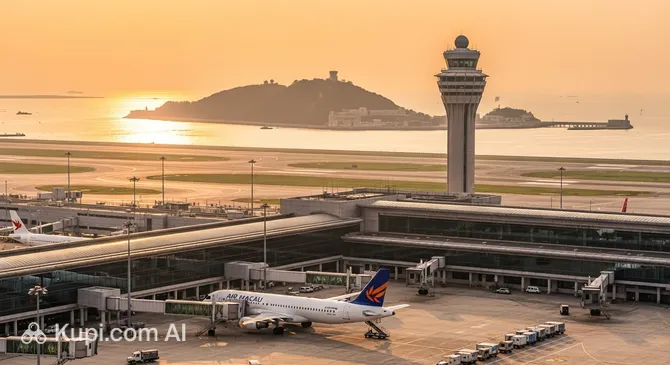
Macau International Airport. Illustration.
Source: Kupi.com AI

Macau International Airport is a true masterpiece of engineering, where the runway seems to float above the waters of the South China Sea on an artificial island. This compact yet modern aviation hub serves as the main aerial gateway to the "Las Vegas of Asia," offering travelers breathtaking views upon landing. Despite its modest size, the airport is distinguished by high technology and provides almost instant access to the luxury hotels and entertainment complexes of the Cotai district.

PropertyValue
IATA CodeMFM
ICAO CodeVMMC
CityMacau
CountryMacau
TimezoneAsia/Macau
Top AirlinesChina Eastern, STARLUX AIRLINES, Air Macau, AirAsia, Korean Air
ScheduleOnline Timetable

Features and Advantages of the Airport

Macau International Airport is valued by tourists for its incredibly convenient logistics. Unlike giant hubs, all procedures here are completed quickly, and walking distances within the terminal are minimal.

  • Unique Location: The runway is located on reclaimed land in the sea and is connected to the apron by two taxiway bridges. This creates the sensation that the plane is landing directly on the water.
  • Free Transport: One of the main "perks" for tourists is the availability of free shuttles from major hotels and resorts (Venetian, Galaxy, MGM, and others), which await passengers right at the terminal exit.
  • Multimodality: The airport is located in immediate proximity to the Taipa Ferry Terminal, allowing for an easy transfer to a ferry to Hong Kong or Shenzhen. The airport is also connected to the city by the Light Rapid Transit (LRT) line.
  • Compactness: Thanks to its small size, the journey from the aircraft steps to the airport exit, including border control and baggage claim, often takes no more than 20–30 minutes.

Contact Information

If you need to contact representatives of Macau International Airport, you can use the following contact details:

  • Official Website: www.macau-airport.com. The site provides the most up-to-date information on flights, services, and airport regulations.
  • Inquiry Service Phone: +853 2886 1111 (24 hours).
  • Address: Airport of Macau, Pac On, Taipa, Macau.
  • Lost & Found Information: For items lost within the terminal building, please contact the special department at +853 8898 2132. If your luggage was lost during the flight, you must contact your airline's representative directly.
  • Email: For general inquiries, it is recommended to use the contact form on the official airport website.
  • Social Media: Follow airport news and updates on its official social media pages, including Facebook and WeChat.

How to Get to the Airport

Macau International Airport (MFM) is conveniently located on Taipa Island, making it easily accessible from any part of the Special Administrative Region of Macau. You can reach the terminal in several ways, from budget buses to comfortable taxis and modern LRT trains. The choice of the best option depends on your budget, amount of luggage, and hotel location.

Public Transport is the most economical way to travel. Several city bus routes (e.g., AP1, AP1X, 26, 36, 51A, MT1) connect the airport with the Macau peninsula, Taipa Island, and the Coloane district. The fare typically does not exceed 6 Patacas (MOP). It is also worth noting the Light Rapid Transit (LRT) system. The "Airport" station on the Taipa line directly connects the terminal with the Cotai border crossing and major hotel complexes, offering a fast and modern route.

Many major hotels and resorts provide free shuttle buses for their guests. This is one of the most convenient and popular ways to get to or from the airport. Buses run at regular intervals throughout the day. We recommend checking the schedule and the shuttle stop location at the airport on your hotel's website in advance.

Taxi is a fast and comfortable option, especially if you have a lot of luggage or are traveling with family. A trip from the historic center to the airport will take approximately 20–30 minutes depending on traffic conditions and will cost on average 80–120 Patacas. All cars operate by meter; a small surcharge may apply for crossing bridges and placing luggage in the trunk.

For those who prefer maximum freedom of movement, car rental is available. However, please note that traffic in Macau is quite dense, and parking in the city can be difficult. Paid parking is available directly at the airport, where you can leave a car for both short and long terms, which is convenient for departing locals and tourists traveling around the region by car.

Thanks to a developed transport network, it is easy to reach other major hubs in the region from Macau. For example, Hong Kong International Airport can be reached by bus via the Hong Kong-Zhuhai-Macau Bridge or by high-speed ferry. Nearby, on the mainland, is Zhuhai Jinwan Airport, and the airports of Shenzhen and Guangzhou are within a few hours' drive.

Terminals and Map

Macau International Airport (MFM) is distinguished by a structure that is well-thought-out and convenient for passengers. In fact, the airport consists of one main passenger terminal, which serves all international and regional flights. This makes navigation intuitive and fast, saving travelers from the need to move between different buildings.

The terminal itself is a multi-level building. Typically, the Departures area is located on the upper floors, and the Arrivals area is on the lower floor, which is a standard and logical scheme for most airports in the world. Signs are in three languages — Chinese, Portuguese, and English — which significantly facilitates orientation. Due to its relative compactness compared to the giant air transport hubs of the region, getting lost in Macau Airport is quite difficult.

Since all operations are concentrated in one terminal, transfers between gates or from the arrivals area to the departures area for transit passengers cause no difficulties. Everything is within walking distance. Check-in, passport control, and security screening procedures are organized efficiently. Nevertheless, it is recommended to arrive at the airport in advance: 2-2.5 hours before the departure of international flights. During peak hours or tourist seasons, waiting times may increase, so extra time will not be amiss.

For comfortable navigation, simply follow the signs to your boarding gate. Gate numbers are clearly marked, and information boards are regularly updated. The main advice is to check your gate number and the approximate walking time to it immediately after passing check-in and passport control, so you can enjoy your time in the waiting area, where shops and cafes are located, without rushing.

Airport History

The history of Macau International Airport (MFM) is a story of ambition and unique engineering solutions. The airport was officially opened in November 1995, becoming a landmark project that gave Macau direct access to international air travel. Until that moment, the region relied heavily on ferry and helicopter connections with neighboring Hong Kong, which limited its tourism and economic potential. The construction of its own airport was a strategic step towards greater autonomy and development.

The main feature and source of pride for the airport is its runway. It was built on an artificial island reclaimed from the sea and connects to the main terminal on Taipa Island via two taxiway bridges. This was a bold and innovative solution dictated by the shortage of available land in densely populated Macau. This fact alone makes MFM one of the most interesting airports in the world in terms of design and construction.

Since its opening, the airport has gone through several stages of development. Particularly rapid growth began in the early 2000s, closely linked to the liberalization of the gaming and entertainment industry and Macau's transformation into a world capital of leisure. MFM became a key hub for many low-cost airlines, such as AirAsia, making travel to the region more accessible for millions of tourists. The passenger terminal has been repeatedly expanded and modernized to cope with the constantly growing flow of passengers and to meet modern standards of comfort and safety.

Throughout its history, the airport has not set global records for passenger traffic, but its main achievement is the role it played in transforming Macau's economy and image. It became a symbol of a new era for the region, opening it to the world and turning it into one of Asia's most popular tourist destinations. Today, MFM continues to remain a vital transport hub serving millions of passengers a year and making an invaluable contribution to Macau's prosperity.

Services and Amenities

Macau International Airport (MFM) offers passengers a wide range of services to make waiting for a flight as comfortable as possible. In the terminal, you will find various dining spots: from restaurants offering Asian cuisine to international fast-food chains and cozy coffee shops. For shopping enthusiasts, there are Duty Free shops where you can purchase perfumes, cosmetics, tobacco products, alcoholic beverages, as well as souvenirs and goods from famous brands.

For those who prefer to await their flight in a calmer atmosphere, the airport features a VIP lounge (Plaza Premium Lounge), available to passengers of all airlines for an additional fee. Free Wi-Fi is available throughout the terminal, and numerous charging stations for gadgets will allow you to stay connected at all times.

Financial matters can be handled at bank branches and currency exchange points. ATMs are also installed in the airport and are available 24/7. In case of necessity, passengers can seek first aid at the medical point located in the terminal building.

The airport cares for the comfort of all categories of travelers. Mother and child rooms are equipped for passengers with children. Passengers with reduced mobility can request special assistance in advance, as well as use ramps and specially equipped restrooms.

Although there are no hotels directly on the airport premises, large hotel complexes offering comfortable accommodation are located just a few minutes' drive away. For business travelers, basic business services, such as access to computers and office equipment, are usually provided in the VIP lounges.

Where to Eat

At Macau International Airport (MFM), travelers will find diverse dining options capable of satisfying any taste and budget — from a quick snack on the run to a full meal while waiting for a flight. The main establishments are concentrated in the departures area, but there are also places to grab a bite in the public area of the airport.

In the public area (landside), before passing passport control and security, the choice is usually limited to coffee shops and small eateries. This is a convenient option if you arrived at the airport early or are meeting someone. Here you can have a coffee and eat a sandwich or pastry.

The main food court and most restaurants are located in the departures area (airside), after passing security control. A wide selection of establishments is presented here: from restaurants offering Asian cuisine (Chinese, Malay) to familiar international fast-food chains. This is the best place for a leisurely lunch or dinner before departure.

Do not miss the opportunity to try local delicacies. Even at the airport, you can find the famous Portuguese egg tarts, Pastel de Nata, which have become a symbol of Macau. Also, look for establishments offering pork chop buns — another popular local street food. This is a great way to enjoy the flavors of the region right until the end of your trip.

Regarding special dietary needs, vegetarian dishes can be found in most Asian cuisine establishments and international chains. However, finding options with stricter requirements, such as vegan, gluten-free, or Halal dishes, may be challenging. It is recommended to study the menu carefully or check directly with restaurant staff to clarify the ingredients of the dishes.

The opening hours of most cafes and restaurants in the departures area are synchronized with the flight schedule; they open early in the morning and work until late at night. Prices at the airport are generally higher than in the city but remain at an average level for airports. Coffee shops and bakeries are ideal for a quick snack, while for a full meal, head to the food court, where everyone will find something to their taste.

Travel Tips

To ensure your journey through Macau International Airport goes as smoothly as possible, use these proven tips. The airport is modern and well-organized, but knowing some nuances will help save time and money.

Currency and Transport upon Arrival. The official currency is the Macau Pataca (MOP), however, Hong Kong Dollars (HKD) are accepted almost everywhere at a 1:1 rate. In the arrivals hall, you will find ATMs and currency exchange points. One of the best features of Macau is the free shuttle buses from major hotels and casinos. Their stops are located in the parking lot at the northern exit of the terminal. Even if you are not staying at one of these hotels, you can take a shuttle to the desired district and save on taxi fare.

Passing Control and Hand Luggage. At security screening, be ready to present your boarding pass and passport. Liquids in hand luggage must be in containers of no more than 100 ml and packed in a transparent bag. Electronics, such as laptops and power banks, must be placed in a separate tray. Please note that Macau may have strict rules regarding the transport of power banks — their capacity must be clearly indicated on the device body.

Seat Selection and Customs. If you have a short flight, a window seat will offer beautiful views during takeoff and landing. For long flights, an aisle seat is more convenient — this way you can stand up without disturbing your neighbors. Upon arrival in Macau, follow the signs to customs control. If you have no goods to declare, feel free to go through the "Green Channel". Large sums of cash and expensive goods are subject to declaration.

For Transit Passengers. Macau International Airport is quite compact, making transfers convenient. You will have access to duty-free shops, various cafes, and rest zones. If the time between flights permits, you can use the services of business lounges for a more comfortable wait.

In Case of Flight Delay. If your flight is delayed, first contact your airline representative for information and possible vouchers for food or accommodation. Follow updates on the departure boards and in the airline's app. Keep all receipts for expenses incurred due to the delay — they may be needed to claim compensation.

Reached the end of the page?

That means the route is fully explored