Support

Bakalalan

About the Airport

Bakalalan Airport is not merely a runway, but the aerial gateway to the very heart of the Borneo highlands in Malaysia. Situated in a picturesque valley, it serves as a vital artery connecting this remote community with the rest of the world. Landing here marks the beginning of an adventure where, instead of the hustle of megacities, you are greeted by emerald hills and the crystal-clear air of a region renowned for its organic produce and unique culture.
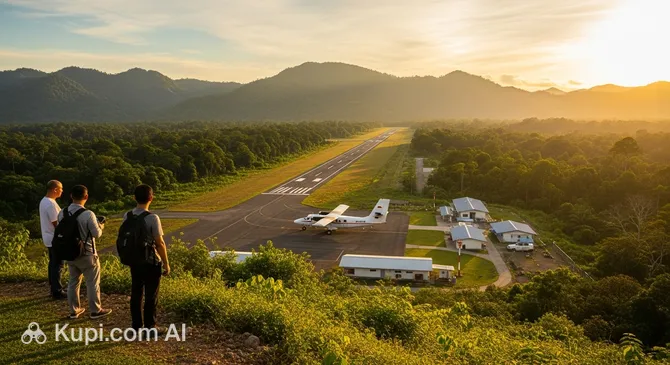
Bakalalan. Illustration.
Source: Kupi.com AI
PropertyValue
IATA CodeBKM
ICAO CodeWBGQ
CityBakalalan
CountryMalaysia
TimezoneAsia/Kuching
Top AirlinesMalaysia Airline
ScheduleOnline Timetable

The main feature of Bakalalan Airport is its status as a STOLport (Short Take-Off and Landing), meaning it is designed to accommodate aircraft capable of short take-offs and landings. Flights here are typically operated by small turboprop aircraft, such as the DHC-6 Twin Otter, which in itself turns the flight into a breathtaking panoramic journey over jungles and mountains.

Do not expect standard infrastructure from this airport. The terminal here is very simple, consisting of a small building where everything happens in a homely atmosphere without any rush. Its primary merit lies not in amenities, but in its critical role for the local population and tourists. For the Lun Bawang community, it is the only fast link to major cities, and for travellers, it is the starting point for trekking in Pulong Tau National Park and experiencing the distinctive life of the Borneo highlands.

Contact Information

Bakalalan Airport (BKM) is a small short take-off and landing airport (STOLport) serving primarily local flights. Due to its size and specific operations, most standard contact details found at major airports are not available. Communication with passengers and query processing are generally handled through the airline.

  • Official Airport Website: Bakalalan Airport does not have its own official website. Up-to-date information on schedules and flights should be sought on the website of MASwings, the airline operating flights to this region, or on the Malaysia Airports management company portal.
  • Information Desk Phone: The airport does not have a direct public telephone line. For all questions related to flights, it is recommended to contact the carrier airline's call centre directly.
  • Airport Address: Bakalalan, 98700, Sarawak, Malaysia.
  • Email: There is no dedicated email address for passengers.
  • Airport Social Media: The airport does not have official pages on social media networks.
  • Lost Luggage Information: All issues related to lost or damaged luggage are handled by the airline you flew with. Please contact the carrier's representatives.
  • Passenger Support Contacts: Passenger support is provided through service centres and representatives of the airline operating your flight.

How to Get to the Airport

Getting to Bakalalan Airport (BKM) is quite simple, as it is located in the immediate vicinity of the Bakalalan settlement itself. However, given its remote location in the highlands of Sarawak in Malaysia, transport options are specific and require advance planning.

Taxis and Transfers. There are no traditional taxi services with meters here. Transport connections are provided by local residents using four-wheel-drive vehicles (4x4). The most reliable method is to arrange a transfer in advance through your hotel, guesthouse, or tour operator. The journey from the settlement centre to the airport takes just 5-10 minutes. The cost is usually agreed upon beforehand and may be included in your accommodation package or paid separately to the driver.

Public Transport. There are no regular city buses, trains, or metro services in Bakalalan. The only mode of transport that could conditionally be called public is shared off-road vehicles plying between key points. However, relying on them for timely arrival at the airport is not advisable. For trips to the airport, it is recommended to use a pre-booked private transfer.

Car Rental and Parking. It is impossible to rent a car directly in Bakalalan. Travellers usually arrive here in an off-road vehicle rented in major cities (such as Miri or Lawas). If you are travelling in your own or a rented vehicle, you can leave it at the airport. Parking consists of a small, typically free area next to the terminal building.

Key Recommendations. The main advice for travellers is to always book transport in advance. Contact your place of accommodation before arrival to organise a meeting at the airport. This ensures a comfortable and hassle-free start to your adventure in the highlands. Given the condition of local roads, the only suitable type of transport is a four-wheel-drive vehicle.

It is worth noting that there are other small air harbours in this region, such as Bario Airport and Lawas Airport. Movement between them and other settlements is also carried out primarily via pre-booked off-road vehicles or through infrequent local flights.

Terminals and Map

Bakalalan Airport (BKM) is a very small regional airfield serving domestic flights, primarily to the cities of Miri and Lawas. Its infrastructure is simple and functional, corresponding to the low passenger flow and the type of aircraft received (small propeller planes). Travellers should not expect a complex layout or large terminals here, as seen in international airports.

The airport structure is extremely simple: it consists of one small terminal. This single building serves both departing and arriving passengers. Due to its compact size, it is impossible to get lost here. All key zones—the check-in counter, waiting area, and boarding gate—are located in one common hall or adjacent rooms, literally a few steps away from each other.

Departure and arrival zones are not effectively separated into large halls. Arriving passengers enter the building directly from the airfield and immediately find themselves in the baggage claim area (if applicable). For departing passengers, there are one or two check-in counters, after which they proceed to a small waiting area before boarding. There are no transfers between terminals, as there is only one terminal.

Check-in and security procedures at Bakalalan Airport are very fast thanks to the small number of flights and passengers. Typically, all formalities take no more than 15-20 minutes. Nevertheless, it is recommended to arrive at the airport approximately one hour before departure to go through all stages without rushing. The main navigation tip is simple: everything is within sight, so orienting yourself here is extremely easy.

Airport History

The history of Bakalalan Airport (BKM) is not a tale of giant terminals and international flights, but a story of survival and connection with the outside world for one of the most remote corners of Malaysia. The airport emerged not as a commercial project, but as a strategic necessity. Its early history is closely linked to the Indonesia–Malaysia confrontation in the 1960s. At that time, a simple airstrip was created here to supply the military and border scouts defending the frontier.

After the conflict ended, the airport did not lose its significance but shifted its mission from military to civil. For decades, it remained a modest airstrip (often unpaved), designed for Short Take-Off and Landing (STOL) aircraft. Its main task became ensuring connectivity for the local Lun Bawang people, delivering mail, medicines, and essential goods, as well as evacuating the sick.

Significant modernisation of the airport took place in the early 2010s. Under a government programme for rural aviation development, the runway was lengthened and paved with asphalt. A new small terminal was also built to replace the old dilapidated structure. These improvements allowed for the reception of turboprop aircraft, such as the DHC-6 Twin Otter, on a more regular and safe basis, significantly increasing the reliability of air connections.

Today, Bakalalan Airport cannot boast passenger traffic records, but its main achievement is far more important—it is a "lifeline" for the entire region. An interesting fact: it is thanks to this small airport that unique local products became known nationwide—Bakalalan apples and award-winning organic rice. The airport allows farmers to deliver their harvest to markets, thereby supporting the local economy and preserving the unique way of life in the highlands.

Services and Facilities

Bakalalan Airport (BKM) is a very small rural airfield (STOLport) serving remote highland areas of Malaysia. Its infrastructure is minimal and designed to fulfil its primary function—ensuring air transport. Passengers departing from Bakalalan or arriving here should note that the range of services differs significantly from major airports.

The terminal infrastructure is extremely simple. There are no restaurants, cafes, or shops in the conventional sense. Occasionally, a small kiosk with basic snacks and drinks may be open, but it is better to bring everything you need with you. VIP lounges, business centres, and conference rooms are absent from the airport. The waiting area is shared by all passengers.

Technical amenities are also limited. Wi-Fi access is not provided, and the number of power outlets for charging electronic devices is minimal or may be non-existent. It is recommended to carry a portable power bank. Banking services, ATMs, and currency exchange points are not available within the airport grounds—all financial matters should be settled in advance in larger cities.

Specialised services, such as medical points or mother and child rooms, are not provided. Passengers with reduced mobility should coordinate necessary assistance with the airline in advance, as special equipment is not available at the airport. There are no hotels directly at the airport, however, in the village of Bakalalan itself, located nearby, there are several guesthouses and homestays.

Where to Eat

When planning a trip through Bakalalan Airport (BKM), it is important to understand its specific nature. This is a very small airport (also known as a STOLport) serving short flights to remote districts of Sarawak state. Due to its size and purpose, passenger infrastructure here is extremely limited.

Within the Bakalalan Airport premises, restaurants, cafes, beverage outlets, or any other dining establishments are completely absent. There are no fast-food counters for a quick snack, nor places for a full meal. Consequently, finding options for vegetarians, vegans, or people with food allergies directly in the terminal building is impossible.

We strongly recommend all passengers arrange for food and drinks in advance. It is best to eat before travelling to the airport or bring a sufficient supply of water and snacks. This is particularly important if you are travelling with children or follow a strict diet.

Some limited opportunities to purchase food may exist in the town of Bakalalan itself, but do not count on a large selection. Simple local snacks or drinks can be found in small shops, but their range and opening hours can be unpredictable. Therefore, the most reliable option is to have everything you need with you.

Traveller Tips

Travelling through a small regional airport, such as the one in Bakalalan, has its own specifics. Here are a few tips to help make your trip as comfortable and predictable as possible when travelling around Malaysia.

Arrival at the Airport and Check-in: Despite the modest size of the terminal, it is recommended to arrive at the airport approximately 1.5-2 hours before departure. Flights from here are infrequent, and schedules may change. The check-in and security screening process usually proceeds quickly, but it is better to have a time buffer. If possible, complete online check-in in advance to save time.

Seat Selection and Hand Luggage: Flights to and from Bakalalan are often operated by small propeller planes. If you have the opportunity to select a seat, sit by the window—on the approach to the airport, stunning views of the Kelabit Highlands open up. Standard hand luggage rules apply here too: liquids up to 100 ml, no sharp objects. Be sure to bring a power bank, as charging opportunities in the terminal may be limited.

Customs Control and Transfers: Bakalalan Airport serves exclusively domestic flights, so there is no international customs control here. Passengers will only undergo standard security screening. Most transfers are routed through larger airports, such as Miri. Allow sufficient time between flights (at least 2-3 hours) to calmly go through all procedures at the transit airport.

Savings and Flight Delays: To save money, book tickets in advance and consider travelling light without checked luggage. Bring water and light snacks with you, as the selection at the airport may be very limited. Be prepared for possible flight delays or cancellations, especially due to weather conditions, which change rapidly in the mountainous terrain. Keep your airline's contact details at hand, have a small supply of cash, and a book or downloaded films in case of a wait.

Reached the end of the page?

That means the route is fully explored