Balandougou is a fascinating corner of Mali, located in the western part of the country within the Koulikoro Region. The town is situated in a picturesque area near the border with Guinea, which adds a unique character to its atmosphere: here, the traditions of various West African ethnic groups intertwine. According to statistics, the population of the city is approximately 1.6 million people, making it a significant, though not the most widely known, center for mainstream tourism.
Balandougou's geographical position near the rolling foothills and fertile lands of the Koulikoro Region creates unique conditions for experiencing the authentic Malian way of life. Here, you can feel the true rhythm of the African province, where time flows more slowly and the hospitality of the locals knows no bounds.
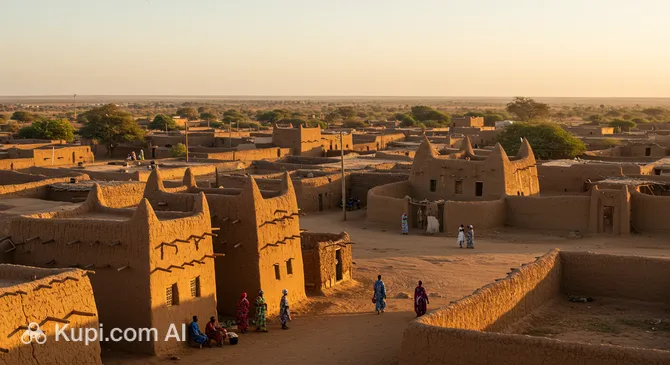
Balandougou. Illustration.
Source: Kupi.com AI
Visiting this region will be a true discovery for those seeking uncharted paths and wanting to touch a living cultural heritage. Balandougou attracts visitors with its sincerity, bustling local markets, and proximity to the natural beauties of western Mali. We invite you to embark on this journey to see Mali from a new, less formal perspective.
Weather Overview
The climate in Balandougou is typical for the tropical savanna of West Africa. Two seasons are clearly defined here: dry and rainy. The hottest period is spring, when in April and May, the thermometer can rise to 41–42°C. During this time, humidity is low, and the sun shines very intensely.
The rainy season usually begins in June and peaks in August, when up to 278 mm of precipitation falls. During this period, nature comes to life, turning green, and the average air temperature drops to a comfortable 26–27°C. However, it should be noted that in July and August, there can be more than 20 rainy days per month, which makes traveling on dirt roads difficult.
The best time to visit Balandougou is from November to February. During this period, the weather is dry and moderately warm, with daytime temperatures around 30–35°C and cool nights (down to 18–19°C). This is an ideal time for long walks and exploring the region's attractions without the exhausting heat.
Average monthly temperature
Average monthly precipitation
Interesting Facts
Strategic Location: The town of Balandougou is located just 20 kilometers from the border with Guinea, making it an important point for cross-border trade and cultural exchange.
Regional Center: Despite being little known outside the country, Balandougou is part of the Koulikoro Region, which historically served as the core of ancient African empires.
Ethnic Diversity: Due to its proximity to the border, one can hear not only the main languages of Mali but also dialects of neighboring Guinean peoples, creating a unique linguistic landscape.
Agricultural Traditions: The surroundings of Balandougou are famous for their farmland, where crops characteristic of the tropical belt of West Africa are grown.
How to Get There
Getting to Balandougou is a task for true explorers. The country's main transport hub is Bamako, from where overland routes lead toward Balandougou. There are no direct regular flights to the city itself, so travelers usually use a combination of a flight to the capital and a subsequent trip by bus or private transport.
Road conditions in this part of Mali depend on the season: during the dry period, roads are quite passable for ordinary cars, but during the rainy season, the journey may take longer. For travel between towns, bush taxis (sept-place) are often used — a popular form of transport in West Africa that allows you to reach even the most remote settlements.
Railway service in Mali is currently limited, so most of the load falls on road transport. If you are planning a trip from neighboring Guinea, entry through border points located in the immediate vicinity of Balandougou is possible, but be sure to check current visa rules and border operating hours in advance.
Main Attractions
Since Balandougou is not a typical tourist hub, its main charms lie in its authenticity and the everyday life of the town. One of the most vibrant features is the local markets, where life bustles from early morning. Here, you can not only buy fresh tropical fruits and spices but also watch local artisans at work, creating leather and wood products using ancient techniques.
The town's surroundings will delight nature lovers. Its proximity to the Guinean border provides access to picturesque landscapes: low mountains and green plains that are especially transformed after the rainy season. Walks through the adjacent rural areas allow you to see traditional Malian settlements and get acquainted with unique adobe (mudbrick) architecture.
While the town lacks world-famous monuments, the very spirit of Western Mali and the opportunity to witness traditional festivals and dance rituals make Balandougou interesting for the sophisticated traveler. This is a place for those who appreciate ethnographic tourism and the chance to see Africa in its natural state.
Local Cuisine
Balandougou's cuisine is classic West African, where rice, millet, and peanuts play the leading roles. You should definitely try Maafe — a hearty meat or fish stew in a thick peanut sauce, served with rice. Also popular is Tô — a dense porridge made from corn or millet flour, eaten with various vegetable sauces, often based on baobab leaves or okra.
Street food in Balandougou deserves special attention. In the markets and along the roads, you can find vendors offering fried plantains, "suya" beef or chicken kebabs generously sprinkled with spices, and freshly baked flatbreads. The local gastro-scene is very accessible and focused on natural products.
Among drinks, non-alcoholic refreshing infusions are favorites. Try bissap juice made from hibiscus flowers or a pungent ginger drink, which is excellent for quenching thirst on a hot afternoon. Alcohol can be found in the city, but due to cultural characteristics, it is not widely represented; most often it is local or imported beer in specialized establishments.
Travel Tips
Balandougou is a place for those ready for a real adventure. To make your trip comfortable and safe, we have prepared some practical tips.
Clothing and Essentials: Choose light clothing made of natural fabrics (cotton, linen), as it is very hot in the region. Don't forget a hat and sunglasses. For visiting local communities, it is better to choose modest clothing that respects local traditions.
Transport: The most efficient way to get around is by moto-taxi. Always agree on the price before the start of the trip. For longer excursions, rent an SUV.
Finances: The official currency is the CFA franc (XOF). Cards are accepted almost nowhere, so always have a sufficient supply of cash with you. ATMs are only available in major centers.
Health and Safety: Be sure to use only bottled water, even for brushing your teeth. It is recommended to carry insect repellents and a first-aid kit with basic medications. Check that you have a yellow fever vaccination.
Communication: The official language is French, but many speak Bambara. Learn a few greeting phrases — this makes a very good impression on the locals. English is not widely spoken.
Local Etiquette: Always say hello before asking a question. Remember that the left hand is considered "unclean," so pass money and food only with your right hand.
What to Avoid: Do not photograph people without their explicit permission. It is also strictly forbidden to film military objects, government buildings, and police posts.
Connectivity: Buy a local SIM card (e.g., Orange or Malitel) immediately upon arrival in the country, as Wi-Fi in Balandougou hotels can be unstable.
May your introduction to this colorful land be filled only with positive emotions and bright discoveries. Mali knows how to surprise those who are open-hearted!
Entertainment & Nightlife
Entertainment in Balandougou is predominantly traditional in nature and centered around community centers and open-air venues. Evening life here doesn't revolve around noisy nightclubs, but rather cozy gatherings in small local cafes where residents meet to discuss the news to the sounds of the radio or live music. On holidays, you can often find performances by griots — traditional storytellers and musicians whose art of playing the kora or balafon mesmerizes listeners.
Daytime leisure in the city usually involves strolling through the central streets and visiting market squares. For tourists, this is an excellent opportunity to observe the local flavor. If you're looking for more active recreation, consider excursions to neighboring towns or natural areas where you can enjoy a picnic against the backdrop of the African savanna.
Safety in the city is at a decent level, but it is better to travel by taxi after dark. The main spots for evening relaxation are located in the central part, where lighting and the presence of people create a comfortable atmosphere. Remember that Balandougou is a city with conservative traditions, so evening leisure here is quiet and measured.
Parks & Museums
Park culture in Balandougou is mainly represented by natural landscapes. Within the city itself, you can find shaded alleys and squares with centuries-old trees that serve as a resting place for city dwellers in the midday heat. The outskirts of the city are a true "wild" park zone, where the savanna meets the hills, offering excellent opportunities for leisurely walks and observing the local flora.
Museum life here is still in the development stage. Major historical artifacts and exhibitions dedicated to the history of the Koulikoro Region and the Mali Empire are concentrated in the capital. However, in Balandougou, the role of museums is often played by craft workshops, where masters eagerly talk about the meaning of traditional patterns on fabrics or the technique of making ritual masks.
If you are interested in culture, it is worth paying attention to the traditional houses of elders, which are sometimes open to visitors. These are not museums in the traditional sense, but living history, allowing you to see the lifestyle and social structure of Malian society from the inside. Such places provide much more information about the spirit of Balandougou than any display stands.
Getting Around
The transport system in Balandougou is simple and fully adapted to local conditions. The main means of getting around the city are moto-taxis and small private vans that serve as shared minibuses. They allow you to move quickly between districts, although they do not always provide a high level of comfort. There is no public transport in the form of a metro or trams here.
For trips over longer distances, intercity buses are used, departing from the central bus station. Payment for travel in city transport is made in cash to the driver or conductor. Prices are fixed for certain routes, but for foreigners they may be slightly higher, so it wouldn't hurt to check the cost with locals in advance.
Taxis in Balandougou are the most convenient option for tourists. A car can be hailed right on the street or arranged through a hotel administrator. If you decide to rent a car, remember that the condition of roads outside the main streets can be difficult, and traffic rules are followed quite specifically, so renting a car with a local driver is the most sensible decision.
Accommodation
The accommodation sector in Balandougou is primarily oriented toward the local market and business travelers, so modest guesthouses and small hotels (auberges) predominate here. Conditions in them are usually basic: a bed, a mosquito net, and a fan. This is a great chance to immerse yourself in the local environment, but be prepared for the absence of usual European comforts.
Most available lodging options are concentrated in the city center or along the main road arteries. It is recommended to choose accommodation with a guarded territory. If you plan a visit during local festivals or holidays, it is worth taking care of booking in advance, as the number of quality spots is limited.
The price range in Balandougou is very affordable. For a small fee, you can find quite decent overnight accommodation. Payment is most often made in cash in the local currency (CFA francs); cards are accepted very rarely. When booking, it is better to check for the presence of a generator, as power outages in the region are not uncommon.
Nearby Cities
Balandougou serves as a convenient starting point for exploring the western provinces of Mali and the border areas. Neighboring towns offer a unique opportunity to see the diversity of cultures and landscapes in this region without traveling significant distances.
Just 36 kilometers away is the town of Kita, known as an important cultural center for the Mandinka people and the sacred Kita-Kourou mountain that towers over the plain. Also interesting is the direction toward the town of Bafoulabé, where the Bafing and Bakoy rivers merge to form the great Senegal River — this place is striking for its natural power. For those who want to peek into the neighboring country, a trip to the Guinean town of Doura is suitable.
City
Population
Distance
Kita
46 435
36 km
Bafoulabe
26 823
147 km
Doura
18 675
159 km
Sibi
26 633
171 km
Kati
66 895
174 km
Exploring these surroundings will allow you to gain a deeper understanding of the region's history and see how nature and people's lives change as you transition from the savanna to more forested foothills. Traveling through these places is best done in a rented SUV or with a local driver.
Shopping & Souvenirs
Shopping in Balandougou is primarily about visiting traditional markets (souks), which are the heart of the city's economy. There are no familiar shopping centers with glass display cases, but there are endless rows of goods where you can find literally everything: from household utensils to unique handmade items. The main trading area is considered to be the central market, where goods are brought from all over the surrounding area and even from neighboring Guinea.
As souvenirs from Balandougou, it is worth bringing back "bogolan" fabrics (traditional Malian mud cloth), which are famous for their complex geometric patterns. Leather goods, wooden figurines and masks, as well as woven baskets and mats, are also popular. Food lovers can purchase authentic spices and dried herbs here.
Shops and market stalls usually operate from early morning until sunset. It is worth remembering that bargaining is part of the culture of communication here, so do not hesitate to discuss the price with the seller, doing so politely and with a smile. Payment is only accepted in cash in West African francs (CFA), so take care to have change for large bills in advance.