Support

Nouadhibou Airport

About the Airport

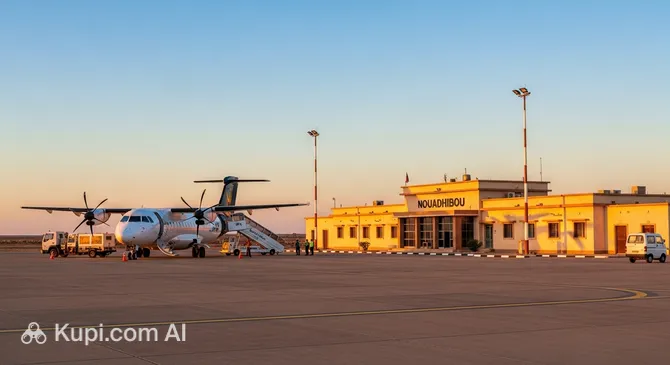
Nouadhibou Airport. Source: Kupi.com Binoculars

Nouadhibou International Airport is not merely a transport hub, but a true aerial gateway to the economic capital of Mauritania. Located on the picturesque Ras Nouadhibou peninsula, where the golden sands of the Sahara meet the waters of the Atlantic, it offers passengers a breathtaking view upon approach. This compact aviation hub serves as a starting point for those arriving in the region for business or seeking to see the unique colony of monk seals and the famous Banc d'Arguin National Park.

IATA Code NDB
ICAO Code GQPP
City Nouadhibou
Distance to Centre ~3 km
Status International
Annual Passengers ~120,000
Schedule Check with the airline

Features and Advantages of the Airport

The main advantage of Nouadhibou Airport is its incredible proximity to the city. The air harbour is located practically within the urban area, so the journey to the central market or most hotels will take no more than 10–15 minutes by taxi. This distinguishes it favourably from the capital's airport, which is located significantly further from residential quarters.

The airport terminal is characterised by its compactness and simplicity. There is only one runway and a small terminal building, which guarantees the absence of long queues and a quick procedure for passing passport and customs control. Despite its modest size, the airport holds international status and receives flights not only from the country's capital but also from the Canary Islands (Gran Canaria), connecting the region with Europe.

Contact Information

Below is the main contact information for Nouadhibou International Airport (NDB). Please note that finding direct and responsive contacts can be difficult, so for questions related to flights, it is recommended to contact your airline first.

  • Official Website: The airport is managed by Aéroports de Mauritanie (ADM). Basic information can be found on their official website: www.admauritanie.com.
  • Inquiry Service Phone: A single public phone number for inquiries is often not published or may be unavailable. To obtain accurate information about flight status, schedule changes, or other flight-related matters, it is strongly recommended to contact your airline's call centre directly.
  • Address: Nouadhibou International Airport (Aéroport International de Nouadhibou), Nouadhibou, Mauritania.
  • Email: A dedicated email address for passengers is not advertised. To contact the administration, you can try using the general contacts on the ADM operator's website.
  • Social Media: At this moment, Nouadhibou Airport does not have official and actively updated pages on popular social networks.
  • Lost Luggage Information: All issues related to lost, delayed, or damaged luggage are handled by the Lost & Found service of your airline. Please contact your carrier's representative at the airport immediately upon discovering a problem.
  • Passenger Support Contacts: Assistance for passengers with special needs, questions regarding tickets, and flight check-in are provided directly by the airlines.

How to Get to the Airport

Getting to Nouadhibou International Airport (NDB) from the city centre of Nouadhibou is quite simple, as it is located very close by. The main modes of transport are taxis and rental cars, as the public transport system in the conventional sense is poorly developed here.

Taxi and Private Transfer

The easiest and most popular way to reach the airport is to use a taxi service. The trip from the central part of the city will take just 10–15 minutes depending on traffic. A car can be found on the street or ordered through a hotel. Key point: always agree on the fare with the driver in advance, before getting into the car, as taximeters are rarely used. For greater convenience, you can book a private transfer through a travel agency or hotel. This is slightly more expensive but guarantees a fixed price and timely vehicle arrival.

Public Transport

There are no direct bus or train routes connecting the city to the airport. The role of public transport in Mauritania is often fulfilled by shared taxis (taxi-brousse), which depart as they fill up. This option may be the cheapest, but it does not have a strict schedule and is less comfortable, so it is not very convenient for travelling to the airport with luggage.

Car Rental

For those who prefer to move around independently, car rental services are available in the city. This is a good option if you plan to explore not only Nouadhibou but also its surroundings. It is recommended to book a car in advance online, especially during the tourist season. Ensure you have all necessary documents, including an International Driving Permit. The road to the airport is simple and well-marked.

Airport Parking

There is parking available within the territory of Nouadhibou Airport. It consists of an open-air lot where you can leave a vehicle for both short and long terms. Given the small size of the airport, finding a free space is usually not difficult. The cost of parking is relatively low, but it is better to check current rates on-site.

Terminals and Map

Nouadhibou Airport (NDB) is a compact and functional aviation hub serving the second-largest city in Mauritania. Its structure is extremely simple, making navigation intuitively clear even for those visiting for the first time.

The airport consists of one passenger terminal, which handles both domestic and international flights. Thanks to this, you do not need to worry about transferring between different buildings — all procedures are concentrated in one place. Departure and arrival zones are located within the same terminal and are clearly demarcated. Check-in counters, the security screening zone, passport control, and boarding gates are arranged in a logical sequence, minimising movement time.

Due to the small size of the airport, completing all formalities usually takes less time than in major international hubs. Nevertheless, it is recommended to arrive at the airport in advance: approximately 1.5-2 hours before a domestic flight departure and 2-3 hours before an international one. This time will be sufficient to check in for the flight, drop off luggage, and pass security screening without rushing. Navigation through the terminal will not cause difficulties: follow the signs, and in case of questions, airport staff are always ready to assist.

Airport History

The history of Nouadhibou (NDB) Airport is closely intertwined with the establishment and development of the city of Nouadhibou itself, which is a key economic centre of Mauritania. The air harbour was built in response to an urgent need for fast and reliable communication with this strategically important port located on the narrow Ras Nouadhibou peninsula.

Although the exact date of the airport's founding is not widely publicised, its appearance most likely dates back to the mid-20th century — a period of active industrial development in the region. Initially, it was a simple airstrip serving the needs of the French colonial administration and companies engaged in iron ore mining and fishing. The main task was to ensure transport accessibility for the city, which had long been isolated from the rest of the country.

As the economic importance of Nouadhibou grew, especially after the launch of the famous Mauritania Railway, the significance of the airport also increased. It became an important hub for transporting specialists, business delegations, and urgent cargo. Although Nouadhibou Airport did not become a major international hub, it has always played a key role in the country's internal logistics, ensuring stable air connections with the capital Nouakchott and other regional centres.

Throughout its history, the airport has undergone necessary stages of modernisation to meet modern standards of safety and aircraft servicing. Today, it is a functional regional airport that continues to be a vital transport artery for the second-largest city in Mauritania. Its history is not a chronicle of records and loud events, but rather an example of how an infrastructure facility serves as a pillar for economic development and connects remote but important regions with the rest of the world.

Services and Amenities

Nouadhibou Airport (NDB) provides passengers with a basic set of services necessary for a comfortable wait for their flight. Although the airport is not large, there is a small café where you can have a snack, coffee, or soft drinks before departure. There are also several kiosks selling souvenirs, press, and essential goods.

A general waiting hall is equipped for passengers. For travellers preferring enhanced comfort, a VIP lounge offering a quieter atmosphere may be available. Access to Wi-Fi in the terminal may be limited or provided for a fee, so it is recommended to have a local SIM card with mobile data. The number of power outlets for charging gadgets may also be small — just in case, it is better to bring a portable power bank.

Typically, a currency exchange point operates in the airport building, where you can exchange money for the local currency of Mauritania — the Ouguiya (MRU). ATMs may also be installed here. A medical point operates to provide emergency assistance to passengers. If you have any questions, you can always contact the airport staff at the information desk.

Passengers with reduced mobility are provided with the necessary assistance. To arrange this, it is recommended to notify your airline in advance of the need for special services, such as the provision of a wheelchair or escort through the terminal territory. Basic amenities may be provided for travellers with small children, but there are no specialised play areas here.

There are no hotels or business centres within the airport itself. The nearest hotels and conference rooms are located in the city of Nouadhibou, which can be reached by taxi in a short time. Business travellers should plan business meetings at hotels in the city that offer appropriate services.

Where to Eat

When planning a flight through Nouadhibou Airport (NDB), it is important to consider that this is a small regional airport, and dining options here are quite limited. The infrastructure is primarily designed to meet the basic needs of passengers before departure.

In the main hall of the airport, typically before the security control zone (landside), a small cafeteria or kiosk operates. Here you can purchase basic beverages and light snacks. The assortment usually includes sandwiches, pastries, packaged snacks (chips, biscuits), as well as hot and cold drinks such as coffee, tea, and bottled water. This is the main and often the only option for a snack on the airport territory.

Regarding recommendations:

  • For a quick snack: The cafeteria in the airport is quite suitable for having a cup of coffee and a sandwich while waiting for a flight.
  • For a full meal: There are no restaurants in the airport offering complex hot meals. If you wish to have a full lunch or dinner, it is strongly recommended to do so at one of the establishments in the city of Nouadhibou before travelling to the airport.

Passengers with specific dietary needs (vegetarian, gluten-free diet) should be prepared for the fact that finding suitable dishes will be practically impossible. The best solution would be to bring food with you. All food offered at the airport is generally Halal, complying with the norms of Mauritania. Prices for food and drinks at the airport are usually higher than in the city. Establishments operate according to the flight schedule, not around the clock.

Travel Tips

When planning a departure from the airport in the city of Nouadhibou, it is worth considering its relatively small size. Despite this, it is recommended to arrive at the airport well in advance: 2-3 hours before an international flight and 1.5-2 hours before a domestic one. This will give you enough time in case of unforeseen circumstances. The possibility of online check-in depends on the airline, so be prepared to go through the procedure at the counter in the airport. Keep your passport, visa (if required), and ticket handy to speed up the process.

Screening and security procedures at the airport are standard but may take longer than in major hubs, so please remain patient. When packing hand luggage, remember the generally accepted restriction on liquids — no more than 100 ml in one container, packed in a transparent bag. Important: the import of alcohol and pork into Mauritania is strictly prohibited, even if purchased in Duty Free. Ensure that there are no prohibited items in your checked and hand luggage to avoid problems at customs.

When choosing a seat on the plane, be guided by your preferences: a window seat will offer you breathtaking views of the Sahara Desert and the Atlantic coast during takeoff and landing. An aisle seat will ensure more freedom of movement during the flight. Nouadhibou Airport is rarely used as a transit hub; most flights are direct. If you do have a transfer planned, check with the airline in advance whether you will need to collect and re-check your luggage.

Customs control upon entering the country may include checking luggage for prohibited goods. Be prepared to answer questions about the purpose of your visit and place of accommodation. When departing from the country, you may be asked about the export of local artefacts or large sums of currency — keep receipts for valuable purchases.

To save time and money, consider booking a taxi or transfer from the airport to the city in advance. It is better to exchange currency for local Ouguiyas (MRU) in small amounts, as the exchange rate at the airport may not be the most favourable. Travelling light with only hand luggage will also help save time waiting for luggage and money on airline fees.

In case of a flight delay, bear in mind that amenities at the airport are limited. It is recommended to carry a portable charger (power bank), a book, or movies downloaded to your device in advance. Maintain contact with your airline representative for current information. Do not hesitate to ask if you are entitled to vouchers for food or drinks, but be prepared that service may not be fast.

Reached the end of the page?

That means the route is fully explored