Support

Sonora in the Revolution Museum

About

In the heart of Ciudad Obregón is one of the most significant cultural institutions in the region — the Museum of Sonora in the Revolution (MUSOR). Housed in an elegant two-story building, this museum invites guests to immerse themselves in the turbulent history of the early 20th century, when Mexico was undergoing a period of radical transformation.
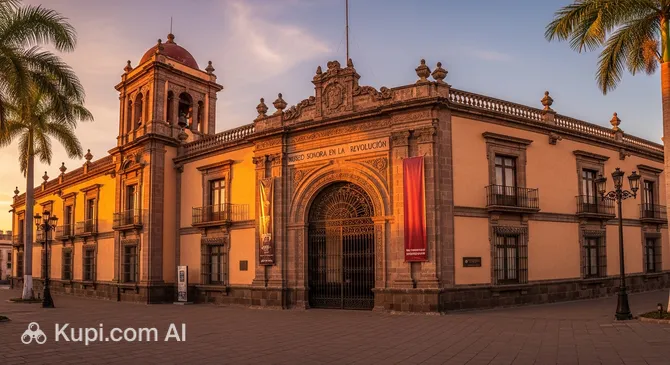
Sonora and the Revolution Museum. Source: Kupi.com AI

The museum building has special historical value: it once served as the private residence of Francisco Obregón Tapia, the son of the famous general Álvaro Obregón. Today, these walls carefully preserve hundreds of artifacts, documents, and records telling of the key role the state of Sonora played in the Mexican Revolution and the building of a new nation.

The museum's exhibition is organized to allow visitors to trace the region's path from the origins of agricultural valley development to heroic battles and political victories. This place is not just a collection of antiquities, but an important educational center operating under the auspices of the Sonoran Institute of Culture.

Contacts

To clarify information about special events or to book group tours, you can contact the museum administration directly. The Museum of Sonora in the Revolution is open to dialogue with visitors and is ready to provide all the necessary information for planning your visit.

Address Av. Nainari 112 Pte., col. Zona Norte, CP 85040, Ciudad Obregón, Cajeme, Sonora, México
Phone +52 644 413 9027, +52 662 212 6570
Email musor@isc.gob.mx
Official Website isc.gob.mx
Social Media Facebook: @musorsonora

What to Do

The main reason to visit the museum is its permanent exhibition. You will walk through three key historical stages: from the development of fertile lands in the Yaqui and Mayo river valleys to the dramatic events of the revolution. Special attention is paid here to the personality of General Álvaro Obregón — you will see him not only as a stern military leader but also learn details of his private life through authentic personal belongings.

For those who prefer active engagement, the museum features the Ludic Hall (Sala Lúdica). This is an interactive space where complex historical processes can be better understood through gaming and educational mechanics. In addition, the museum regularly updates its temporary exhibitions, showcasing works by contemporary Mexican artists and photographers dedicated to regional culture.

You can conclude your visit with a walk through the memorial gardens on the complex grounds, where cultural events and creative evenings are often held. Don't forget to stop by the museum shop: it offers an excellent selection of local crafts, traditional gourmet products, and books on the history of Sonora, which will serve as a wonderful reminder of your trip.

Getting There

Finding the Museum of Sonora in the Revolution is easy, as it is located in the central part of the city on one of the key avenues — Avenida Nainari. If you are staying downtown, a taxi ride will take only a few minutes. For those who prefer to use a rental car, parking can usually be found near the museum.

If you are arriving from another region, the nearest transport hub is Ciudad Obregón International Airport. From the airport to the museum complex, it is most convenient to get there by official taxi or a pre-booked transfer. The city also has good bus connections with other major cities in the state of Sonora.

Public transport in the city is represented by bus routes passing through the central areas; however, taxi remains the most comfortable and fastest way to get around for tourists. Simply tell the driver the address "Avenida Nainari 112," and you will be taken right to the doors of this historic building.

History & Facts

The official opening of the Museum of Sonora in the Revolution took place on October 29, 2009. The event was timed to coincide with the centennial celebrations of the Mexican Revolution. The initiative to create such a space came from the state government, which sought to immortalize the contribution of local residents to the formation of modern Mexico.

Interestingly, the foundation for the museum collection was the private collection of Francisco Obregón Tapia. For many years, he carefully preserved the personal belongings, documents, and photographs of his father, the prominent general Álvaro Obregón. Later, this home collection was transformed into a full-scale state exhibition available to everyone.

The museum building itself is a historical monument. The former private residence of the Obregón family has preserved the atmosphere of the early 20th century, allowing visitors to literally travel back in time. The organizers have tried to structure the exhibition so that it reflects not only military actions but also the deep social changes in the Yaqui and Mayo river valleys.

Today, the museum is not just a repository of antiquities, but a living cultural center managed by the Sonoran Institute of Culture. Work is constantly being done here to study archival materials, making it an important link in preserving the historical memory of the entire northwestern region of the country.

Time Needed

To leisurely explore all the halls and delve into the details of the exhibition, most travelers need about 2–3 hours. This is the optimal time to study both the main historical documents and the personal belongings of the participants in the revolutionary events.

If you plan to visit temporary exhibitions in the gallery or stop by the museum shop for unique souvenirs, it is worth adding another 30–40 minutes to your visit. For families with children, the visiting time may increase thanks to the interactive zones, which traditionally attract the attention of young guests.

Working Hours

When planning your visit, keep in mind that the museum welcomes guests from Tuesday to Sunday, 10:00 AM to 5:00 PM. The complex is closed to visitors on Mondays, as this is the traditional day for technical maintenance and exhibition updates.

The admission fee is very affordable: the standard rate is 20 Mexican pesos, while a discounted price of 10 pesos is available for children, students, and seniors. Since the schedule may change on holidays, it is recommended to check the current information on the museum's official website before your trip.

Nearby

Your exploration of history within the museum's walls can be complemented by a walk around the neighborhood. The area where the cultural center is located allows you to see the modern life of the city and encounter other landmark sites in Ciudad Obregón.

Within walking distance and a few minutes' drive are architectural monuments, cozy squares, and interesting art objects that will help you form a more complete picture of the culture of the state of Sonora.

Attraction Type Distance (km)
Biológicos Acuícolas Industriales 0.5
Torre de la Antigua Catedral del Sagrado Corazón de Jesús 0.7
Casa donde nació Julio César Chavez 0.7
Monumental Watch 0.8
Monumento Plaza Zaragoza 1.3
La Mesita 1.5
El Deshuesadero 1.9
Haciendas 2.8
Acción Acuicola - Compras 2.9
CASTILLO DEL DIABLO 3.8

Reached the end of the page?

That means the route is fully explored