Support

Dakhla Airport

About the Airport

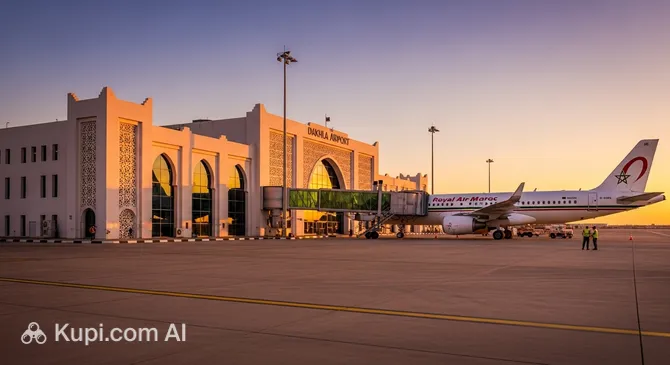
Dakhla Airport. Source: Kupi.com Binoculars

Dakhla Airport is not merely a transport hub, but a true gateway where the endless sands of the Sahara meet the surging waters of the Atlantic. From the very first moment, this small yet charismatic airport immerses travellers in an atmosphere of seclusion and freedom, for which this land of kitesurfing and desert adventures is renowned. The terminal is distinguished by clear navigation and a calm rhythm, perfectly preparing guests for their encounter with the region's unique nature.

IATA Code VIL
ICAO Code GMMH
City Dakhla
Distance to centre 5 km
Status International
Annual Passengers About 300,000 people
Schedule Check official online flight boards

Airport Features and Advantages:

Despite its compact size, the air harbour possesses a number of undeniable advantages for tourists:

  • Instant Transfer: Thanks to its location just 5 km from the city, the journey to most hotels and kite camps takes mere minutes.
  • No Queues: The low passenger traffic allows for passing through passport control and retrieving luggage much faster than in the country's major hubs.
  • Convenience for Athletes: Airport staff are accustomed to tourists with non-standard luggage, so processing surfing and kitesurfing equipment proceeds here without unnecessary complications.
  • Atmosphere: The terminal building was recently modernised, combining modern amenities with elements of local design that remind visitors of the desert's proximity.

Contact Information

For your convenience, we have compiled the main contacts for the airport. Please note that the airport is managed by the national operator ONDA, so some support services operate through a unified call centre.

  • Official Airport Website: www.onda.ma (management company website, airports section)
  • Information Service (Call Center): +212 80 1000 224 (available 24/7, service in multiple languages)
  • Airport Address: Aéroport de Dakhla, Route de Laayoune, Dakhla
  • Email for Enquiries: reclamations@onda.ma (for complaints and suggestions)
  • Social Media: Official ONDA pages on Facebook, Instagram, and X (Twitter) publish current news about the operations of all airports in the network
  • Lost Luggage Information: In case of lost luggage, it is recommended to first contact your airline representative or call the unified call centre at +212 522 43 58 58
  • Passenger Support Contacts: +212 522 43 58 58 (general questions and assistance at the airport)

How to Get to the Airport

Dakhla Airport (VIL) is located just 5 kilometres north of the city centre, making the trip quick and effortless. However, given the specifics of the region, it is important to plan your route in advance, especially if you are heading not to the city itself, but to one of the remote hotels or kite camps on the lagoon.

Hotel Transfer

This is the most popular and reliable way to reach your accommodation. Most hotels and sports camps located on the lagoon coast (approximately 25–30 km from the airport) offer a guest pick-up service. Often, the transfer is already included in the cost of accommodation or the kitesurfer service package. It is recommended to contact your hotel administration a few days before departure so that a driver meets you with a sign at the exit of the arrivals area.

Taxi

If you have not booked a transfer, a taxi is the best alternative. The rank is located right at the terminal exit. There are two types of taxis in Dakhla, but for trips from the airport, Grand Taxis (large cars, often older Mercedes or minivans) are most commonly used, as they accommodate luggage and sports equipment.

  • Travel Time: To the city centre — about 10–15 minutes. To hotels on the lagoon — 25–30 minutes.
  • Cost: Prices are usually fixed, but it is worth confirming with the driver before boarding. A trip to the city will cost approximately 50–70 MAD (Moroccan Dirhams), while a transfer to the lagoon will be more expensive — around 150–200 MAD.

Car Rental

For those planning to explore the peninsula and wild beaches on their own, renting a car is an excellent option. Rental company counters are located in the arrivals hall. Both local agencies and some international brands are represented here. It is recommended to book a car in advance, especially if you need an SUV (4x4) for driving on the sands.

Public Transport

There is no railway service or metro in Dakhla. City buses run through the city streets, but there are practically no specialised bus routes connecting the airport with the centre or the tourist zone for visitors. Given the luggage and sports equipment, attempting to use public transport can be inconvenient, so travellers almost always choose a taxi or transfer.

Parking

An open car park is equipped on the airport territory, located directly in front of the terminal building. It is convenient for short-term parking if you are being seen off or met by private transport. The parking zone is within walking distance of the entrance to the check-in area.

Terminals and Map

Dakhla Airport (VIL) is a compact and modern aviation hub, the structure of which is maximally simplified for passenger convenience. Thanks to its small size and recent modernisation, navigation here is intuitive, and moving between zones takes minimal time.

Number of Terminals and Layout

The airport features one passenger terminal, which serves both domestic flights (mainly from Casablanca and Agadir) and international destinations. The terminal building represents a single architectural complex, divided into functional zones for arriving and departing passengers. The total area of the terminal is about 3,000 square metres, which allows for comfortably accommodating the passenger flow characteristic of this tourist destination.

Departure and Arrival Zones

The terminal is designed linearly, eliminating confusion when moving around:

  • Departure Zone: Located in the left part of the building (if looking from the street entrance). Here you will find check-in counters, the security screening area, and the boarding lounge. In the "secure area," there is a small café, a souvenir shop, and seating areas.
  • Arrival Zone: Located in the right part of the terminal. After disembarking from the aircraft, passengers walk to the passport control hall (for international flights) or directly to the luggage claim belts (for domestic flights).

Walkways and Navigation

Since the airport consists of a single building, there is no need for shuttles or complex transfers. All movements are made on foot. The distance from the airport entrance to the check-in counter is just a few dozen metres, and from the screening zone to the boarding gate is literally a couple of minutes' walk. Inside the terminal, clear signs are installed in French, Arabic, and English.

Terminal Features

Despite its compactness, the terminal is equipped with everything necessary for a comfortable wait:

  • Design: The interior is executed with elements of traditional Moroccan decor, creating a cosy atmosphere.
  • Climate Control: The building is equipped with modern air conditioning systems, which is particularly important in desert climate conditions.
  • Accessibility: The terminal has a barrier-free environment, convenient for passengers with reduced mobility and families with strollers.

Processing Times

Processes at Dakhla Airport usually go faster than in major hubs, however, the specifics of the region should be taken into account:

  • Check-in and Luggage Drop-off: Queues rarely occur; the procedure takes 10–20 minutes. However, if you are carrying sports equipment (kites, surfboards), allow extra time for its processing (payment for oversized luggage is made at a separate cashier).
  • Security and Passport Control: The security service works thoroughly. Passport control on arrival can take from 15 to 40 minutes if several planes land simultaneously.
  • Recommended Arrival Time: It is recommended to arrive at the airport 2 hours before an international flight and 1.5 hours before a domestic one. This time is more than sufficient for calmly passing all formalities.

Navigation Recommendations

It is practically impossible to get lost in Dakhla Airport. The main advice for departing passengers: immediately upon arrival, proceed to the check-in counters, which are visible from the entrance. The arrival zone has a single exit to the city, where transfer representatives and taxi drivers will immediately meet you. If you are travelling in a large group with equipment, stick together, as the luggage claim area is compact and can be crowded during peak loads.

Airport History

The history of Dakhla Airport (VIL) is inextricably linked with the romance of early aviation and the era of great geographical discoveries. What is today a modern gateway to the world of water sports began as a strategically important point on the map of legendary air routes connecting Europe, Africa, and South America.

The "Aéropostale" Era and Legendary Pilots

In the 1920s, when the city was named Villa Cisneros, the local airfield became a key stopover point for the airline "Aéropostale". Planes delivering mail from Toulouse to Dakar and further across the ocean landed here. The airport's history remembers the names of great aviators such as Jean Mermoz and Antoine de Saint-Exupéry. For pilots, this stop was an island of civilisation amidst the endless desert, a place of rest before difficult flights over the Atlantic.

Military Significance and Transition to Civil Aviation

During World War II, the airfield was used for military purposes by Allied forces, thanks to its advantageous geographical location. For a long time, the infrastructure remained basic, oriented mainly towards logistical and military tasks. The full-fledged development of civil transport began significantly later, when the region started attracting attention as a unique tourist destination.

Modernisation and the Modern Stage

A key moment in the airport's recent history was 2010, when a large-scale reconstruction was completed and a renovated passenger terminal was opened. This project was intended to bring the air harbour into compliance with international standards and increase capacity.

  • During the modernisation, the terminal area was expanded to 3,000 square metres (previously it was only 260 sq. m).
  • Throughput capacity grew from 55,000 to 300,000 passengers per year.
  • The runway (3,000 metres long) and aircraft stands were updated, allowing the reception of modern medium-haul liners like the Boeing 737 and Airbus A320.

Achievements and Records

Despite its modest size, Dakhla Airport demonstrates impressive dynamics. With the growth in popularity of kitesurfing, passenger traffic is steadily increasing. The airport received the ISO 9001:2008 quality certificate, confirming a high level of passenger service and safety, which is a significant achievement for a regional hub.

Interesting Historical Facts

  • Literary Trace: It is believed that the landscapes seen during flights over this part of the Sahara (including stops in Villa Cisneros and neighbouring Cape Juby) inspired Antoine de Saint-Exupéry to write his famous works, such as "Wind, Sand and Stars" and "The Little Prince".
  • Architectural Style: During the last reconstruction, architects tried to preserve the spirit of the place. The terminal building is designed to let in maximum natural light, reminding one of the bright desert sun, while decor elements refer to the traditional ornaments of the region.
  • Role in Sports: The airport became a catalyst for transforming Dakhla into a world kitesurfing capital. It was precisely the ability to quickly and comfortably transport athletes and their bulky equipment that allowed world championship stages to be held here.

Services and Amenities

Dakhla Airport (VIL) is a small regional hub, so the range of services here is significantly more modest than in major international hubs like Casablanca or Marrakech. Nevertheless, the terminal provides passengers with everything necessary for a comfortable wait for a flight or meeting upon arrival. The compactness of the airport works in the travellers' favour: all amenities are within walking distance.

Restaurants, Cafés, and Shops
The catering and retail zone in the airport is presented in a "mini" format.

  • Dining: A small café-snackbar operates in the terminal, where you can order coffee, soft drinks, sandwiches, and pastries. There are no full-service restaurants with hot meals here, so if you are hungry, it is recommended to have lunch in the city before leaving for the airport.
  • Shops: There are several retail points in the departure zone. Particular attention should be paid to souvenir kiosks selling local handicrafts, traditional clothing, and cosmetics based on Argan oil. This is an excellent opportunity to buy gifts if you didn't manage to do so during your holiday. Duty Free is presented in a scaled-back format with a basic set of goods (perfume, tobacco, sweets).

Lounges and VIP Services
For passengers who value privacy and enhanced comfort, the airport features a VIP Lounge (Convives de Marque). It is located in the departure zone after passing security control. Guests are offered comfortable armchairs, newspapers, free Wi-Fi, a television, and light snacks with beverages. Access to the lounge is granted to business class passengers of certain airlines or holders of relevant loyalty cards (conditions are best clarified in advance or at the check-in counter).

Connectivity and Electronics
Free Wi-Fi provided by the management company ONDA is available throughout the terminal. Connection usually does not require complex registration, but speed may vary depending on network load. Charging stations for mobile devices can be found in the waiting hall, however, their number is limited. Experienced travellers recommend having a fully charged power bank with you, especially if a long connection lies ahead.

Financial Services
Currency exchange points and ATMs are located in the arrivals hall. This is critically important for tourists, as taxi drivers and many small shops in Dakhla accept only cash Dirhams. It is recommended to exchange or withdraw a small amount immediately upon arrival to pay for the transfer to the hotel.

Medical Services and Safety
A first aid post functions in the terminal, ready to respond promptly to passenger ailments. A police station is also present to ensure law and order.

Services for Special Categories of Passengers
The airport is adapted to receive various groups of tourists:

  • Passengers with Children: There are no specialised playrooms in the airport, but basic amenities such as changing tables in the restrooms are provided.
  • Passengers with Reduced Mobility: The terminal is equipped with ramps and special toilets. The ONDA support service provides wheelchairs and assistance with boarding/disembarking (ambulift). It is important to request this service through your airline at least 48 hours before departure.

Hotels and Accommodation
There are no hotels directly on the airport territory or in the transit zone. However, thanks to the proximity to the city, this is not a problem:

  • The nearest city hotels are just a 5–10 minute drive by taxi.
  • Popular kite camps and bungalow hotels on the lagoon are located slightly further, a 25–30 minute drive away.

Business Services
Specialised conference halls or business centres with office equipment are not provided for general access in the terminal. If you need to work or hold a meeting, it is better to use the services of the VIP lounge or the infrastructure of your hotel in Dakhla.

Where to Eat

The gastronomic scene at Dakhla Airport (VIL) fully corresponds to its intimate format. You will not find a wide selection of fine dining restaurants or chain fast food here. The catering infrastructure is organised to provide passengers with a basic set of food and drinks while waiting for a flight but does not imply lengthy gastronomic sittings.

Location and Establishments

Since the airport consists of one compact terminal, navigation here is extremely simple. Food points are divided into two zones:

  • Public Zone (Landside): In the terminal hall, accessible to those seeing off and meeting passengers, a small kiosk or mini-coffee shop usually operates. Here you can buy water, takeaway coffee, and packaged snacks. This is a convenient place to refresh yourself immediately after arrival or before check-in.
  • Departure Zone (Airside): The main establishment of the airport is located in the "secure" zone after passing passport control and screening. This is a café-snackbar located in the boarding lounge. Its windows offer a view of the airfield.

Menu and Local Specialities

The café assortment is oriented towards a quick bite. Hot lunches or complex dishes are not prepared here. The basis of the menu consists of:

  • Beverages: Good bean coffee (espresso, cappuccino), bottled juices, and carbonated drinks. It is definitely worth ordering traditional mint tea — in this region, it is brewed strong and sweet, which is excellent for invigorating you before a flight.
  • Food: Fresh sandwiches (usually with tuna, chicken, or cheese), paninis, croissants, and other pastries, for example, pain au chocolat (chocolate buns).
  • Local Flavour: Sometimes traditional sweets can be found on sale, for example, "Gazelle Horns" (cookies with almond paste), which make an excellent accompaniment to tea.

Dietary Options (Halal, Vegan, Gluten)

  • Halal: In accordance with the traditions and customs of the region, virtually 100% of meat products used in sandwiches and snacks comply with Halal standards.
  • Vegetarians: The choice is limited to pastries, cheese sandwiches, or simple vegetable salads (if available on the day of departure).
  • Vegans and Gluten-Free Diet: Specialised options are practically non-existent. Passengers with strict dietary restrictions are strongly recommended to bring food with them. In the airport, you will only be able to buy water, juice, or fruit (subject to availability).

Prices and Opening Hours

  • Opening Hours: Food points do not work around the clock in the usual sense. They open according to the flight schedule. If you have an early departure or a night delay, the café will operate as long as there are passengers in the hall.
  • Price Range: Prices are higher than in the city but remain moderate by international standards.
    • Coffee or tea: about 20–30 MAD.
    • Sandwich or panini: 40–60 MAD.
    • Water/soda: 15–20 MAD.
  • Payment: Cash Dirhams are accepted. Card terminals may work intermittently, so it is better to have small notes with you.

Recommendations for Passengers

For a quick snack: The café in the departure zone will cope perfectly with the task of "satisfying light hunger" with a cup of coffee and a pastry.

For a full lunch: We strongly recommend eating in the city before travelling to the airport. Dakhla is famous for its freshest oysters and seafood, and you will find nothing of the sort in the terminal. The best strategy is to enjoy lunch at one of the restaurants on the lagoon, and arrive at the airport already full, leaving time only for passing formalities and a cup of farewell tea.

Tips for Travellers

To ensure your journey goes as smoothly as possible, we have prepared a list of practical tips. Dakhla Airport has its own specifics, related both to its geographical location and the rules in force in the region.

Optimal Arrival Time

Despite the compactness of the airport, do not arrive at the last moment. Check-in counters close strictly according to schedule (usually 40–60 minutes before departure). Optimal arrival time:

  • For domestic flights: 1.5 hours before departure.
  • For international flights: 2 hours before departure.

This will allow you to calmly pass security control, which can be quite thorough here, and avoid stress.

Check-in and Security Control

In Moroccan airports, and Dakhla is no exception, you are often required to present a printed boarding pass for stamping by police officers before entering the screening zone. Even if you have a mobile version, it is strongly recommended to have a paper copy. If you have not printed the pass in advance, visit your airline's check-in counter, even if flying without luggage.

Choosing a Seat on the Plane

A flight to Dakhla is a case where a Window Seat is a mandatory part of the programme. Upon approach for landing, stunning views open up of the peninsula, where the yellow sands of the Sahara cut into the turquoise waters of the Atlantic Ocean and the lagoon. Try to choose a seat on the right side when flying from Casablanca to enjoy the panorama of the spit and the city from above.

Hand Luggage: What is Allowed and Prohibited

Besides standard international rules (liquids up to 100 ml, no sharp objects), Dakhla has its own nuances:

  • Quadcopters (Drones): Importing drones into Morocco without a special permit is prohibited. If you are carrying a drone in hand luggage or checked baggage, it will likely be confiscated at customs upon entry and placed in storage until your departure (a paid service).
  • Power Banks and Batteries: All lithium batteries must be in hand luggage only. They are prohibited in checked baggage and will be removed during scanning.
  • Souvenirs: Do not attempt to export large rocks, unprocessed fossils, or large amounts of sand in hand luggage — this may raise questions with security.

Tips for Connecting Passengers

Most often, flights to Dakhla are operated via transit through Casablanca (Mohammed V Airport). If you are flying on a single ticket (e.g., Royal Air Maroc), your luggage is usually checked through to the final destination. However:

  • Always clarify at the check-in counter of your first departure whether you need to collect luggage at the transfer point for customs clearance (sometimes required when changing from an international to a domestic flight).
  • In Casablanca airport, transfer can take time due to passport control, so choose connections with a duration of at least 2–3 hours.

Customs Control Features

Upon arrival in Dakhla, customs control usually proceeds quickly. They may selectively ask to pass luggage through a scanner. Main attention is paid to professional photo/video equipment (without permits) and drones. If you are carrying sports equipment (kites, boards), be ready to confirm that these are personal items, not goods for sale.

How to Save Time and Money

  • Cash: Exchange a little money (Euros or Dollars to Dirhams) at the airport only for immediate needs (taxi, water). The rate in the city is usually more favourable.
  • Transfer: Arrange a transfer with your hotel in advance. This is often cheaper or even free (included in accommodation) than taking a taxi on the spot, where prices for tourists may be inflated.
  • Food: Prices in the airport café are higher than in the city. If you want to save money, have a snack in the city before leaving.

In Case of Flight Delay

Delays in Dakhla can happen due to strong winds or sandstorms reducing visibility. Since terminal infrastructure is limited:

  • Have a charged power bank and a book or downloaded films with you — Wi-Fi may work intermittently with large crowds.
  • Keep the contacts of your hotel or transfer handy to promptly warn them about the change in arrival time.
  • If the delay is long, check with airline representatives about the possibility of providing water and food, as the choice of food in the terminal is small.
Airports in nearby cities

Reached the end of the page?

That means the route is fully explored