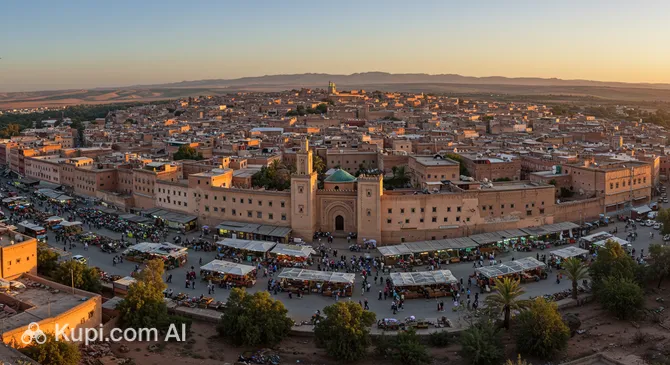
El Kelaa des Sraghna is an authentic corner of Morocco, where time seems to slow down, allowing travelers to experience the country's genuine way of life. The city's name translates as "Fortress of Sraghna," reflecting its historical significance as an important military and administrative outpost for the local Sraghna tribe. The city is nestled on a fertile plain, surrounded by endless olive groves.
Located in the Marrakesh-Safi region at an altitude of about 400 meters above sea level, this city is a significant agricultural center for the region. The rich history of El Kelaa des Sraghna dates back to the era of Sultan Moulay Ismail, who fortified the stronghold to control trade routes. Today, the city has a population of about 84,000 people, although the entire province brings together more than one and a half million residents.
El Kelaa des Sraghna. Illustration.
Source: Kupi.com AI
The main features of the city are its massive defensive walls and the traditional architecture of the medina with its narrow, winding streets. El Kelaa des Sraghna is considered the "olive capital" of Morocco, and visiting local plantations will be an unforgettable experience for ecotourism enthusiasts. We invite you to discover this authentic place, where the hospitality of the locals and the aroma of fresh olive oil create a unique atmosphere.
Weather Overview
The climate in El Kelaa des Sraghna is characterized as Mediterranean with a noticeable influence of continental air masses. The weather in the city pleases with an abundance of sunny days, making the region ideal for growing the olive trees for which this area is so famous.
Summers here can be truly hot: in July and August, daytime temperatures often reach +37°C...+38°C. Winters remain mild and pleasant for walking — averaging about +14°C...+16°C, although nights can be quite cool. The majority of precipitation falls in the spring months, refreshing the landscapes of the fertile plains and providing moisture to the groves.
Average monthly temperature
Average monthly precipitation
Interesting Facts
The city was significantly fortified in the 17th century by the legendary Sultan Moulay Ismail, who used it as a strategic fortress to control mountain tribes.
El Kelaa des Sraghna is officially recognized as one of the main centers of olive oil production in Morocco; the local climate is considered ideal for growing high-quality olives.
Historically, the settlement served as a vital trade hub on the caravan route connecting the two imperial capitals — Fez and Marrakesh.
The traditional irrigation system, established during the Almohad dynasty, still sustains life in the lush gardens and groves surrounding the city.
How to Get There
The most convenient way to reach El Kelaa des Sraghna is through the country's major transport hubs, as the city is well-connected by a network of modern roads to major centers. The transport accessibility of the city mainly relies on bus services and private carriers.
There are no direct flights to the city itself, so most tourists use the international Marrakesh Menara Airport (IATA: RAK). This is one of Morocco's largest aviation hubs, located about 100-150 kilometers away. From the airport, you can reach the city by rented car or a comfortable bus in about two hours.
Although there is no railway station within the city limits, the nearest major station is in Marrakesh. You can arrive there by high-speed train from Casablanca or Rabat, and then continue your journey on an intercity CTM bus or use the services of grand taxis, which regularly run towards the Sraghna fortress.
Main Attractions
El Kelaa des Sraghna is a place for those seeking authenticity away from overcrowded tourist trails. One of the city's main gems is its ancient fortress walls, built to protect the settlement. A walk along these massive fortifications allows you to feel the spirit of history and the former greatness of the "Fortress of Sraghna."
The heart of the city is its old medina. Unlike Marrakesh, here you will find a calm rhythm of life, narrow winding streets, and houses with shady courtyards. The city's architecture reflects classic Moroccan traditions, where every facade holds its own centuries-old secret.
It is impossible to imagine a visit to this region without visiting the famous olive groves. These endless gardens surround the city, creating a green belt on the fertile plain. For ecotourism lovers, a walk among century-old trees is an excellent way to get acquainted with the region's agricultural heritage and see how the famous Moroccan olives are grown.
Local Cuisine
The culinary traditions of El Kelaa des Sraghna are deeply rooted in the richness of the local land. The main ingredient in almost every dish here is extra-class olive oil produced on the surrounding plantations. It gives a unique flavor to traditional Moroccan salads and stewed vegetables, which are always served fresh here.
Be sure to try the local lamb tagine with prunes, which is prepared in this region with special skill and an abundance of aromatic spices. Also popular is the hearty couscous served with seven types of vegetables — this dish is a symbol of prosperity and hospitality. The freshness of the products bought at the morning market guarantees high food quality even in the humblest establishments.
The food culture here is closely linked to unhurried socializing. Traditional sweet mint tea is served everywhere — from small shops to cozy cafes in the center. The best place to get acquainted with the local cuisine is the small restaurants around the central market, where you can taste authentic street food in the company of local residents.
Travel Tips
To ensure your trip to this unique corner of Morocco is as comfortable as possible, we have prepared some practical tips for you.
Clothing and Essentials: Choose light clothing made from natural fabrics to protect yourself from the heat. In Morocco, modesty in dress is valued, so try to cover your shoulders and knees when visiting residential areas.
Transport: For short trips around the city, use petit taxis. If you plan to explore the surrounding villages, it is better to use grand taxi services or rent a car in Marrakesh.
Finances: The local currency is the Moroccan Dirham (MAD). Cards are rarely accepted in the province, so always carry a supply of cash with you.
Health and Safety: The city is safe, but be careful in the sun. Drink only bottled water and use sunscreen.
Communication: The main language is Arabic, and many understand French. Knowing basic phrases like "Shokran" (thank you) and "Salam Alaikum" (hello) will significantly facilitate communication.
Local Etiquette: Moroccans are very hospitable. It is customary to take off your shoes when entering a private house, and you should not refuse offered tea — it is a sign of respect.
What to Avoid: Do not take photos of people without their permission and try not to discuss political topics in casual conversations.
Time to Visit: The best time to visit is spring or autumn, when daytime temperatures are most comfortable for walking.
By following these simple rules, you will be able to fully immerse yourself in the culture of the "olive capital" and take home only pleasant impressions.
Entertainment & Nightlife
In El Kelaa des Sraghna, you won't find noisy nightclubs or neon disco signs. Life here follows the quiet rhythm of a provincial town, where evening entertainment consists of leisurely strolls along the main streets and friendly gatherings in tea houses. The city's atmosphere encourages thoughtful relaxation and deep immersion into the local culture.
The main centers of attraction in the evening are the main squares and cafes, where residents gather to discuss the day's news over a glass of fragrant mint tea. This is the perfect time to feel the true soul of the city, free from tourist bustle. Safety in the city is high, so evening walks through the lit streets of the center are perfectly calm.
If you want a more active nightlife, bright shows, or concerts, it is best to head to neighboring Marrakesh, which is only a couple of hours away. During the day in El Kelaa des Sraghna itself, it is worth spending time visiting the colorful local markets or exploring the historical defensive structures, which are the main "stages" of this ancient city.
Parks & Museums
In El Kelaa des Sraghna, the main exhibition is history itself under the open sky. Although there are no large art galleries, the city streets and the ancient medina serve as a living museum of Moroccan architecture and daily life. An attentive traveler will find many interesting details here: from ornaments on old doors to the massive stonework of the fortress walls.
Endless olive gardens surrounding the settlement serve as natural recreation areas. These groves can be considered natural parks where locals like to spend time in the shade of century-old trees. A walk among the rows of olive trees at sunset brings peace and allows you to appreciate the scale of the region's agricultural wealth.
For those craving classic museum exhibits, a trip to Marrakesh, where the region's largest cultural treasures are concentrated, is an excellent option. However, El Kelaa des Sraghna itself is valuable precisely for its pristine nature and the opportunity to see the country's life as it has been for many centuries, without unnecessary display cases or fences.
Getting Around
The transport system in El Kelaa des Sraghna is simple and primarily oriented towards the needs of locals and those traveling within the region. For getting around the city itself, it is most convenient to use petit taxis. These are small cars that operate at fixed rates within the city and are easy to find on the main streets.
For trips to neighboring settlements or Marrakesh, grand taxis are used — larger vehicles that depart as they fill with passengers. This is a popular and inexpensive way to travel between cities. There is also a bus station in the city, from which scheduled buses depart, providing connections to key regional centers.
In the central part of the city, many people prefer to move around on foot, as the main points of interest are located quite compactly. Bicycles are also a common means of transportation among townspeople. If you are used to full mobility, it is recommended to rent a car at the arrival airport, as rental points are rare within the city itself.
Accommodation
Accommodation options in El Kelaa des Sraghna are mainly represented by small authentic hotels and traditional riads. These guest houses allow visitors to feel true Moroccan coziness. The level of comfort here varies from simple budget rooms to decent middle-class establishments with home-style hospitality.
The most convenient area to stay is the city center, especially the neighborhoods near the main market and the historical walls. Staying here puts you in the thick of things, within easy walking distance of key attractions and local cafes. Housing prices here are significantly lower than in the country's popular tourist meccas.
When planning a visit, keep in mind that the number of hotels is limited, so during local holidays, it is better to book in advance. If you are looking for luxury five-star resorts, you should consider them in Marrakesh, using El Kelaa des Sraghna as a base for an interesting and educational day trip.
Nearby Cities
El Kelaa des Sraghna serves as an excellent starting point for exploring the fertile valleys and foothills of the High Atlas. The region around the city offers travelers many interesting destinations to gain a deeper understanding of life in the Moroccan provinces.
Undoubtedly, the most vibrant destination for a trip is the legendary Marrakesh. The journey there takes about two hours, but the reward is the famous gardens, palaces, and bustling medina markets. It is also worth visiting the town of Tamallalt, which is located nearby and is known for its picturesque views of the surrounding rural landscapes.
Another interesting destination is a visit to the small town of Shtiba, where you can see traditional Moroccan agricultural life without embellishment. Reaching these places is easiest by grand taxi or a rented car, driving through endless olive plantations.
City
Population
Distance
Chtiba
9 122
19 km
Dzouz
11 501
20 km
Sidi El Hattab
9 421
26 km
Mayate
12 101
26 km
Tamallalt
16 539
29 km
Exploring the nearby towns will allow you to see the diversity of the Marrakesh-Safi region and enjoy the silence that is so rare in major tourist centers. Each trip to the surroundings will bring you new discoveries and bright impressions.
Shopping & Souvenirs
Shopping in El Kelaa des Sraghna is primarily about visiting the colorful local markets (souks). There are no huge shopping malls here, but there is an abundance of authentic goods produced by local artisans and farmers. The main shops are concentrated in the city center, offering guests everything from aromatic spices to household items.
The city is rightfully proud of its olive oil and pickled olives, which are considered some of the best in all of Morocco. This is exactly the product worth bringing from here as a healthy and tasty souvenir. You can also find high-quality leather goods and traditional fabrics made by the region's craftsmen in the markets.
Shops and stalls usually operate from early morning until late evening, taking a short break during the hottest time of the day. Payment is almost always made in cash, so don't forget to exchange currency in advance. And remember that in local markets, the ability to bargain will not only help you save money but will also be a great reason for friendly communication with the sellers.