Support

Khenifra

About

Khénifra is a remarkable city nestled in the foothills of the Middle Atlas in Morocco. Located on the banks of the Oum Er-Rbia River at an altitude of about 1,000 meters, it serves as the administrative center of the province of the same name and is home to over 220,000 residents. The city is steeped in the spirit of Berber traditions and surrounded by majestic cedar forests, giving it a unique, peaceful, and authentic atmosphere far from the hustle and bustle of major metropolises.

The city's architecture is dominated by reddish-hued buildings that blend harmoniously with the rugged mountain landscape. Exploring the history of Khénifra, one learns that it has long been considered the capital of the Zayane confederation of Berber tribes. This is a place where the Tamazight language still prevails, and the city's name itself translates to "hearth" or "place of warmth," highlighting its role as a center for gathering and hospitality.
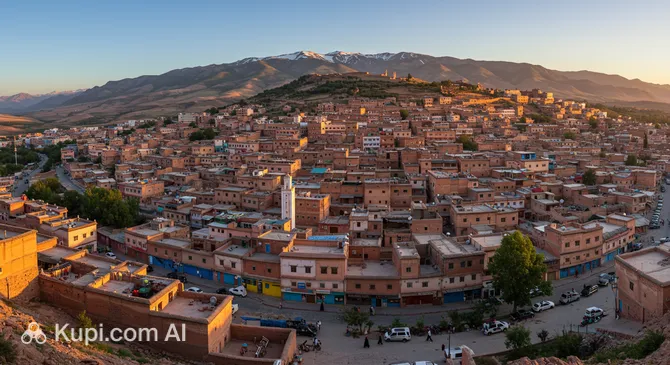
Khenifra. Illustration.
Source: Kupi.com AI

For travelers, Khénifra is primarily attractive for its natural riches. Its proximity to the National Park, with its crystal-clear lakes and ancient forests, makes the city an ideal starting point for ecotourism and hiking. Here, you won't find massive shopping malls, but you can experience the true culture of Morocco while enjoying the silence and coolness of the mountain foothills.

If you are looking for a place to feel a genuine connection with nature and the history of the Berber people, be sure to visit this "hidden mountain" city. Khénifra warmly welcomes those who appreciate the tranquility, authenticity, and wild beauty of the Middle Atlas.

Weather Overview

The climate in Khénifra is distinctly continental and mountainous, due to its elevation of about 1,000 meters above sea level. The city is located in the foothills of the Middle Atlas, which ensures cooler air and better air quality compared to the country's lowland regions. Thanks to the abundance of forests and the proximity of the Oum Er-Rbia River, breathing is easy even during the hot months.

Summer in the city is usually dry and quite hot: in July and August, average daytime temperatures reach +36°C, though the low humidity helps in enduring the heat. Winters, on the other hand, can be quite cold and wet. In January, the temperature often drops to +2°C, and snow falls in the nearby mountains. Most precipitation occurs between November and April, with March often being the rainiest month. Detailed data on the weather in Khénifra will help you better plan your wardrobe for the trip.

The most favorable times for a visit are spring (April-May) and autumn (September-October). During these periods, comfortable temperatures in the range of +20...+25°C are established, which is ideal for long walks in the National Park and visiting historical kasbahs. If you plan a trip in winter, be sure to bring warm clothing, as traditional houses can be quite cool.

Average monthly temperature

Average monthly precipitation

Interesting Facts

  • The city's name originates from the Tamazight root "khanfar", which translates to "warmth" or "hearth"—historically, it was a gathering place for Berber tribes to stay warm and socialize.

  • The city is considered the unofficial Berber capital of the Middle Atlas, specifically for the Zayane tribal confederation, famous for their fierce resistance during the colonial period.

  • Khénifra is surrounded by a unique cedar forest, which is part of a National Park covering over 840 square kilometers, protecting the region's biodiversity.

  • The Oum Er-Rbia flows through the city—one of Morocco's longest and most voluminous rivers, with its sources located nearby in the Atlas Mountains.

  • The buildings in the city have a characteristic reddish-ochre hue, resulting from the use of local geological materials, and this serves as the architectural signature of the Middle Atlas.

How to Get There

The accessibility of Khénifra is defined by its location in a mountainous area, so the primary way to get here is by road. The city is situated on the N8 national highway, which connects it to the country's major cultural centers. A trip from Fes (about 160 km) takes approximately 3 hours, while the journey from Marrakesh (300 km) can last up to 5 hours due to the scenic but winding mountain serpentines.

For international travelers, the nearest major aviation hub is Casablanca's Mohammed V International Airport (CMN). Although it is about 250 km away, most international flights arrive there. It is also convenient to use Fes–Saïss Airport to reduce travel time by car. You can find more details about flights and logistics in the section on ways to reach the city.

AirportPassenger trafficDistance
Fes-Saiss Airport2.5 mln128 km
Sale Airport1.2 mln160 km
Moulay Ali Cherif Airport89 000162 km
Mohammed V9.8 mln186 km
Ouarzazate Airport182 000250 km

There is no direct rail connection to the city, as Khénifra is not part of the main Moroccan rail network. Tourists often take a train to Meknes or Fes and then transfer to intercity buses operated by CTM or Supratours, which run regularly and offer high levels of comfort. "Grand taxis" operating between cities are also a popular and affordable option.

Main Attractions

While Khénifra is not a classic tourist center with an abundance of monumental sights, it possesses its own unique charm rooted in its historical heritage and natural landscapes. The main symbol of the city is the Kasbah Mouha ou Hammou Zayani—the only surviving fortress of the Zayane Berber confederation. This fort serves as a reminder of the region's heroic past and its role in defending Berber territories.

Another significant landmark is the so-called "Portuguese" Bridge across the Oum Er-Rbia River. Despite its name, its origins are shrouded in local legends, and the structure itself is a popular spot for walks, offering picturesque views of the riverbanks and the old city quarters. Nearby, you can also find the ruins of Kasbah Adekhsal, which add historical depth to the city.

For nature lovers, the main "attraction" is Khénifra National Park itself, which begins right on the city's doorstep. This vast territory features cedar forests where you can encounter wild Barbary macaques, and high-altitude lakes such as Aguelmame Sidi Ali. Khénifra serves as an ideal transit point for anyone heading to these natural gems of Morocco.

Local Cuisine

The cuisine of Khénifra offers the honest and rich flavors of the Berber Atlas. Traditional Moroccan dishes prepared according to ancient recipes form the basis of the local diet. You must try the local lamb tagine, which is often complemented by prunes and almonds, or the hearty couscous with seven vegetables, which is made particularly filling here.

A specific feature of the region is the use of products from the cedar forest. Here you can find unique dishes featuring pine nuts and magnificent mountain honey. Harcha—dense cornmeal flatbreads served for breakfast with butter and honey—is also popular. In street stalls in the city center, you can always grab a bite of freshly prepared kebabs or hot harira soup.

The main drink, as in all of Morocco, remains mint tea, which locals call "Berber whiskey." It is drunk very sweet and hot at any time of day. In Khénifra, you can also always find fresh-squeezed orange juice, with fruit brought in from neighboring valleys. The city's gastronomic scene is simple and accessible, and you can eat at small family restaurants by the river or in the lively market squares.

Travel Tips

A trip to Khénifra will show you Morocco from a completely different, mountainous, and authentic side. To ensure your trip goes smoothly and leaves only pleasant impressions, check out these practical tips.

  1. Clothing and Essentials: Even if you are traveling in summer, be sure to bring warm clothing—it can get chilly in the mountains in the evenings. For walking around the city and its surroundings, comfortable closed shoes are necessary. Also, keep the dress code in mind: choose modest clothing that covers shoulders and knees to show respect for local traditions.
  2. Transport: Inside the city, it is most convenient to move around by Petit Taxi (small taxis); they are cheap and easy to find. For longer trips, use CTM buses or Grand Taxis.
  3. Finances: The main currency is the Moroccan Dirham (MAD). Cards are rarely accepted in Khénifra, so always carry cash with you. ATMs are available in the center, but it's better to exchange money beforehand in larger cities.
  4. Health: Drink only bottled water and avoid ice in street cafes. Pharmacies are easy to find in the city center, marked with a green cross.
  5. Communication: The main languages are Berber (Tamazight) and Arabic, and many people speak French. English is not widely spoken here, so a few phrases in French or Arabic will be very useful.
  6. Etiquette: Greet people with your right hand. If you are invited for tea, don't decline immediately—it's an important gesture of hospitality.
  7. What to Avoid: You should not photograph locals without their explicit consent. Also, avoid walking in remote, unlit neighborhoods at night.
  8. Extra Tip: The best time to visit is spring or autumn, when the nature of the National Park is at its most beautiful and the weather is ideal for hiking.

Khénifra is a place for those seeking sincerity. Be open to communication, and this region will respond with the warmth of its "hearth"!

Entertainment & Nightlife

Traditional nightlife with loud clubs and bars is virtually non-existent in Khénifra, as the city maintains conservative Berber traditions. In the evenings, the central squares and the Oum Er-Rbia riverfront become the main gathering points. Here, locals congregate in traditional cafes to discuss the day's events over a cup of mint tea, creating an atmosphere of cozy and leisurely relaxation.

Daytime entertainment in the city is closely linked to strolling through local markets and bazaars, where you can observe the daily lives of artisans and traders. For those seeking more active leisure, the primary option is heading out into nature. The National Park offers opportunities for hiking, lakeside picnics, and wildlife watching, which are the main "entertainment" for visitors to the region.

During the summer, local festivals dedicated to Berber culture and music are sometimes held in the city; however, these are family-oriented and focused on preserving traditions rather than mass partying. If you crave more vibrant urban bustle and cultural events, travelers usually head to nearby major centers such as Fes or Meknes.

Parks & Museums

In Khénifra itself, there are virtually no traditional museums; however, the entire city and its surroundings can be described as a living museum of Berber culture. The absence of exhibition halls is more than compensated for by historical kasbahs and the traditional way of life preserved in the old quarters. The region's main cultural treasure is its heritage, passed down through crafts and architecture.

Regarding parks, urban greenery is minimal, but Khénifra possesses something much more grand—Khénifra National Park. This 842 km² nature reserve is the main pride of the residents. It is home to the famous lakes Aguelmame Sidi Ali and Aguelmame Aziza, surrounded by majestic cedar forests. These are ideal spots for those seeking solitude in nature, clean mountain air, and picturesque hiking trails.

The Oum Er-Rbia River flowing through the city also creates natural green zones on its banks, which serve as favorite leisure spots for city dwellers. The lack of typical urban parks is not felt as a disadvantage here, as the wild nature of the Middle Atlas starts literally just beyond the city limits, offering tourists endless opportunities for walks and picnics.

Getting Around

Public transport in Khénifra is mainly represented by small buses and shared taxis, though the system does not follow a strict schedule. To get around the city, tourists most often choose walking, as the city center is quite compact, or use what are known as Petit Taxis (small taxis). This is an inexpensive and convenient way to travel: a trip around the city will cost approximately 10–20 dirhams.

For trips to the suburbs or neighboring villages of the Middle Atlas, Grand Taxis (large taxis) are used. These are usually older Mercedes vehicles that depart once they are full of passengers. Prices for such trips are fixed, but it's worth noting that during peak hours, especially on market days, the taxi stations can be crowded.

If you plan to visit the National Park or the high-altitude lakes, the best solution is to rent a car. This will give you the necessary freedom of movement, as public transport to natural attractions is infrequent. Bicycle rental is practically non-existent in the city due to the mountainous terrain, so for active exploration of the surroundings, you should rely on your own strength or hire a guide with a car.

Accommodation

Accommodation in Khénifra is primarily geared toward travelers who appreciate simplicity and authenticity. You won't find luxury five-star hotels here, but the city offers a decent selection of mid-range and budget hotels, often used by tourists as a base for transit or for exploring the National Park. Most establishments are concentrated in the city center and along the main N8 highway.

For a deeper immersion into the local culture, it is worth looking into guesthouses and apartments rented out by locals. This is an excellent option for families or those planning to stay in the region for a longer period. The most convenient area to stay is the center near the river, as it provides the easiest access to markets and major transport hubs.

Housing prices in Khénifra remain very affordable compared to Morocco's major tourist cities. However, if your trip is planned for the spring or autumn—the best times to visit the mountains—it is recommended to book in advance through international services, as the number of high-quality options in the city is limited.

Nearby Cities

Thanks to its location in the heart of the Middle Atlas, Khénifra is an excellent starting point for exploring nearby settlements and natural sites. Every journey from the city is an opportunity to see the diversity of Moroccan landscapes, from arid foothills to dense forests and high-altitude pastures.

Just a few kilometers away is Sidi Ameur El Hadi, and a bit further is Zaouia Ait Ishaq. These small towns allow you to see the non-touristic side of the region. It is also worth visiting Mrirt, famous for its weekly markets where you can buy authentic Berber rugs and local handicrafts at very attractive prices.

CityPopulationDistance
Sidi Amer El Hadi11 81419 km
Zaouia Ait Ishak19 13320 km
Ait Yazza14 25924 km
Mrirt42 73027 km
Ait Ouaoumana8 84928 km

For those ready for longer trips, the region offers journeys to the cultural capital of Fes or imperial Meknes, which can be reached in a few hours. However, remember that the main value of the area surrounding Khénifra is not the large cities, but the quiet mountain villages and the untouched nature of the Atlas, which should be discovered slowly.

Shopping & Souvenirs

Shopping in Khénifra is primarily about visiting traditional markets, known as souks. There are no glittering storefronts of shopping malls here, but there is the vibrant atmosphere of an oriental bazaar. The most interesting market stalls are located in the city center, along the riverfront and main streets. Locals come here for fresh produce, spices, and essential items, creating the unique flavor of the Moroccan province.

The main souvenirs to bring back from Khénifra are the products of local Berber artisans. The city is famous for its handmade rugs with patterns characteristic of the Zayane tribes. Also, look out for cedarwood items, honey from local apiaries, and pine nuts, which are gathered here in abundance. These are natural, high-quality goods that are rarely found in such plenty in other regions of the country.

Most shops follow a traditional schedule: they open in the morning and close in the evening, with a mandatory lunch break during the hottest time. Payment is made predominantly in cash (Moroccan Dirham); cards are accepted in only a few large stores or pharmacies. Haggling in the markets is part of the communication culture, so don't be afraid to discuss the price, especially when buying rugs or souvenirs.

Reached the end of the page?

That means the route is fully explored