Support

Inhambane Airport

About the Airport

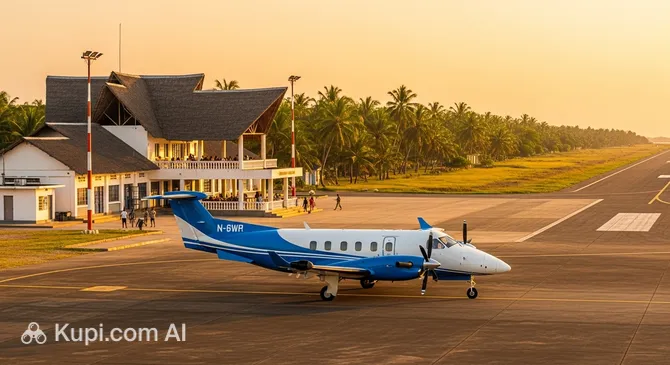
Inhambane Airport. Source: Kupi.com Binoculars

Inhambane Airport is not merely a transit point, but a true gateway to a tropical paradise, where your introduction to the legendary "Land of Good People" begins. This compact air hub, surrounded by palm trees and permeated by a warm ocean breeze, sets the mood for a relaxed coastal holiday rhythm from the very first minutes. The terminal serves as the main starting point for adventurers eager to see the famous marine giants at Tofo Beach or enjoy the endless sand dunes of the Barra resort.

IATA Code INH
ICAO Code FQIN
City Inhambane
Distance to center 4 km
Status International
Passengers per year ~20,000 (estimated)

Airport Features and Advantages

The main advantage of Inhambane Airport is its intimate atmosphere and lack of hustle. Unlike noisy capital hubs, there are no endless queues or complicated transfers here; all pre-flight formalities and baggage claim are surprisingly fast and calm. Intuitive navigation and a small territory allow passengers to feel confident, even if they have flown here for the first time.

Its strategic location makes this airport an ideal choice for tourists: a trip to the historic city centre takes just minutes, and popular beach resorts can be reached by transfer in less than half an hour. Despite its modest infrastructure, the airport retains the unique flavour of Mozambique, where the friendliness of the staff and the leisurely atmosphere become part of a pleasant journey.

Contact Information

To obtain current information about the operation of Inhambane Airport (INH), it is recommended to use the following contacts. Please note that as a regional airport, it may not possess all the communication channels typical of major international hubs.

  • Official Website: Inhambane Airport is managed by Aeroportos de Moçambique (ADM), E.P. Current information should be sought on their official website. The airport does not have a separate website.
  • Inquiry Service Phone: +258 29 320 549. We recommend verifying the validity of the number before calling, as it may change.
  • Address: The airport is located in the city of Inhambane, Mozambique.
  • Email: There is no specialised email address for passengers. For official inquiries, use the contacts listed on the Aeroportos de Moçambique website.
  • Social Media: The airport does not maintain its own pages on social networks. News related to air travel in the region can be tracked on the official pages of airlines flying to Inhambane.
  • Lost Luggage Information: For all questions related to lost or damaged luggage, you must apply directly to the airline whose services you used. Airport staff do not engage in luggage tracing.
  • Passenger Support Contacts: For immediate assistance and consultations, please contact the information desk in the terminal or your airline's representative office.

How to Get to the Airport

Getting to Inhambane Airport (INH) from the city centre of Inhambane is simple, as the distance between them is only a few kilometres. A trip by car usually takes no more than 10-15 minutes, depending on the traffic situation. There are several transport options suitable for different budgets and preferences.

The most common and convenient method for tourists is a taxi. You can find cars in the city centre or ask to book a car at your hotel reception. Besides regular taxis, cheaper moto-taxis are also popular. It is extremely important to agree on the cost of the trip with the driver before it begins, as meters are rarely used. Another reliable option is to book a private transfer through a hotel or travel agency, which guarantees a fixed price and comfort.

For those looking for the most budget-friendly option, there is local public transport — "chapas". These are route minibuses that serve as the main means of transport for residents of Mozambique. They do not have a strict schedule and can be overcrowded. There may not be a direct route to the terminal entrance, so be prepared to walk a short distance. This method is suitable for experienced travellers ready to immerse themselves in the local atmosphere.

If you prefer independence in movement, you can rent a car. Several rental agencies operate in the city, offering various types of vehicles. It is recommended to book a car in advance, especially during the tourist season. Inhambane Airport has a small car park where you can leave a car for a short time. Conditions for long-term parking are best clarified on-site, but typically, they are quite basic.

Terminals and Map

The Inhambane Airport (INH) is a small regional airport primarily serving domestic flights. Its structure is extremely simple and clear, making it very convenient for travellers arriving in this part of Mozambique for the first time.

The airport consists of one passenger terminal, which is a compact single-storey building. Both arriving and departing passengers are served in this same building. Due to the small size and simple layout, there are no complex diagrams or long walkways in the airport. All key zones are within walking distance of each other.

Departure and Arrival Zones are located in different parts of the same hall. Immediately upon entering the terminal, you find yourself in a common area where the check-in counters of several airlines are located. After check-in, passengers pass through security screening and enter a small waiting lounge with a boarding gate. The arrival zone is just as simple: after disembarking from the aircraft, passengers walk to the terminal, where a luggage claim belt and counters of local transport companies are located in a small hall.

Completing all pre-flight procedures, such as flight check-in and screening, usually takes no more than 30-45 minutes thanks to the low passenger flow. Nevertheless, it is recommended to arrive at the airport 1.5-2 hours before departure to avoid rushing. Navigation at Inhambane Airport is intuitively understandable; getting lost here is practically impossible. All signs are clearly visible, and the staff is always ready to help you orient yourself.

Airport History

The history of Inhambane Airport (INH) is closely linked to the development of the eponymous province in Mozambique. Although the exact founding date of the airfield is not always indicated in official sources, its appearance dates back to the colonial period when Portugal administered this territory. Initially, it was likely a simple airstrip created for administrative and logistical needs, ensuring communication between the remote province and the then-capital Lourenço Marques (now Maputo).

A key stage in the airport's development was Mozambique gaining independence and the subsequent growth of tourist interest in the region. The beaches of Tofo and Barra, known for their opportunities for diving and observing whale sharks, began to attract travellers from all over the world. This stimulated the gradual modernisation of the airport. The runway was improved to accommodate larger aircraft, and the modest terminal eventually underwent reconstruction to meet basic international standards and cope with the growing flow of passengers.

Inhambane Airport has not been the arena of major historical events on a global scale; its history is a chronicle of gradual transformation from a utilitarian facility into a key gateway for tourism. For many travellers, it is from this small and cosy airport that their acquaintance with one of the most picturesque corners of Africa begins. Its main achievement is not passenger traffic records, but ensuring accessibility to the unique natural attractions of the province.

Among interesting facts, one can note its compactness and atmosphere. Unlike giant international hubs, everything here happens leisurely and in a friendly manner. Passengers often walk from the aircraft to the terminal building, immediately immersing themselves in the warm tropical air. Today, Inhambane Airport is a vital transport hub playing a key role in the region's economy, directly linking it with the world and allowing thousands of tourists to discover the beauties of the Indian Ocean coast.

Services and Amenities

Inhambane Airport (INH) is a small regional airport serving the city of the same name and popular beach destinations in Mozambique, such as Tofo and Barra. Given its compact size, the range of services here is focused on the basic needs of passengers and differs significantly from large international hubs. When planning a trip, it is worth preparing in advance for the fact that most services are available in the city itself, rather than in the terminal.

Inside the airport, you will find a very limited selection of dining establishments and shops. Typically, a small kiosk or café operates here, where you can buy water, soft drinks, and light snacks. Do not expect full-service restaurants or duty-free shops. The main waiting hall is small, and separate VIP zones or business lounges are not provided here.

Opportunities for internet connection at the airport are also minimal. Public Wi-Fi is generally absent, and the number of sockets for charging electronic devices is limited. It is recommended to carry a portable power bank. Regarding financial services, there may be no ATMs or currency exchange points at the airport, so it is better to take care of money exchange in advance in the city of Inhambane.

Specialised services, such as medical posts, mother and child rooms, or business centres, are absent at Inhambane Airport. Passengers with reduced mobility or those travelling with small children and needing special assistance should notify their airline in advance to organise support. There are no hotels directly on the airport territory, but various accommodation options can be found in the nearby city and on the coast.

Where to Eat

When planning a departure from Inhambane Airport (INH), it is important to consider that this is a small regional airport, and dining options here are extremely limited. Unlike large international hubs, you will not find a wide variety of restaurants and cafés here.

Typically, a small buffet or kiosk operates in the main and only terminal building. The assortment usually includes basic beverages (water, soda, juice), packaged snacks (chips, biscuits, chocolate), and possibly simple coffee. This is sufficient for a light snack while waiting for a flight, but one should not count on a full hot lunch or dinner.

Unfortunately, it will not be possible to try local Mozambique cuisine at the airport. For authentic gastronomic experiences, it is better to visit one of the restaurants in the city of Inhambane. Specialised dietary options (vegetarian, vegan, gluten-free, or Halal meals) are also absent at the airport. If you have strict dietary restrictions, it is strongly recommended to bring food with you.

The café's operating hours depend directly on the flight schedule — it opens shortly before departures and closes after the last aircraft leaves. Prices may be slightly higher than in the city. Thus, if you only need a quick snack, the local kiosk will suffice. For a more substantial meal, the best solution would be to eat beforehand in the city before travelling to the airport.

Travel Tips

To ensure your journey through the airport of Inhambane city goes as smoothly as possible, use our tips. Inhambane Airport (INH) is a small air harbour serving mainly domestic flights, so it has its own specifics.

Arrival Time: Despite the compact size of the airport, it is recommended to arrive 1.5-2 hours before the departure of a domestic flight. This time will be sufficient to check in, drop off luggage, and pass security without haste. For international flights (if any are operating), allow at least 2-3 hours.

Check-in and Security: Procedures at regional airports may not be as fast as at major hubs. Complete online check-in in advance if your airline provides such an option — this will save time. Keep your passport and boarding pass ready. Security checks are standard, but be prepared for a manual inspection of hand luggage.

Seat Selection on the Plane: Small propeller aircraft are often used on flights to Inhambane. To enjoy views of the Indian Ocean coast, choose a window seat. If comfort and the ability to exit quickly after landing are important to you, an aisle seat is more suitable.

Hand Luggage: Standard rules apply here as well: liquids in containers up to 100 ml, packed in a transparent bag. Sharp objects and flammable substances are prohibited. Be sure to put all valuables, documents, medicines, a portable charger, and perhaps a light snack in your hand luggage, as the selection at the airport may be limited.

Connecting Passengers: Inhambane is rarely a transit point. Most often, transfers to international flights take place in Maputo. If you have a connecting flight, clarify at check-in whether you will need to collect and re-check your luggage at the transfer point.

Customs Control: Upon entering Mozambique, you will have to pass passport and customs control. Be prepared to answer standard questions about the purpose of your visit and place of stay. Declare all goods subject to declaration. Upon departure, customs procedures are usually formal unless you are exporting items requiring special permission.

Saving Time and Money: Book airline tickets in advance, especially during the high tourist season. To avoid overpaying for drinks, take an empty water bottle with you and fill it after passing security. It is better to arrange a transfer from the airport (taxi or hotel shuttle) in advance.

In Case of Flight Delay: In the event of a flight delay or cancellation, immediately contact your airline representative. Find out about your rights to beverages, meals, or accommodation. Given the modest infrastructure of the airport, it is highly recommended to have a book, a charged laptop, or a tablet with movies to pass the waiting time.

Reached the end of the page?

That means the route is fully explored