Support

Matundo Airport

About the Airport

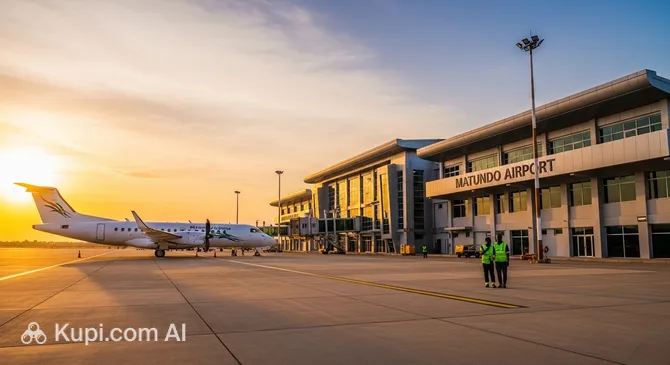
Matundo Airport. Source: Kupi.com Binoculars

Matundo Airport (TET), also known as Chingozi Airport, serves as the main air gateway to the Tete province in Mozambique. Located on the banks of the mighty Zambezi River, this airport acts as a departure point for both business travelers heading to one of the country's key industrial hubs and tourists wishing to explore the region's unique nature. Despite its compact size, the airport plays a strategic role, providing vital connections to the capital and neighboring countries.

IATA Code TET
ICAO Code FQTT
City Tete
Distance to Center About 7 km.
Status International.
Annual Passengers Exact current data on annual passenger traffic is not regularly published; however, the airport handles dozens of flights per week, serving as a key transport hub for the region.
Popular Airlines LAM Mozambique Airlines, Airlink, Ethiopian Airlines.
Schedule "Matundo Airport" online flight board

A key advantage of Matundo Airport is its strategic importance and functionality. It provides direct connections not only to the capital of Mozambique, Maputo, but also to a major international hub—Johannesburg in South Africa—which significantly simplifies logistics for international travelers. The airport terminal is modern and convenient, allowing passengers to quickly go through all necessary pre-flight and post-flight formalities. Essential services are available for travelers, including airline counters and car rental services.

The airport is particularly important for the economic development of the Tete province, which is rich in natural resources. It serves a large flow of specialists and business delegations, contributing to the region's growth. Thanks to its efficiency and convenient location, Matundo Airport is an indispensable element of the transport infrastructure of northern Mozambique.

Contact Information

Below is the main contact information for Matundo Airport (TET), which may be useful for travelers. Please note that the airport is managed by Aeroportos de Moçambique (ADM), and many contact details may be general for all airports in the country.

  • Official Website: There is no direct website for Tete Airport. All official information is published on the portal of the management company, Aeroportos de Moçambique (ADM): www.adm.co.mz.
  • Inquiry Service Phone: +258 25 223 371
  • Address: Aeroporto de Chingozi, Tete, Moçambique
  • Email: For general inquiries, you can use the management company's e-mail: geral@adm.co.mz.
  • Social Media: There are no official social media pages for the airport. News can be tracked on Aeroportos de Moçambique resources.
  • Lost Luggage Information: For issues related to lost or damaged luggage, it is recommended to first contact the support service of the airline you flew with.
  • Passenger Support Contacts: For assistance and consultations on general issues, please use the airport inquiry service phone number.

How to Get to the Airport

Chingozi Airport (TET), also known as Matundo Airport, is located quite close to the city of Tete in Mozambique. You can get there from the city center in several ways, the choice of which depends on your budget, time, and comfort preferences. In general, the journey will not take much time, as the airport is just a few kilometers from the main districts of the city.

Taxi and Transfer — the most popular and reliable way to get to the airport. The trip from the center of Tete will take approximately 10–15 minutes depending on traffic conditions, particularly on the bridge across the Zambezi River. Taxis can be found on the city streets or ordered at your hotel reception. Key point: be sure to negotiate the price of the trip with the driver before starting the journey, as taximeters are rarely used. The cost is usually low, but it is better to clarify it in advance. An alternative could be a pre-booked transfer.

Regarding public transport, route taxis known as "chapas" operate in Tete. This is the most budget-friendly option, which allows you to experience the local atmosphere. However, it has significant downsides: the lack of a clear schedule, heavy crowding, and the fact that the route may not pass directly by the terminal entrance. This method is suitable for experienced travelers with light luggage but is not recommended for those traveling with large bags or rushing for a flight.

Car Rental — an excellent choice for those who value independence and plan to explore not only the city but also its surroundings. Several car rental companies operate in Tete. The car can be picked up either in the city or directly at the airport by prior arrangement. Having your own transport will allow you to move freely and not depend on taxi schedules.

For travelers with a personal or rented car, parking is provided at Chingozi Airport. You will easily find a space for both short-term and long-term parking. Given that the airport is small, problems with the availability of free spaces usually do not arise, and parking prices are quite moderate.

Terminals and Map

Matundo Airport (TET), serving the city of Tete and its surroundings in Mozambique, is a modern and compact aviation hub. Navigating here is quite simple, as all operations are concentrated in one passenger terminal, which was built relatively recently to replace the old building.

The terminal serves both domestic flights (for example, to Maputo) and international flights, mainly to neighboring countries. All infrastructure is under one roof, making navigation intuitively clear. You won't have to worry about transfers between terminals—they simply do not exist here. Departure and arrival zones are clearly separated.

Terminal Structure and Navigation:

  • Departure Zone is usually located on one level or in one part of the building. Here you will find airline check-in counters, a security checkpoint, and a small waiting hall with boarding gates.
  • Arrival Zone includes passport control counters for international flights, a baggage claim belt, and customs inspection. After completing all formalities, passengers exit into the general hall.

Registration and screening procedures at Tete Airport generally take less time than at major international hubs. Nevertheless, it is recommended to arrive at the airport in advance: 1.5–2 hours before a domestic flight and 2–3 hours before an international one. Thanks to the compact size of the terminal and clear signage, you will easily find your way from the entrance to your gate.

Airport History

The history of Matundo Airport (TET), also known as Chingozi Airport, is closely intertwined with key events in the life of the city of Tete and all of Mozambique. Its origins go back to the 1960s when it was founded by the Portuguese Air Force as a military airfield (Base-Aeródromo nº 8). During that period, its main task was to provide air support during the Mozambican War of Independence. This military chapter of history laid the foundation for future civilian infrastructure.

After the country gained independence in 1975, the airfield was converted into a civilian airport and began to play a key role in the region's transport system. Its importance grew significantly after the end of the civil war, when the active development of rich coal deposits began in Tete province. The airport became a vital artery connecting this industrial center with the rest of the country and the world, facilitating the transport of both passengers and cargo.

The airport experienced a real development boom in the 2010s, which was directly linked to the growth of the mining industry. To meet the increased demands, a large-scale modernization was carried out. A key stage was the opening of a new, modern passenger terminal in 2016. This project allowed the airport's capacity to increase from 50,000 to more than 300,000 passengers per year. In addition, the runway was reconstructed to accommodate heavier aircraft.

Thus, Matundo Airport has come an impressive way from a modest military base to a modern air gateway of strategic importance to the economy of Mozambique. Interesting fact: its history is a mirror reflecting the transformation of the entire country, from a colonial past to an independent future built on the development of its own natural resources. Today, it is not just a transport hub, but an important element of the economic prosperity of the entire region.

Services and Amenities

Matundo Airport (TET), serving the city of Tete, is a compact regional aviation hub. The set of services here is focused on meeting the basic needs of passengers before departure. It is important to consider that the airport's infrastructure corresponds to its size, so the choice of amenities may be limited compared to major international hubs.

In the terminal building, you will find small kiosks and cafés where you can buy light snacks, soft drinks, and coffee. Opportunities for shopping are modest and mostly limited to souvenirs. Regarding connectivity, Wi-Fi access may be unstable or unavailable, so it is recommended to have your own mobile data. The number of power outlets for charging devices is limited. For financial transactions, a currency exchange point or ATM may be operating, but it is better to handle major banking services in the city beforehand.

Specialized VIP lounges or lounge areas may be absent at the airport. Passengers traveling in business class should check information about the availability of privileged waiting areas directly with their airline. For passengers with reduced mobility, basic assistance is provided during boarding and disembarking, but the air carrier should be notified of the need for such service in advance. Facilities for passengers with small children are minimal, so it is worth bringing everything you need with you.

There are no hotels or business centers within the airport territory. The nearest hotels and conference rooms are located in the city of Tete, which is easily accessible by taxi. Medical assistance is limited to a first aid station; in case of serious problems, it is necessary to contact city medical institutions.

Where to Eat

Matundo Airport (TET) offers passengers basic options for a snack and rest before departure. Given its relatively small size, the selection of establishments here is quite modest but sufficient to have a coffee or a light bite while waiting for a flight.

The main place for dining at the airport is a small café or snack bar located in the main hall of the terminal. Typically, it is situated in the public area (landside), meaning before passing pre-flight security, making it convenient for both departing passengers and those seeing them off. Here you can order hot and cold drinks, including coffee, tea, and juices, as well as light snacks.

For a quick snack, the menu usually features sandwiches, pastries, chips, and chocolate. If you want to try something from the local cuisine, the choice will likely be limited to simple snacks, subject to availability. For a full lunch or dinner, Matundo Airport is not the best place—for a wider selection of dishes, it is worth visiting one of the restaurants in the city of Tete before traveling to the airport.

Passengers with strict dietary restrictions (vegetarians, vegans, or those following a Halal or gluten-free diet) should note that specialized options are practically impossible to find here. In this case, the most reliable option is to bring food with you. Prices in the airport café are expectedly higher than in the city. Opening hours are usually synchronized with the flight schedule—they open before the first flights and close after the departure of the last ones.

Travel Tips

To ensure your journey through Matundo Airport goes as smoothly and comfortably as possible, take advantage of our useful tips. These recommendations will help you save time, stress, and money, making your experience at the airport of Tete more predictable and pleasant.

Arrival Time: Even for a small regional airport like Matundo, it is better to arrive in advance. We recommend arriving at least 1.5-2 hours before domestic flights and 2-3 hours before international ones. This time will be sufficient to calmly go through all procedures without unnecessary rushing.

Check-in and Security: If possible, complete online check-in for your flight—this will save you time at the airport. Keep your passport and boarding pass ready. When passing through security control, take laptops and other large gadgets, as well as your plastic bag with liquids, out of your hand luggage in advance.

Seat Selection: If there is an opportunity to choose a seat during check-in, consider your preferences. A window seat will allow you to enjoy the views during takeoff and landing, while an aisle seat offers more legroom and the ability to stand up without disturbing neighbors.

Hand Luggage: Be sure to put all valuables in your hand luggage: documents, money, bank cards, electronics, and medication. Remember that liquids can only be carried in containers of no more than 100 ml, packed in a transparent bag. Sharp objects, weapons, and flammable substances are prohibited.

Passengers with Transfers: If you have a connecting flight, clarify during check-in whether you will need to collect and re-check your luggage at the intermediate airport. Upon arrival, immediately find information on the flight board about the gate number for your next flight.

Customs Control: When entering Mozambique or leaving the country, be prepared for standard questions from the customs service. Familiarize yourself with the rules for importing and exporting currency and goods in advance to avoid misunderstandings. Declare all items subject to mandatory declaration.

Saving Time and Money: To save money, bring an empty water bottle with you and fill it after passing security control. Prices for food and drinks at airports are generally higher. A pre-booked transfer from the airport may also turn out to be cheaper than a taxi taken on the spot.

Flight Delays: In case of a flight delay, stay calm. Contact your airline representative for information on the flight status and check if you are entitled to vouchers for food or drinks. Have a book, a charged power bank, or downloaded movies with you to pass the waiting time.

Reached the end of the page?

That means the route is fully explored