Support

Yangon International Airport

About the Airport

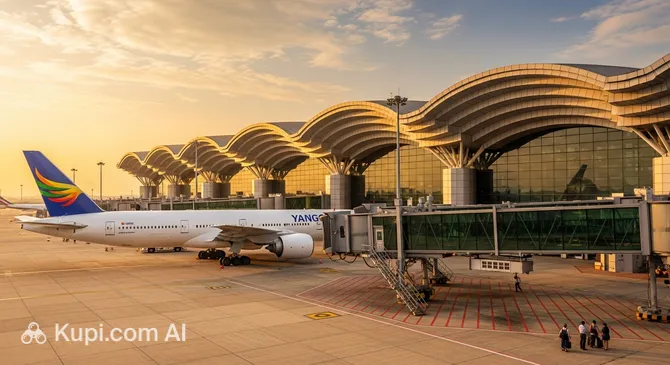
Yangon International Airport. Source: Kupi.com Binoculars

Yangon International Airport (Mingaladon Airport) is the main aerial gateway to Myanmar and a key transport hub connecting the country with major Asian cities. The airport complex welcomes travellers with a unique combination of modern efficiency and traditional Burmese architecture, where the terminal roofs resemble golden pagodas. It is not merely a transit point, but the first introduction to the charm and hospitality of the "Golden Land," offering comfortable conditions to begin your adventure.

IATA Code RGN
ICAO Code VYYY
City Yangon
Distance to Centre ~15 km
Status International
Passengers per Year ~3.25 million (2023)
Schedule Regular flights

Airport Features and Highlights

Yangon Airport is actively modernising and today offers passengers a high level of service. The complex consists of several terminals: Terminal 1 serves international flights and is the most modern, whilst Terminal 3 is dedicated to domestic flights within Myanmar. The old Terminal 2 is currently under reconstruction, indicating the continuous development of the air harbour.

Travellers have access to various relaxation zones and business lounges, such as the Mingalar Sky Lounge, where one can await their flight in comfort. The airport features a wide selection of dining establishments: from famous international chains (such as KFC and Burger King) to cafés serving local cuisine, where it is worth trying the traditional mohinga soup.

Transport accessibility is also at a good level. You can reach the city centre via official taxis, with counters located in the arrival zone, or use the budget-friendly YBS bus service running between the airport and Yangon Railway Station. Free Wi-Fi is available throughout the terminals, along with currency exchange points and Duty Free shops.

Contact Information

Below is the essential contact information for Yangon International Airport (RGN) that may be useful for travellers.

  • Official Airport Website: yangonairport.aero
  • Inquiry Service Phone: +951 9670111
  • Airport Address: Yangon Airport Road, Mingaladon Township, Yangon, Myanmar
  • Email: info.yia@yia.aero (for general enquiries)
  • Social Media: The airport maintains an active Facebook page where you can follow news and updates.
  • Lost Luggage Information: If you have lost your luggage, you should first contact your airline's representative. For items left within the terminals, you may approach the information counters or call the lost and found service: +95 9 451893114 (Terminal 1) and +95 9 451893115 (Terminal 3).
  • Passenger Support Contacts: For assistance, you may call the general airport phone number or speak to staff at the information counters located in the arrival and departure halls.

How to Get to the Airport

There are several ways to get to Yangon International Airport (RGN) from the city centre, each with its own advantages depending on your budget, time, and preferences. Yangon is a large city with heavy traffic, so it is worth planning your journey to the airport in advance. A trip from the central part of the city usually takes from 45 minutes to 1.5 hours, but during peak hours, it may require more time.

Taxi and Transfer — the most popular and convenient option. You can hail a taxi on the street or book a car via the Grab app, which is widely used in Myanmar and offers a fixed trip cost. When using a street taxi, it is strongly recommended to agree on the price with the driver before the journey begins to avoid misunderstandings. The average cost of a trip from the city centre to the airport is approximately 8,000–12,000 Myanmar Kyat (MMK). A pre-booked hotel transfer may cost more but ensures maximum comfort.

Public Transport is represented by special Yangon Bus Service (YBS) shuttle buses. This is the most budget-friendly way to reach the airport. The buses are equipped with air conditioning and luggage space. Routes connect the airport with key points in the city, including the central railway station. The fare is significantly lower than a taxi, however, the journey may take longer, and this option might not be very convenient if you have a lot of luggage. There is no direct train or metro connection to the airport in Yangon.

For those who prefer to drive themselves, car rental services are available. Several companies offer their services both in the city and directly at the airport. This option is convenient if you plan further travel around the country. The airport territory features parking where you can leave a vehicle for a short or long term. Please note that driving in Yangon can be challenging due to heavy traffic and local road conditions.

Terminals and Map

Yangon International Airport (RGN) consists of two main passenger terminals that serve international and domestic flights. It is important to check in advance which terminal your flight departs from to avoid confusion upon arrival at the airport.

Terminal 1 (T1) is a modern international terminal serving all flights outside Myanmar. It is a multi-level building where the departure zone is located on the upper floor, and the arrival zone on the lower floor. Key amenities are concentrated here: duty-free shops, various cafés and restaurants, VIP lounges, currency exchange points, and tourist information counters. Navigation inside the terminal is intuitive thanks to signs in English and Burmese.

Terminal 3 (T3) is used for servicing all domestic flights within the country. It is significantly smaller and simpler in structure than the international terminal. It also features departure and arrival zones, but the choice of services is limited to essentials: a few cafés, souvenir shops, and check-in counters for local airlines. The atmosphere here is calmer, and procedures are completed faster.

Terminals T1 and T3 are located in close proximity to each other. You can easily move between them on foot via a covered walkway, which takes no more than 5-10 minutes. This is convenient for passengers transferring from an international flight to a domestic one and vice versa.

For international flights, it is recommended to arrive at the airport 2.5-3 hours before departure to calmly complete check-in, passport control, and security screening. For domestic flights, 1.5-2 hours is usually sufficient. During peak hours, waiting times may increase, so it is always better to have a time buffer.

Airport History

The history of the main airport of Myanmar dates back to the post-war years. It was built in 1947 on the site of a former British Royal Air Force airfield, known as RAF Mingaladon. Upon its opening, the airport was considered one of the most modern and well-equipped in Southeast Asia, receiving flights from many international airlines and acting as a vital transit hub in the region.

For several decades, the airport functioned without significant changes. However, with the increase in tourist flow and the country's economic development in the early 21st century, a need for radical modernisation arose. The first large-scale reconstruction phase was completed in May 2007, when a new, modern international terminal was opened, capable of serving a much larger number of passengers and meeting new standards of safety and comfort.

Further development followed swiftly. In 2016, the new international Terminal 1 (T1) was commissioned, and at the end of that same year, the new domestic Terminal 3 (T3). These steps allowed the airport's capacity to increase to 20 million passengers per year. Today, Yangon International Airport serves as the country's key transport hub, continuing its story from a modest airfield to a modern complex opening the way to amazing Myanmar.

Services and Amenities

Yangon International Airport (RGN) offers passengers a full range of modern services to make waiting for a flight as comfortable and productive as possible. Regardless of the purpose of your trip, you will find everything you need here — from various cafés and shops to specialised services for business travellers and families with children.

Feeling hungry? The airport terminals house numerous restaurants and cafés where you can try both dishes of local Myanmar cuisine and familiar international snacks. For shopping enthusiasts, there are duty-free shops with a wide selection of perfumes, beverages, and tobacco products, as well as souvenir stalls where you can purchase traditional handmade items, jewellery, and textiles — excellent gifts to remember your trip by.

For those who value privacy and enhanced comfort, VIP halls and business lounges operate at the airport. Here you can relax in a quiet atmosphere, enjoy complimentary snacks and drinks, and utilise work zones. Free Wi-Fi is available throughout the terminals, and numerous gadget charging stations will allow you to stay connected at all times.

Financial matters can be settled right in the airport building. At your service are bank branches, ATMs, and 24-hour currency exchange points where you can exchange money upon arrival or before departure. In case of need, passengers can visit the medical centre for first aid.

Travellers with children will appreciate the presence of mother and child rooms. For passengers with reduced mobility, a barrier-free environment has been created: the airport is equipped with ramps, special lifts, and restrooms. It is recommended to notify the airline in advance if assistance is required. Although there are no hotels within the airport building itself, several hotels offering comfortable accommodation and transfer services are located in the immediate vicinity.

For business people who need to work while waiting for a flight, comfortable workspaces are provided in the business lounges. Some lounges also offer conference room services for meetings and negotiations, making Yangon Airport a convenient venue for business.

Where to Eat

At Yangon International Airport, passengers will find sufficient options for a snack or a full meal before departure. Dining establishments are mainly concentrated in Terminal 1 (international flights), but Terminal 3 (domestic flights) also has places to refresh yourself.

The main choice of restaurants and cafés is located in Terminal 1. In the public area (landside), before passing passport control, you can find several establishments where it is convenient to sit with those seeing you off. After passing control, in the departure zone (airside), the choice becomes even wider: from international fast-food chains, such as KFC, to coffee shops like Gloria Jean's Coffees, where you can enjoy quality coffee with fresh pastries. In Terminal 3, the selection is more modest, but there are also local cafés offering snacks and drinks.

For those wishing to enjoy local cuisine one last time, some cafés offer traditional Burmese dishes. This is an excellent opportunity to try the famous mohinga soup or a hearty curry with rice. If time is short, numerous coffee shops and kiosks offer sandwiches, salads, and desserts that are convenient to take on board.

Regarding special dietary needs, finding certified Halal or gluten-free dishes might be challenging. However, vegetarians will find it easier: the menus of many establishments feature meat-free dishes, such as vegetable curries, salads, and rice-based meals. The price range at the airport is generally higher than in the city, but one can find both budget options for a quick snack and more expensive restaurants for a comfortable wait. Most establishments operate according to the flight schedule, opening early in the morning and closing after the departure of the last flights.

Traveler Tips

To ensure your journey through the main airport of Myanmar leaves only pleasant impressions, make use of our tips. They will help you orient yourself upon arrival and make waiting for your flight comfortable.

Currency and Connectivity upon Arrival: Immediately after passing passport control in the arrival zone, you will find mobile operator kiosks (MPT, Ooredoo) and currency exchange points. We recommend purchasing a local SIM card for internet access and exchanging a small amount into Myanmar Kyat (MMK). The exchange rate at the airport is quite acceptable, and cash will be needed for small purchases and taxis, especially if you plan trips outside Yangon.

Getting to the City: The most convenient and reliable way to get to your hotel is to order a taxi via the Grab app. This is the Asian equivalent of Uber/Careem, which shows a fixed trip cost, eliminating the need to bargain. Free Wi-Fi at the airport will allow you to make a booking. Install the application in advance to save time.

Check-in and Security Control: To speed up pre-flight formalities, complete online check-in if your airline provides this option. This allows you to go straight to the baggage drop-off counter. Keep your passport and boarding pass handy, and be prepared to remove laptops and other large electronic devices from your hand luggage during security screening.

Baggage and Hand Luggage Rules: Always pack your most valuable items in your hand luggage: documents, money, bank cards, electronics, power banks, and necessary medication. Remember the standard restriction on liquids — no more than 100 ml in one container. When departing the country, be careful with souvenirs: the export of antiques and certain Buddha images is strictly regulated.

Customs Control: Upon entering the country, it is necessary to fill out a declaration. Declare expensive electronics and large sums of cash to avoid misunderstandings. If you are unsure whether an item needs to be declared, it is better to consult a customs officer.

Transit Passengers: If you have a connection in Yangon, clarify at check-in whether your luggage will be transferred automatically. Typically, when flying with one airline or alliance, this happens without your involvement. Follow the "Transit"/"Transfer" signs to avoid exiting into the general zone and to save time on repeated security screening.

Reached the end of the page?

That means the route is fully explored