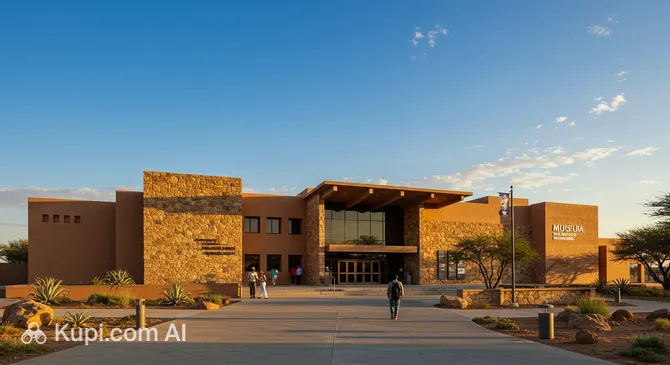
Towering over the historical center of Windhoek, the Independence Memorial Museum is an impressive modern building that has become an important symbol of national identity. This socialist realism-style architectural landmark was opened in 2014 and is dedicated to the long and arduous journey Namibia took toward sovereignty. Its golden facade, which many compare to a "kitchen appliance" due to its unusual shape, stands out strikingly against the capital's colonial-era architecture.
Independence Museum. Illustration.
Source: Kupi.com AI
Traveler photos:
One of the museum's most notable features is its external glass elevators. As they ascend, visitors can enjoy breathtaking panoramic views of the city and the neighboring Christuskirche. Guests are greeted at the main entrance by a monumental statue of the country's first president, Sam Nujoma, highlighting the solemnity and significance of this site for every citizen of the republic.
Inside the museum, guests can expect a deep immersion into cultural heritage and history. The exhibits tell the stories of colonial resistance and the fight for freedom through large-scale murals, dramatic sculptural compositions, and rare archival photographs. It is not just a repository of artifacts, but a living reminder of the resilience and unity of the people.
Contacts
To check for the latest information regarding special exhibitions or group visits, you can use the museum's official contact details.
The main reason to visit the museum is to explore its three-level exhibition in detail. On the first floor, you will find portraits of resistance leaders and scenes from the colonial era. Moving to the second and third levels, you will see impressive North Korean-style murals illustrating the stages of the liberation struggle and the final moment of independence in 1990. Here, you can see the harmonious coexistence of representatives from various ethnic groups, such as the Himba, Ovambo, and Herero.
Be sure to take the glass elevator located on the outside of the building. It is an attraction in itself: during the ascent, the best panorama of Windhoek unfolds before you. From the height of the museum floors, you can see the famous German church and the cozy streets of the city center, making the visit not only educational but also visually aesthetic.
For fans of photography and art, the monumental murals and sculptures will be of particular interest. They are crafted with great drama, allowing you to literally feel the atmosphere of historical events. After touring the galleries, it's worth lingering in the panoramic hall on the top floor to process the scale of what you've seen in a peaceful setting and enjoy the silence high above the bustling city.
Getting There
The Independence Memorial Museum occupies a central position in the city, situated on a hill along Robert Mugabe Avenue. It is easy to find: the golden building is visible from afar and is located in close proximity to iconic landmarks like Christuskirche and the Alte Feste (Old Fortress).
For those already walking around the city center, the stroll to the museum will take no more than 10–15 minutes. If you prefer comfort, you can use a local taxi, which will take you to the foot of the hill from any point in the capital. Parking is available near the museum complex for those traveling by car.
If you are arriving from Hosea Kutako International Airport, the journey is about 45 kilometers. A taxi or transfer will take approximately 30–40 minutes. Public transport routes also run along Robert Mugabe Avenue, making the site accessible for budget travelers.
Nearest city: Windhoek
History & Facts
The history of this site is inextricably linked to the people's struggle for self-determination. The museum was officially opened in 2014 on the anniversary of the country's independence. Its exhibitions cover a dramatic period from the beginning of colonial rule in 1884 to the triumphant proclamation of freedom in 1990. The building itself is a symbol of a new era, towering over monuments of the colonial past.
The interior space is divided into three thematic levels. The first floor is dedicated to "Colonial Oppression," revealing the history of resistance by early leaders like Hendrik Witbooi through archival photographs and documents. The second floor tells the story of "Liberation" and the role of the People's Army, while the third-floor exhibits lead visitors along the "Road to Independence," concluding with a large-scale collage symbolizing the unity of the country's modern ethnic groups.
An interesting fact is the museum's architectural origin. The project was realized by the North Korean company Mansudae Overseas Project, which explains the monumental socialist realism style of the murals and sculptures. Standing before the entrance is a majestic statue of Sam Nujoma, the country's first president, holding the Constitution — a symbol of statehood and law.
Time Needed
To thoughtfully explore all three floors of the exhibition, examine the detailed murals, and read the historical information, most visitors need about 1.5 to 2 hours. This is enough time to walk through the halls at a leisurely pace and soak in the atmosphere of national pride.
Don't forget to allow an extra 15–20 minutes for the ride in the glass elevators and to enjoy the panoramic views of the city from the upper deck. If you plan to visit the restaurant on the top floor or take many photos of the surroundings, your visit may last longer.
Working Hours
The Independence Memorial Museum is open to visitors throughout the work week and on Saturdays. When planning your visit, please refer to the following schedule:
Monday – Friday: 09:00 – 16:30
Saturday: 10:00 – 15:00
Sunday: Closed
Please note that operating hours may change on public holidays. It is recommended to check the current schedule on the museum's official website before your visit.
Day
Opening hours
Monday
09:00–16:30
Tuesday
09:00–16:30
Wednesday
09:00–16:30
Thursday
09:00–16:30
Friday
09:00–16:30
Saturday
10:00–15:00
Sunday
Закрыто
Nearby
The museum's location in the heart of the historical center makes it an ideal starting point for further exploration of the capital. Key monuments and interesting sites reflecting different eras of the region's development are just steps away.
A walk through the surrounding area will allow you to see both modern memorials and the architectural heritage of past centuries. Below is a list of interesting places within walking distance: