Support

Kamperbinnenpoort

About

In the heart of the ancient city of Amersfoort stands the majestic Kamperbinnenpoort—a unique monument of medieval architecture preserved to this day. It is one of the last remaining sections of the first city wall, which once provided reliable protection for the local residents. When traveling through the Netherlands, it is definitely worth stopping here to see the massive towers and authentic brickwork that create the city's unmistakable historical character.
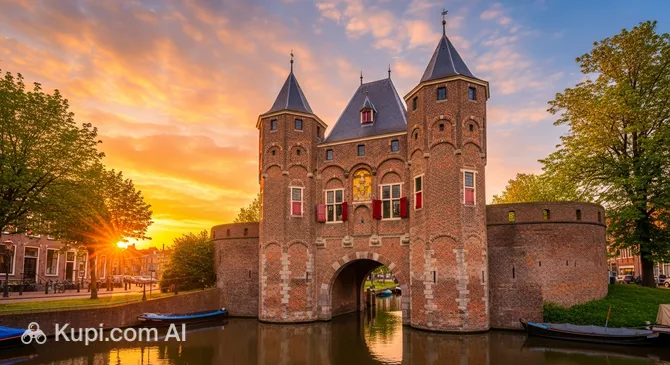
Kamperbinnenpoort
Kamperbinnenpoort. Иллюстрация. Источник: Kupi.com AI

The gate is located at the intersection of Langestraat and Kamp, acting as a kind of portal between different eras. Thanks to its powerful construction with characteristic loopholes and an elegant arch, the site has become a real magnet for photography and history enthusiasts. Kamperbinnenpoort is inextricably linked to the famous Muurhuizen street ("Wall Houses"), which was built directly onto the foundations of the old fortifications.

Today, it is a well-maintained and popular attraction that symbolizes the city's transition from a closed fortress to an open trading hub. The gate is surrounded by cozy alleys and canals, making it the perfect starting point for a leisurely exploration of the region's cultural heritage.

Contacts

For up-to-date information on events or detailed historical information, you can contact the local tourist office. There are no direct contact phone numbers specifically for the gate, as it is an open-air architectural monument.

How to contactContact
AddressKamperbinnenpoort 8, 3811 AL Amersfoort, Нидерланды

What to Do

The main pleasure of visiting Kamperbinnenpoort is the opportunity to walk beneath its ancient vaults and feel like a resident of the Middle Ages. Be sure to notice the architectural details: the towers and loopholes still preserve the spirit of the city's defensive past. Passing through the arch, you will find yourself in the historical Kamp district, home to more than 20 national monuments.

During your walk, keep a close eye on the house facades. Here, you can find fascinating facade stones (gevelstenen) that served as building numbers in the old days. For example, on the house at Kamp 2, an image of a tobacco mill is preserved, and on the corner with Coninckstraat, you can see a 1687 facade titled "D'Gekroonde Bye-Korf" (The Crowned Beehive), which once housed a coffee and tea warehouse.

For those seeking peace and quiet, the de Armen de Poth is located nearby—a medieval "hofje" (enclosed courtyard) founded as far back as 1350. It is a true oasis of tranquility with a rich history of helping those in need. Also, don't forget to take a selfie with the modern sculpture "Dé Stier" (The Bull) by Thijs Trompert, which creates a striking contrast with the ancient gate.

Visitors often note that the area around the gate is perfect for a leisurely photo tour. The canals reflecting the brick walls of the towers and the lack of large tourist crowds allow for atmospheric shots at any time of day.

Getting There

The attraction is located in the very heart of the historical center, so the easiest way to reach it is by public transport. Most travelers arrive by train from Amsterdam or Utrecht at the Amersfoort Centraal station. From the station, the gate is a pleasant 10–20 minute walk, allowing you to enjoy the city's architecture along the way.

If you are already in the center, look for the special metal arrow-shaped markers on the ground—they lead to the main historical sites. You can also walk down the main shopping street, Langestraat, which leads directly to the gate's arch.

For those traveling by car, it is recommended to use the coordinates POINT(5.3929276 52.1572069) for your GPS. Keep in mind that the historical core of Amersfoort is primarily a pedestrian zone, so it is best to leave your car in one of the parking lots located just outside the central canal ring.

Ближайший город: Amersfoort

History & Facts

The history of Kamperbinnenpoort dates back to the 13th century, when the gate was built as part of Amersfoort's first city wall. At that time, it served as an important defensive hub and the main entrance to the city from the side of the pastures. Interestingly, the name "Kamp" comes from the Latin word campus, meaning "enclosed field."

Around 1380, the city began to grow rapidly, and the need arose for a new, wider outer wall. After the construction of the outer gate (Kamperbuitenpoort), the old inner tower lost its military significance. At one point, the gate was even called the "Viepoort" (Cattle Gate), as livestock were regularly driven through it to the pastures.

The monument's fate has not always been easy. In the 19th century, many elements of the fortifications were demolished, including the arch between the towers. In the early 20th century, city authorities even planned to demolish the structure entirely to make room for a square. Fortunately, thanks to the intervention of the central government and the provision of subsidies, a large-scale restoration began in 1914, returning the gate to its historical appearance.

Today, this site is considered one of the oldest surviving examples of medieval urban planning in the region. Walking under its vaults, you can literally feel the breath of centuries: over 700 years ago, life was just as busy here, with merchant wagons passing through and thousands of people going about their day.

Time Needed

To see Kamperbinnenpoort itself, take photos, and examine the ancient masonry details, you will need very little time—about 20–30 minutes. However, the gate serves as an "entry point" to a very picturesque neighborhood.

We recommend setting aside 1 to 2 hours to visit this site and stroll through the adjacent streets of the historical quarter. This is plenty of time to leisurely admire the facades of old houses, find hidden courtyards, and soak up the atmosphere of the medieval city.

Working Hours

As Kamperbinnenpoort is an architectural monument located on a public street, you can view the exterior of the gate and walk under its arch 24 hours a day. However, if you plan to visit the interior spaces or any themed exhibitions (if they are being held), you should follow the standard opening hours for similar sites in the city.

Typically, access to the interior parts is possible from Wednesday to Saturday, 11:00 AM to 5:00 PM. Access to the inside may be closed on Mondays, Tuesdays, and Sundays. We recommend checking the current schedule on the official Amersfoort tourism portal before your visit.

DayWorking hours
понедельникЗакрыто
вторникЗакрыто
среда11:00–17:00
четверг11:00–17:00
пятница11:00–17:00
суббота11:00–17:00
воскресеньеЗакрыто

Nearby

Amersfoort is a remarkably compact city where national monuments can be found at every turn. A walk from the gate in any direction will allow you to discover even more interesting locations and immerse yourself in the atmosphere of old Holland.

NameDistance
St George's Church0.2 km
Kafe van Zanten0.3 km
The Break Pool & Lounge Café0.3 km
Mondrian House0.3 km
Waterlijn Canal Cruises Amersfoort0.3 km
Boothill Saloon Amersfoort0.4 km
Flehite Museum0.4 km

Reached the end of the page?

That means the route is fully explored