Support

Paintmill De Kat

About

Like a living illustration from an old art history book, De Kat Dye Mill (or "The Cat") stands proudly over the banks of the Zaan River. This unique structure in Amsterdam (Zaanse Schans district) is the world's only working windmill where artistic pigments are still produced using 17th-century techniques.

Here, in the heart of the Netherlands, visitors can witness massive stone millstones grinding raw natural materials into vibrant powders. It is believed that the great Rembrandt van Rijn used paints just like these in his work. Today, the mill's products remain in high demand by professional artists and restorers from the world's leading museums.
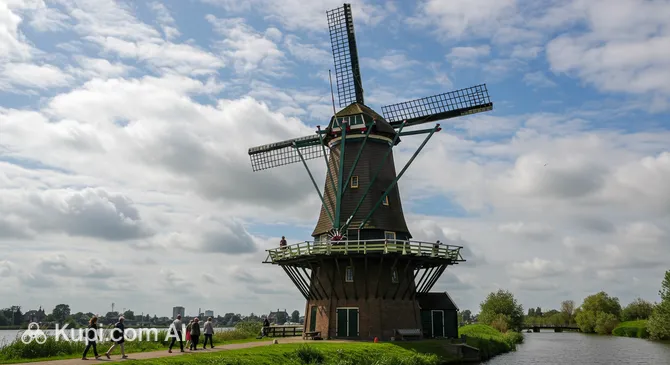
De Kat Paint Mill
De Kat Paint Mill. Иллюстрация. Источник: Kupi.com AI

The octagonal mill is equipped with a rotating cap and a spacious external gallery. From the high deck, guests can enjoy breathtaking panoramic views of the polders and neighboring historic buildings. Every year, this site attracts more than 130,000 tourists wishing to experience the living heritage of the Dutch Golden Age.

Contacts

To contact the mill administration and inquire about group tours, you can use the official contact details. The site is open to visitors throughout the tourist season.

How to contactContact
AddressKalverringdijk 29, 1509 BT Zaandam, Netherlands
Phone+31 75 621 0477
Websitewww.verfmolendekat.com

What to Do

The main highlight awaits you inside: here, you can see the operation of complex wooden mechanisms firsthand. To the steady rumble of rotating sails, a professional miller demonstrates the process of grinding chalk and natural dyes. Watching the power of the wind turn stones into the finest colored dust is a truly hypnotic sight.

Be sure to climb up to the mill's external gallery. This vantage point offers one of the best views of Zaanse Schans: traditional green houses, the mirror-like surface of the river, and the sails of neighboring mills, such as the De Zoeker oil mill. It is the perfect spot for panoramic photos capturing the atmosphere of Old Holland.

At the end of your visit, stop by the local shop. It sells unique handmade paints, pure pigments recreated from the recipes of the old masters, and original souvenirs. For curious visitors, there are information brochures available in various languages to help you understand the workings of this engineering marvel in detail.

Getting There

The journey to this iconic landmark from central Amsterdam takes very little time. The most convenient way is to take bus No. 391 or No. 395, which depart from the Central Station (Amsterdam Centraal). The trip to the Zaanse Schans stop takes about 30 minutes, and the ticket costs approximately 5 euros.

If you prefer traveling by rail, take a train to Zaandam station. From Zaandam station, the mill complex can be reached by bus No. 24 or No. 28 in about 15 minutes. During the summer, special tourist boats also run between the capital and the Zaanse Schans district, offering guests a scenic canal trip.

Travelers by car can reach the site via the A8 highway in just 20 minutes. Paid parking is available on the complex grounds (about 6 euros per day). Since the area is pedestrianized, from the entrance of Zaanse Schans, you will need to take a pleasant walk along the banks of the Zaan River, where the historic mills are lined up.

Ближайший город: Amsterdam

History & Facts

The history of this site dates back to the mid-17th century. The first mill on this plot received official permission to use wind power in January 1646. Decades later, it was converted into an oil mill; however, in 1782, the wooden structure was severely damaged by fire, after which it was fully restored.

In the early 20th century, the mill lost its upper section and was used for a long time only as a warehouse for drying chalk. De Kat Dye Mill experienced its "rebirth" in 1960, when the octagonal top of another old mill—De Duinjager, built in 1696—was installed on its preserved base. Thus, today we see a unique architectural symbiosis of two historical sites.

At one time, about 50 dye mills operated in the Zaan region, but only "De Kat" has survived to the present day. Thanks to the efforts of the Zaan Windmill Society, established in 1925, this monument of industrial architecture was preserved and is now the world's only working windmill producing paints using traditional techniques.

Time Needed

A detailed visit specifically to the "De Kat" mill usually takes 45 to 90 minutes. This is plenty of time to explore the internal mechanisms, climb the external gallery for photos, and browse the unique pigment shop.

However, since the mill is located in the picturesque Zaanse Schans park, you should allow at least 2–3 hours for a general stroll through the area. This will let you enjoy the views of the Zaan River at your own pace, visit neighboring oil mills, and discover other traditional crafts of the region.

Working Hours

The mill welcomes visitors daily, making it easy to include in any travel itinerary. The operating schedule is consistent throughout the week:

Monday – Sunday: from 09:00 to 16:30.

It is important to note that the pigment grinding demonstration is directly dependent on the wind force and the miller's current schedule. On windless days, the mechanisms may be still, but the mill itself and the shop remain open for visitors.

9:00 – 16:30

Nearby

A visit to the dye mill can easily be combined with exploring other interesting locations nearby. As the site is part of a large ethnographic complex, other craft workshops and open-air museums are literally just a few steps away.

Exploring neighboring attractions will help you better understand the lifestyle and traditions that the Netherlands is famous for. Below is a list of interesting places located at various distances from the mill:

NameDistance
De Gekroonde Poelenburg Saw Mill0.1 km
Fabrique des Lumières10.5 km
Eye Filmmuseum11.5 km
Anne Frank House12 km
Camping Vliegenbos12 km
WONDR Experience12.1 km
Café Hill Street Blues12.3 km

Reached the end of the page?

That means the route is fully explored