Support

Peace Palace

About

The majestic Peace Palace (Vredespaleis) is not just an architectural masterpiece, but one of the most recognizable symbols of justice that the Netherlands is proud of. Located in the heart of The Hague, it serves as the administrative center for the planet's key legal institutions, including the UN International Court of Justice and the Permanent Court of Arbitration.
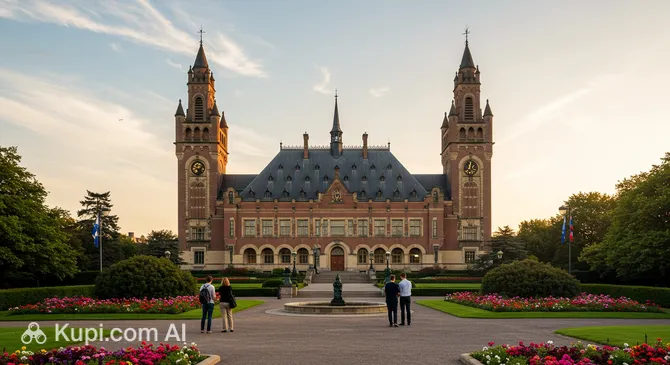
Peace Palace. Illustration.
Source: Kupi.com AI

Traveler photos:

The building, constructed in the early 20th century, impresses with its Neo-Renaissance appearance. Massive red brick and granite walls, an elegant 80-meter clock tower, and a sloping grey roof create a solemn and dignified image. The palace's architecture harmoniously blends elements of Gothic and Byzantine styles, emphasizing its international status and historical significance.

Today, the Peace Palace is considered "the most photographed building" in the country. It is a place where the great ideals of peace take physical form, and its doors are open to those who want to touch the history of the modern world order's formation.

Contacts

To check visiting possibilities and book excursions, you can use the following contact information:

How to contactContact
AddressCarnegieplein 2, 2517 KJ Den Haag, Netherlands
Phone+31 70 302 4242
Websitewww.vredespaleis.nl

What to Do

Inside the Peace Palace, visitors will find a true journey around the world, as the building's interiors are decorated with unique gifts from various nations. You will see magnificent Japanese tapestries, which craftsmen worked on for several years, luxurious carpets from Turkey, and an elegant porcelain fountain donated by Denmark. Every detail here speaks of a striving for unity.

Special attention should be paid to the Great Hall of Justice. It features impressive massive wooden sculptures, intricate mosaics, and stained-glass windows depicting allegories of peace. Walking through the halls, one can notice rare wood species from Brazil and Malaysia, Italian marble, and Chinese Ming Dynasty vases, making the interior look like a rich art museum.

Don't forget to visit the Peace Palace Library — one of the oldest and richest libraries dedicated to international law. Even if you are not a lawyer, the very atmosphere of this academic repository of knowledge makes a strong impression with its monumentality and silence.

Getting There

The famous architectural ensemble is located at Carnegieplein 2. Reaching it from the city center is easy. If you prefer walking, the route from The Hague Central Station takes about 20–30 minutes through picturesque city neighborhoods.

For those who value their time, public transport is ideal. Tram No. 17 goes directly to the gates of the attraction (get off at the Vredespaleis stop). You can also use bus No. 24. A taxi from the city center will take you to the site in just 5–10 minutes.

Please note that parking around the palace is very limited, so using public transport or a bicycle is the most convenient and eco-friendly solution, perfectly in keeping with Dutch traditions.

Nearest city: The Hague

History & Facts

The history of this "temple of justice" began with an ambitious idea following the First Hague Peace Conference of 1899, convened at the initiative of the Russian Emperor Nicholas II. Diplomats dreamed of creating a permanent venue for resolving international disputes peacefully, which led to the founding of the Permanent Court of Arbitration.

The realization of the project was made possible by the generosity of American philanthropist Andrew Carnegie. In 1903, he donated a vast sum for that time — 1.5 million dollars (equivalent to about 50 million today) — to build a structure that would become a symbol of global unity and the rule of law.

Construction was completed in 1913, and since then, the palace has never changed its purpose. Even during history's darkest periods, it remained a reminder of humanity's quest for justice. Today, it houses not only the court but also one of the world's largest libraries of international law.

Time Needed

When planning your visit, you should consider the format of your tour. If your goal is simply to see the building from the outside, walk through the adjacent park, and visit the Visitor Center at the main gates, 1–2 hours will be quite enough. This time is sufficient to take beautiful photos and explore the introductory exhibition.

If you are lucky enough to join a full guided tour of the interior halls (which are conducted by reservation on specific days), allow at least 2–2.5 hours. The palace's interiors are so rich in detail and works of art that rushing here would be unnecessary.

Working Hours

The site's schedule has its own specifics due to its status as an active state institution. Access to the Visitor Center and for external viewing is limited to the following hours:

  • Wednesday – Sunday: 12:00 PM – 4:00 PM
  • Monday – Tuesday: Closed

Please keep in mind that access to the palace's interior is only possible as part of organized groups and may be closed during court sessions or official events.

DayWorking hours
MondayClosed
TuesdayClosed
Wednesday12:00 – 16:00
Thursday12:00 – 16:00
Friday12:00 – 16:00
Saturday12:00 – 16:00
Sunday12:00 – 16:00

Nearby

The area around the Peace Palace is filled with interesting locations that will help you better understand the history and culture of the city. A walk through the neighborhood allows you to combine viewing majestic government buildings with visits to entertainment centers and parks.

NameDistance
Coffeeshop Dizzy Duck0.4 km
Panorama Mesdag0.6 km
Sorghvliet Park0.8 km
O'Casey's Irish Pub & Restaurant0.9 km
Noordeinde Palace1 km
Kunstmuseum The Hague1.1 km
Murphy's Law1.2 km

Reached the end of the page?

That means the route is fully explored