Support

Zaria

About the Airport

Zaria Airport is not merely a runway, but an aerial gateway to one of the oldest and most significant cultural and educational centres of Nigeria. Located near the historic city of Zaria, it serves as a starting point for those seeking to explore the rich heritage of the Zazzau Emirate and visit the renowned Ahmadu Bello University. Although it is not a bustling international hub, its role in the country's aviation life cannot be overstated, as it is here that the cradle of Nigerian aviation is found.
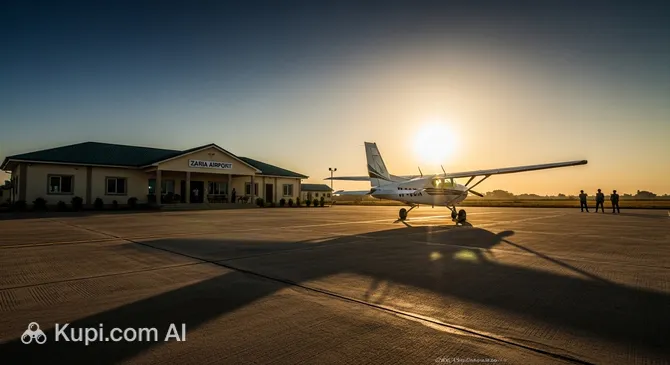
Zaria. Illustration.
Source: Kupi.com AI
PropertyValue
IATA CodeZAR
ICAO CodeDNZA
CityZaria
CountryNigeria
TimezoneAfrica/Lagos
ScheduleOnline Timetable

A key feature of Zaria Airport is its status. It is the main training base for the Nigerian College of Aviation Technology (NCAT) — the leading aviation educational institution not only in Nigeria but throughout West Africa. It is here that future pilots, air traffic controllers, and engineers take their first steps into the sky, creating a unique atmosphere at the airport filled with the spirit of learning and development.

For travellers, the airport is convenient due to its strategic location. It is situated in close proximity to the city, allowing quick access to hotels, landmarks, and the main campus of Ahmadu Bello University. Although regular commercial flights are extremely rare here, the airport actively serves private and government charters, playing an important role in the transport system of the northern region. Its compact size and the absence of large crowds typical of metropolises make passing through formalities quick and maximally comfortable.

Contact Information

Finding precise and up-to-date contact information for a small regional airport like Zaria Airport (ZAR) can be challenging. Below are general details and recommendations for contacting the airport.

  • Official Website: Zaria Airport does not have a separate official website. It is managed by the Federal Airports Authority of Nigeria (FAAN), and general information can be sought on their portal.
  • Inquiry Service Phone: A direct public phone number for the airport inquiry service is not available in open sources. For urgent matters, it is recommended to contact your airline directly.
  • Airport Address: Zaria Airport (ZAR), Zaria City, Kaduna State, Nigeria.
  • Email: A dedicated email address for general passenger inquiries is not provided.
  • Social Media: The airport does not maintain official pages on social media platforms.
  • Lost Luggage Information: For all issues related to lost or damaged luggage, you must contact the support service of the airline you flew with directly. The air carrier bears responsibility for luggage.
  • Passenger Support Contacts: Passenger support within the airport is provided by representatives of specific airlines at check-in counters and before boarding gates.

How to get to the airport

Reaching Zaria Airport (ZAR), located in close proximity to the city of Zaria in Nigeria, can be done in several ways. Thanks to its convenient location, the trip from the city centre usually takes no more than 15-30 minutes, although this time may vary depending on traffic. The choice of transport will depend on your budget, level of comfort, and amount of luggage.

Public Transport is the most economical option. The cost of a trip on local tricycles (known as "Keke Napep") or buses is usually only 100–300 Nigerian Naira (NGN). However, it is worth noting that this is not the most comfortable method, especially with luggage, and a transfer may be required. Specialized shuttles, trains, or metro lines to the airport are not provided. This option is best suited for those travelling light and wishing to save as much as possible.

Taxi or Private Transfer are the most popular and convenient ways to get to the airport. A taxi ride from the city centre will cost approximately 2,000 – 4,000 NGN. Taxis can be found throughout the city or ordered through a hotel. It is extremely important to agree on the fare with the driver in advance, before getting into the car, as meters are rarely used. For maximum convenience and safety, it is recommended to book a private transfer through a verified service or hotel. This ensures a fixed price and a meeting at the appointed time.

If you value independence and plan to travel extensively around the region, you might consider car rental. Several car hire companies operate in Zaria, but it is recommended to book a vehicle in advance online. The airport has a parking area where you can leave the car during your absence.

If you have not found convenient flights directly to Zaria Airport, you can consider flying into one of the neighbouring airports and travelling to the city by ground transport from there. The nearest alternatives include Kaduna Airport (KAD), located approximately 63 km away, and the major Mallam Aminu Kano International Airport (KAN) at a distance of about 137 km. You can also consider Katsina Airport (DKA), Gusau Airstrip (QUS), and Yakubu Gowon Airport (JOS).

Terminals and Map

Zaria Airport (ZAR) is a small regional airport serving the city of the same name and its surroundings in Nigeria. It consists of one compact terminal, which is used for both domestic departures and arrivals. Due to its modest size and simplicity, there is no complex structure with multiple terminals or walkways between them, making navigation intuitively clear even for first-time visitors.

The interior space of the single terminal is functionally divided into key zones. Immediately at the entrance are the check-in counters, followed by the security checkpoint. The Departure Zone consists of a small waiting hall with a boarding gate. The Arrival Zone is equally simple: passengers enter the baggage claim hall and then proceed immediately to the airport exit. The entire layout is extremely logical, and getting lost here is practically impossible.

Passing through pre-flight formalities at Zaria Airport usually takes little time due to the low passenger volume. Nevertheless, it is recommended to arrive at the airport in advance — approximately 1.5–2 hours before your flight departure. This time will be sufficient to calmly check in, drop off luggage, and pass through security screening without rushing, even in the event of small queues.

The main advice for navigation at Zaria Airport is simply to follow the signs and the general flow of passengers. All key points — from the entrance to the boarding gate — are within direct line of sight. The compactness of the terminal is its main advantage, saving travellers from stress and the need to search for the right exit or counter in a large and confusing building.

Airport History

The history of Zaria Airport (ZAR) is inextricably linked with the establishment of the aviation industry in Nigeria. The airport was built and commissioned in the mid-1960s, practically simultaneously with the founding of the Nigerian College of Aviation Technology (NCAT) in 1964. From the very beginning, its primary task was not serving commercial flights, but creating a practical base for training future pilots, engineers, and other aviation specialists.

Unlike large international airports, the development of Zaria Airport followed the path of improving infrastructure for educational purposes. Its history is not a chronicle of opening new passenger terminals, but rather a record of modernising the training base. For decades, it has served and continues to serve as a "flying classroom" for thousands of NCAT students, which is considered one of the leading aviation educational institutions in Africa. The entire history of the airport is, in essence, the history of the college itself.

In recent years, the airport has undergone several important stages of modernisation aimed at improving the safety and efficiency of training flights. Work was carried out on the reconstruction of the runway and the installation of modern lighting equipment. This allowed training flights to be conducted at night, significantly expanding the possibilities for pilot training in conditions as close to reality as possible.

The main achievement and most interesting fact in the history of Zaria Airport is not records for passenger traffic, but its unique status as the "cradle of Nigerian aviation". Although it receives a limited number of private and government flights, its key role remains unchanged: to be the country's main training airfield, where future generations of sky professionals hone their skills.

Services and Amenities

Zaria Airport (ZAR) offers passengers a basic set of services necessary for a comfortable wait for their flight. Being a small regional airport, it provides key amenities, although the selection may not be as extensive as in major international hubs.

Dining and Shopping. Within the terminal, there is typically a small café or snack bar where you can purchase drinks, snacks, and light meals. Opportunities for shopping are limited to kiosks selling essentials, press, and local souvenirs. There are no large stores or Duty-Free zones here.

Lounges and Connectivity. A general waiting hall is equipped for passengers. Specialised VIP or business lounges are likely absent at the airport. Access to public Wi-Fi may be unstable or unavailable, so it is recommended to have mobile internet. The number of power outlets for charging gadgets may also be limited — it is best to bring a portable power bank.

Financial and Other Services. An ATM for cash withdrawals may be installed at the airport. Currency exchange points and full-service bank branches are unlikely here, so financial matters are best resolved in advance in the city of Zaria. A medical point is provided in the terminal for first aid.

Facilities for Special Categories of Passengers. The airport provides assistance to passengers with reduced mobility. To obtain a wheelchair and escort, it is necessary to notify your airline in advance. There are no special playrooms for children, but airport staff are always ready to assist families with young travellers. Regarding business services, conference rooms and business centres are absent at the airport. The nearest hotels are also located in the city itself, not on the airport grounds.

Where to Eat

When planning a departure from Zaria Airport (ZAR), it is important to consider that this is a small regional airport, and the choice of dining establishments here is quite limited. Do not expect a wide variety of restaurants and cafés as found in major international hubs. Nevertheless, you can find options for a light snack before your flight.

On the airport premises, usually in the main hall before the security zone, there are small kiosks or cafés. Their assortment typically includes packaged snacks such as chips, biscuits, and nuts, as well as soft drinks and bottled water. Sometimes you can find more substantial options, for example, classic Nigerian pastries — meat pies or sandwiches. This is an excellent choice for quickly satisfying hunger.

For a full lunch or dinner, it is recommended to eat at one of the numerous establishments in the city of Zaria itself before travelling to the airport. Local cafés will offer you a much wider selection of authentic Nigeria cuisine at more affordable prices. Offerings at the airport are primarily oriented towards a quick snack rather than a leisurely meal.

Travellers with strict dietary restrictions (vegans, vegetarians, people with gluten intolerance) are strongly advised to bring food with them, as finding specialised dishes at the airport is practically impossible. Regarding Halal food, given the predominantly Muslim population in the region, most meat products are likely to comply with Halal standards by default, although you may not find specific labelling. The opening hours of local cafeterias are usually tied to the flight schedule, so they may be closed late at night or early in the morning.

Tips for Travellers

To ensure your journey through the airport of Zaria city goes smoothly, it is important to consider the specifics of this small regional aviation hub. These practical tips will help you prepare for your flight and make your stay in this part of Nigeria more comfortable.

Key Preparation — Do everything in the city: Remember that infrastructure at the airport is minimal. It is strongly recommended to resolve all important matters before arriving at check-in. Exchange currency, buy water, snacks, and other necessary items in Zaria. Also, ensure your electronic devices, including portable chargers, are fully charged.

Arrival Time: For domestic flights, it is recommended to arrive at the airport at least 2 hours before departure. This time is usually sufficient to pass through all formalities without rushing, which, although simple, may take time due to a lack of automation.

Check-in and Control: If your airline offers online check-in, take advantage of this opportunity. Upon arrival at the airport, keep your passport and boarding pass ready. The security screening procedure is standard: be prepared to remove laptops and liquids from your hand luggage for scanning.

Hand Luggage: Follow general aviation rules. Liquids can be carried in containers of no more than 100 ml each, packed in a transparent bag. Sharp objects and flammable substances are prohibited. Be sure to take documents, money, necessary medication, and valuables into the aircraft cabin with you.

Passengers with Transfers: Zaria Airport mainly serves direct flights. If you plan to transfer to another flight, be prepared for the likelihood that you will have to collect your luggage and go through the check-in procedure again. Clarify this point with the airline in advance.

Economy and Transport: To avoid inflated prices and long waits, arrange a taxi or transfer from the airport in advance. This is the most reliable and cost-effective way to get to the city or hotel.

In Case of Flight Delay: In the event of a schedule change, immediately contact your airline representative for information. Since waiting facilities at the airport are limited, it is useful to have a book or a downloaded film with you. Remain calm and be prepared that resolving the issue may take some time.

Reached the end of the page?

That means the route is fully explored