Support

Muscat International Airport

About the Airport

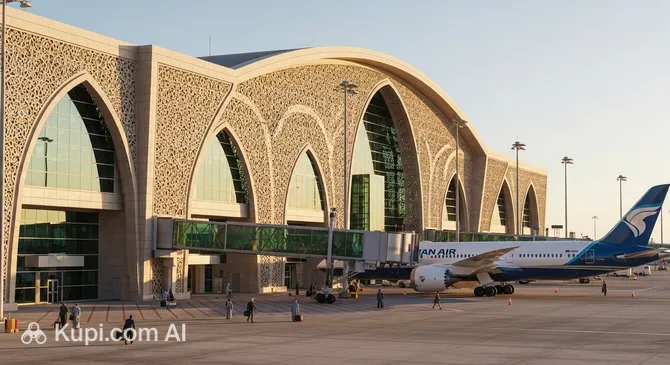
Muscat International Airport. Source: Kupi.com Binoculars
Muscat International Airport is not just a transport hub, but a true gateway to the East, where modern technology seamlessly intertwines with traditional Omani hospitality. Opened in 2018, the new terminal captures the imagination with its architecture inspired by desert landscapes and oases, creating a sense of tranquillity from the very first moments of your stay. Here, travellers can enjoy the unique atmosphere of a "silent airport," where announcements are kept to a minimum so as not to disturb the comfort of guests.
IATA Code MCT
ICAO Code OOMS
City Muscat
Distance to City Centre ~32 km
Status International
Passengers per Year ~12.6 million (2023 data)
Schedule 24 hours

Features and Advantages of the Airport:

Architectural Splendour: The terminal is designed to reflect the beauty of Oman's nature. Geometric patterns on the ceilings resemble dunes, while the use of water and light creates the feeling of a cool oasis amidst the hot climate.

"Silent Airport" Concept: Muscat is one of the few airports in the region that maintains a silence policy. Voice announcements are made only in exceptional cases, significantly reducing noise levels and stress for passengers.

Premium Comfort: The airport is renowned for its luxurious lounge areas with a high level of service. There is also a hotel located directly in the transit area, allowing for a comfortable rest between flights without leaving the terminal.

Convenient Navigation and Technology: Despite its impressive size (over 580,000 sq. m), the terminal is intuitive. Modern baggage handling and passport control systems ensure rapid processing of all formalities.

Contact Information

Below you will find contact information for Muscat International Airport to help you plan your trip and resolve any potential queries.

  • Official Website: www.muscatairport.co.om
  • Information Desk Phone: +968 24 351234
  • Address: Muscat International Airport, P.O. Box 1, PC 111, Muscat, Sultanate of Oman
  • Email for Feedback: feedback@omanairports.com
  • Social Media: Follow news and updates on the airport's official pages on X (formerly Twitter), Facebook, and Instagram.
  • Lost & Found: For issues related to lost or damaged luggage, it is recommended to contact your airline's representative or the ground handling operator directly. Contact details are usually listed on the airport's official website in the relevant section.
  • Customer Support Contacts: For general information and support, you can use the main airport information desk phone number.

How to Get to the Airport

Getting to Muscat International Airport from the city centre or other districts of the capital of Oman is straightforward. Depending on your budget, time, and preferences, you can choose from several convenient methods to get to your flight on time.

The most economical way is via Mwasalat public buses. The special Route A1 connects the airport with the Ruwi bus station in the centre of Muscat and other key areas. The buses are modern, air-conditioned, and run on schedule. The journey takes an average of 40-60 minutes depending on traffic, and the cost is around 1 Omani Rial. This is an excellent choice for solo travellers and those looking to save money. Please note that there is no metro or rail service in the city.

A faster and more comfortable option is a taxi. Outside the terminal exits, you will easily find official taxis (orange and white Mwasalat cars) operating on a meter. Mobile taxi apps, such as Otaxi, are also popular in the city and often offer more competitive rates. A trip from the city centre to the airport will take approximately 20-30 minutes, and the cost will average 6-10 Omani Rials. For families and large groups, a pre-booked transfer can be a convenient solution.

For those who value independence and plan to explore the picturesque surroundings of Muscat, renting a car is the best choice. Offices of many international and local rental companies are located within the airport building. This allows you not to depend on transport schedules and travel at your own pace. We recommend checking driving licence requirements in advance — citizens of some countries may need an International Driving Permit (IDP).

If you are driving to the airport in a personal or rented vehicle, convenient parking is at your service. There are both short-term parking zones for quick drop-offs and pick-ups, as well as secure long-term car parks where you can leave your car for the duration of your trip. Rates depend on the duration of parking and the distance from the terminal.

Terminals and Map

Muscat International Airport (MCT) is a modern and comfortable aviation hub of Oman, which was completely renovated with the opening of a new passenger terminal in 2018. Currently, the airport consists of two main terminals, although the vast majority of international and domestic flights are handled in the new building.

New Terminal (Terminal 1): This is the main and most modern building of the airport. It is a single large complex, which significantly simplifies navigation for passengers. The terminal's architecture is inspired by Omani traditions, while the interior space is characterised by spaciousness and light. The terminal serves flights for the national carrier Oman Air and most other major international carriers. All infrastructure — from check-in counters to boarding gates — is located under one roof.

Old Terminal (Terminal 2): Following the opening of the new complex, the old terminal was repurposed. It is now used primarily to serve budget airlines, such as SalamAir, as well as for special and cargo flights. Transfer between the old and new terminals, if necessary, is carried out by special shuttle buses, not on foot.

Layout and Navigation in the New Terminal:

  • Departures Area is located on the upper level. Here you will find check-in counters, passport control, and security checkpoints. After completing all formalities, passengers enter a spacious transit zone with numerous Duty Free shops, restaurants, and business lounges.
  • Arrivals Area is located on the lower level. Passengers go through passport control, collect baggage, and pass through customs inspection before exiting into the general hall, where they are met by hotel representatives and taxis.
  • Boarding Gates are divided into three piers (A, B, C). Distances to some gates can be significant, so moving walkways (travelators) are provided for passenger convenience.

Time for Formalities: Muscat Airport is known for its efficiency. On average, check-in and security screening take about 30-45 minutes during normal times. However, during peak hours or the tourist season, there may be queues. It is recommended to arrive at the airport 2-3 hours before an international flight to complete all procedures without rushing and enjoy the terminal's amenities.

Navigation Tips:

  • Pay close attention to signs — they are in Arabic and English and are very clear.
  • Immediately after passing security control, check your boarding gate number on the information screens, as it may change.
  • Allow enough time to walk to your gate, especially if it is at the end of one of the piers.

Airport History

The history of the main airport of Oman began in 1973, when it was opened under the name Seeb International Airport. Its construction was an important part of the country's modernisation programme and was intended to strengthen the Sultanate's ties with the rest of the world. For decades, it served as the main point of arrival for tourists and business travellers, gradually increasing passenger traffic.

A key moment in the airport's history was 2008, when it was officially renamed Muscat International Airport. This decision was made to better associate the airport with the capital and strengthen its brand on the global stage. By this time, it became obvious that the old terminal could no longer cope with the growing number of passengers, and a large-scale expansion and modernisation project was launched.

The most significant event in the airport's recent history was the opening of the new, ultra-modern terminal in March 2018. This project completely transformed the airport, turning it into one of the most modern and comfortable in the Middle East. The new terminal, with its impressive architecture inspired by Omani traditions, significantly increased capacity to 20 million passengers per year in the first phase, with the possibility of further expansion.

Immediately after opening, the new complex received international recognition, including the prestigious World Travel Awards as "World's Leading New Airport" of 2018. Today, it is equipped with advanced technologies, including automated baggage handling systems and 100% screening. An interesting fact: the new terminal is capable of handling the world's largest passenger aircraft, including the Airbus A380, confirming its status as an important regional aviation hub.

Services and Amenities

Muscat International Airport (MCT) is a modern and comfortable hub offering passengers a full range of services for a pleasant wait for their flight. In the spacious terminal, you will find numerous restaurants and cafes to suit every taste: from fast food outlets and coffee shops to restaurants where you can experience the cuisine of Oman. An extensive Duty-Free zone and numerous shops offer a wide selection of goods, including perfumes, electronics, souvenirs, and local delicacies.

For those who value enhanced comfort, several business lounges operate at the airport, such as the Primeclass Lounge and Majan Lounge. Access is open not only to business class passengers but also to everyone else for a fee. In the lounges, guests can relax in silence, use shower facilities, enjoy snacks and drinks, and work in a calm environment. Conference rooms and business centres are provided for business travellers.

Free Wi-Fi is available throughout the terminal, and numerous gadget charging stations allow you to stay connected at all times. Financial matters can be easily resolved at bank branches, ATMs, and currency exchange bureaus located in the arrival and departure halls. In case of necessity, passengers can contact the 24-hour medical centre for qualified assistance.

The airport is well-equipped for travellers with children: there are special play areas and baby care rooms for nursing infants. All conditions have also been created for passengers with reduced mobility, including ramps, lifts, specially equipped toilets, and an escort service that can be booked in advance through the airline.

If you have a long layover or an early flight, you can stay at the Aerotel hotel, which is located directly in the airport's transit zone. It offers comfortable rooms for hourly rental. Additionally, several international chain hotels are located in the immediate vicinity of the airport, accessible by shuttle or taxi.

Where to Eat

At Muscat International Airport (MCT), travellers will find a wide selection of establishments to suit every taste and budget. Whether you are looking for a quick snack before departure or want to have a leisurely dinner, you will easily find a suitable option both in the public area and after passing through security.

The majority of restaurants and cafes are concentrated in the departure area, after passport control (airside). Here, you will find well-known international coffee chains, perfect for grabbing a coffee and a sandwich, as well as full-service restaurants. Many of them operate around the clock, which is particularly convenient for passengers on night flights. For a full lunch or dinner, you can choose establishments offering international cuisine — from Italian pasta to Asian delicacies. The price range varies from budget food courts to mid-range restaurants.

While in Oman, it is worth taking the opportunity to try local dishes. There are restaurants at the airport where you can order traditional Omani delicacies. This is a wonderful chance to enjoy authentic flavours before flying out. Also, do not miss the opportunity to drink a cup of Qahwa — aromatic Arabic coffee with cardamom, traditionally served with dates. Regarding dietary preferences, all food here is Halal. Vegetarian dishes are widely available and usually marked on the menu, while for vegan or gluten-free options, it is best to check with the staff of the specific establishment.

In the public area (landside), before passing through control, there are also several cafes and fast-food outlets. They are perfect for those meeting passengers or for those who have arrived at the airport well in advance. Here you can comfortably spend time over a cup of tea or have a light snack. Overall, Muscat Airport offers quality and diverse dining options to make waiting for your flight as pleasant as possible.

Traveller Tips

Planning is the key to a stress-free start to your journey. To ensure your visit to Muscat International Airport (MCT) goes smoothly, use our tips.

Arrival Time: Muscat Airport is modern and spacious, but for complete peace of mind, we recommend arriving 3 hours before international flights and 2 hours before domestic ones. This will give you enough time to check in, drop off luggage, and pass through control without rushing, especially during peak hours and seasons.

Check-in and Security: To save time, complete online check-in for your flight in advance and save the boarding pass on your phone. Security checkpoints at the airport operate efficiently. Keep your passport and boarding pass ready, and place laptops and liquids in your hand luggage so they are easy to remove.

Seat Selection: Want to enjoy a view of the Oman coast during takeoff? Choose a window seat on the right side of the aircraft (side F, K). If comfort and legroom are more important to you, an aisle seat is better. For the quietest flights, try to book seats in the front of the cabin, away from the engines and toilets.

Hand Luggage: Standard rules apply here too: liquids can be carried in containers up to 100 ml, packed in a transparent bag. All electronic devices with lithium batteries (power banks, laptops) must be in hand luggage. Ensure you are not carrying prohibited sharp objects. Pay special attention to souvenirs — for example, traditional "Khanjar" daggers can only be transported in checked luggage.

Transit Passengers: Muscat Airport is a convenient transit hub. At your service are numerous shops, restaurants, comfortable waiting lounges (including paid lounges), free Wi-Fi, and even a transit hotel. If you have a long layover, you can rest with all amenities.

Customs Control: Oman strictly prohibits the import of pork in any form, materials with obscene content, and certain medications without a doctor's prescription. The import of alcohol and tobacco products is limited — be sure to check current allowances before your trip. Declare large amounts of cash to avoid questions.

Saving Time and Money: Book a taxi or transfer online in advance — this can be cheaper than taking a car on the spot. Take an empty water bottle with you to fill it at drinking fountains after passing security. Exchange only a small amount at the airport, as the exchange rate in the city is usually better.

Flight Delays: In case of a flight delay, contact your airline representative to find out about your rights (provision of drinks, meals, or accommodation). Use this time to relax in waiting lounges, shop, or work by connecting to the airport's free Wi-Fi. Having travel insurance will help compensate for unforeseen expenses.
Reached the end of the page?

That means the route is fully explored