Support

Buka

About the Airport

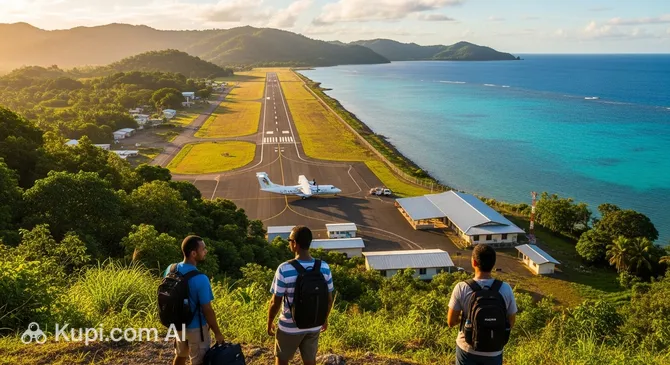
Buka. Illustration.
Source: Kupi.com AI

Buka Airport is not just a standard transport hub, but an atmospheric gateway to the world of unique culture and pristine nature of the Autonomous Region of Bougainville. Landing here is often called one of the most picturesque in Papua New Guinea: the aircraft descends over the glistening strait, revealing a panorama of turquoise lagoons and emerald islands to passengers even before touching the runway. From the very first minutes, this compact airfield immerses travellers in the relaxed rhythm of tropical life, far removed from the bustle of large metropolises.

PropertyValue
IATA CodeBUA
ICAO CodeAYBK
CityBuka
CountryPapua New Guinea (Niugini)
TimezonePacific/Bougainville
Top AirlinesAir Niugini
ScheduleOnline Timetable

Features and Advantages of the Airport

Despite its modest size, Buka Airport possesses a number of advantages that make travelling through it comfortable and memorable. The main feature is its phenomenal proximity to the city. The airport is located at the southern tip of Buka Island, literally a few steps from the administrative centre and the famous Buka Passage. The journey from the terminal to the main wharf, from where water taxis depart for the large island of Bougainville, takes just a couple of minutes by car.

Another advantage is the speed of service. Thanks to the low passenger flow and simple terminal layout, all pre-flight formalities are completed very quickly. There are no long queues here, which are typical for major hubs, allowing tourists to avoid unnecessary stress. The airport staff are generally friendly and ready to assist, creating a sense of hospitality immediately upon arrival.

The airport also plays the role of an important social centre. As it is the only reliable air harbour connecting the region with Port Moresby and other parts of the country, life is always bustling here. For tourists, this is an excellent opportunity to observe local colour, witness family reunions, and feel the true spirit of the region even before the main part of the journey begins.

Contact Information

Finding direct contact details for a small regional airport, such as Buka Airport, can be challenging. The airport is managed by the National Airports Corporation (NAC) of Papua New Guinea. Below is the most current and available information.

  • Official Airport Website: Buka Airport does not have its own separate website. All official information is published on the website of the management company — National Airports Corporation (NAC) of Papua New Guinea.
  • Information Desk Phone: A direct phone number for the Buka Airport information desk is not published. For information, it is recommended to contact the airline you are flying with directly, or the NAC head office.
  • Airport Address: Buka Airport, Buka Island, Autonomous Region of Bougainville, Papua New Guinea.
  • Email: There is no dedicated email address for general public use. For communication, use the contact forms on the NAC website or contact your airline.
  • Airport Social Media: Official social media pages for Buka Airport do not exist.
  • Lost Luggage Information: For issues regarding lost or damaged luggage, you should contact the representative of the airline you flew with directly. Airport staff do not handle luggage tracing.
  • Passenger Support Contacts: Passenger support regarding booking, ticket changes, and flight schedules is provided by the airlines operating flights to Buka Airport (e.g., Air Niugini, PNG Air).

How to Get to the Airport

Getting to the airport in the city of Buka (BUA) in Papua New Guinea is not difficult, as it is located in the immediate vicinity of the city centre. The distance is so short that the trip takes only 5 to 15 minutes depending on your exact location and the chosen transport. The main modes of transport are local minibuses, taxis, and pre-booked transfers.

Public Transport in Buka is mainly represented by route taxis known as PMVs (Public Motor Vehicles). This is the most budget-friendly way to get to the airport. PMVs are minibuses or small trucks that travel along main roads without a strict schedule. This is a great option for those who want to immerse themselves in local life, however, be prepared that the transport may be overcrowded. Payment is made in cash to the driver.

Taxis and Transfers are the most convenient and reliable option for tourists. You can find taxis in the city, but it is strongly recommended to agree on the price of the trip in advance, as meters are rarely used. The easiest way is to book a transfer through your hotel or guesthouse. This guarantees that you will be met on time and taken to the airport without unnecessary hassle, which is especially important if you have a lot of luggage or are departing early in the morning.

Car Rental in Buka is possible, but it is not the most common method for a short trip to the airport. If you have rented a car for travelling around the island, driving to the airport will be very easy. Parking at the airport consists of a simple open area where you can leave a car for a short time to drop off or pick up passengers. Long-term secure parking is generally not provided.

Terminals and Map

Buka Airport (BUA) is a small regional air terminal distinguished by a simple and clear structure. It serves domestic flights, connecting Buka Island with other parts of Papua New Guinea, and its layout is maximally functional, making navigation very easy for passengers.

The airport has only one terminal, which serves both departing and arriving passengers. The terminal building is compact, and all key zones are within walking distance of each other. You will not find a complex scheme with multiple levels or long corridors here. Essentially, it is one large space divided into functional zones: check-in counters, security screening area, a small waiting hall, and a baggage claim area.

Since there is only one terminal, the question of transfers between terminals is irrelevant. All procedures take place in one building. The departure and arrival zones are located next to each other. After checking in for the flight and dropping off luggage, passengers pass through pre-flight security and enter the general waiting hall before boarding. The arrival zone is a small room where passengers collect their luggage from a cart or belt.

Completing all formalities usually takes minimum time. Thanks to the low passenger volume, queues for check-in and security are usually short. Nevertheless, it is recommended to arrive at the airport approximately 1.5-2 hours before departure to go through all procedures without rushing.

Navigation recommendations here are simple: it is practically impossible to get lost at Buka Airport. Follow the signs or simply orient yourself by the location of other passengers. The airport staff are always ready to help and suggest the direction. The main advantage of this airport is its simplicity and speed of service, allowing travellers to save time and nerves before their flight.

Airport History

The history of Buka Airport (BUA) is closely intertwined with key events in the history of the Autonomous Region of Bougainville and all of Papua New Guinea. Its origins go back to the time of World War II. The airfield was built by Japanese forces in 1942 and was used as a strategic airbase during hostilities in the Solomon Islands region. After the war, it was converted for civil use, becoming the main air gateway of Buka Island.

The most dramatic period in the airport's history occurred during the civil conflict in Bougainville (1988–1998). During these years, the airport was closed, leading to the virtual isolation of the region. Its reopening became a crucial step in the peace process and recovery. This moment symbolised not only the resumption of transport connections but also hope for a peaceful future and economic revival.

Since resuming operations, the airport has undergone several stages of modernisation aimed at improving infrastructure and enhancing flight safety. Although it remains a small regional airport, its role in connecting Bougainville with the rest of the country and the world cannot be overestimated. Today, Buka Airport serves regular flights, mainly to Port Moresby, and is a vital hub for passenger transport, cargo delivery, and tourism development in the region.

Interesting fact: the airport is located on Buka Island, while the main part of the Autonomous Region is on the larger Bougainville Island. Passengers arriving in Buka need to take a short but scenic boat trip across the Buka Passage to reach the main island. This small detail adds a touch of adventure to the very beginning of a journey through this unique corner of Papua New Guinea.

Services and Amenities

Buka Airport (BUA) is a small regional air terminal serving as the main air gateway to Buka Island. It is important to understand that the infrastructure here corresponds to its size, offering passengers a basic but necessary set of services for a comfortable wait for their flight.

Restaurants, Cafes, and Shops. The choice of dining establishments and retail outlets on the airport territory is limited. Usually, a small kiosk or cafe operates here, where you can purchase light snacks, sandwiches, bottled water, and other drinks. You can also find local handmade souvenirs. Full-service restaurants and duty-free shops are absent.

Waiting Halls and VIP Service. There are no separate VIP halls or lounges for premium class passengers at Buka Airport. All travellers wait for departure in the general hall, which is equipped with seating. The setting is simple and functional.

Wi-Fi and Charging Stations. Stable and free Wi-Fi for passengers is generally not provided. The number of electrical outlets for charging gadgets is severely limited, so it is strongly recommended to bring a portable charger (power bank) with you.

Financial Services. There are usually no bank branches or currency exchange points within the terminal building. All financial transactions, including exchanging money for local currency (Kina, PGK), are best done in advance in Buka city.

Additional Services. Medical assistance is limited to a first aid point. Special mother and child rooms or play areas for children are not provided. Passengers with reduced mobility are recommended to contact the airline in advance to request assistance at the airport.

Hotels and Business Services. There are no hotels on the airport grounds. The nearest accommodation options are located in Buka city, which can be reached by local transport or taxi. Conference rooms and business centres are absent at the airport.

Where to Eat

Buka Airport (BUA) is a small regional airport, and dining options here are quite modest, but they allow for a snack before departure. It is important to understand that there is no large selection of restaurants and cafes here, as found in major international hubs. The infrastructure is simple and oriented towards serving a few flights a day.

In the airport's single terminal, you will find a few small kiosks or one simple canteen located in the general area (landside), accessible to both departing passengers and those meeting them. Here you can buy basic snacks, such as crisps, biscuits, as well as bottled soft drinks, tea, and coffee. Sometimes simple hot dishes typical of Papua New Guinea cuisine, such as rice with chicken or fish, are on sale.

For a quick snack, packaged snacks or fresh tropical fruits, which are often sold at local markets and may be available at the airport, are perfect. If you are looking for a more substantial lunch, it is better to eat in the city of Buka before travelling to the airport, as the choice of dishes there will be significantly wider.

Specialised dietary options, such as vegetarian, vegan, gluten-free, or halal dishes, are practically impossible to find at Buka Airport. Travellers with strict dietary restrictions are strongly advised to bring food with them. Prices at the airport are moderate but may be slightly higher than in the city. Opening hours of outlets depend directly on the flight schedule — they open a few hours before departure and close shortly after the last plane departs.

Travel Tips

The airport of Buka city (BUA) is the main air gateway to Bougainville Island in Papua New Guinea. Despite its modest size, it plays a key role in the region's transport system. To ensure your journey goes smoothly, use our tips.

Arrival Time at the Airport. Buka Airport is small and serves mainly domestic flights. We recommend arriving at least 2 hours before departure. This time will be sufficient to go through check-in, baggage drop, and security screening without rushing.

Check-in and Security. Procedures at the airport are fairly standard but may proceed slower than in major hubs. Have your passport and ticket ready. Security screening involves checking hand luggage and personal items, so remove all metal objects and electronics in advance.

Seat Selection on the Plane. If possible, choose a window seat. Flights in this region are often accompanied by breathtaking views of coral reefs, turquoise lagoons, and tropical islands. Particularly picturesque landscapes open up during take-off and landing.

Hand Luggage Rules. Try to pack all liquids over 100ml in your checked baggage. Be sure to put all valuables, documents, necessary electronics, and a portable charger in your hand luggage. Given the humid climate, it is worth using waterproof cases for technology.

Passengers with Connections. Buka Airport is not a transit hub. If you have a connecting flight planned, you will likely need to collect your luggage and check in again for the next flight. Verify this information with your airline in advance.

Customs Control. Since flights are mainly domestic, strict customs control is absent. However, strict biosecurity rules apply in Papua New Guinea. It is forbidden to transport certain plants, fruits, and animal products between islands without a special permit.

Saving Time and Money. If possible, check in for your flight online. The airport may have a limited selection of cafes and shops, so bring a water bottle (it can be filled after security) and a light snack. Be sure to carry some local currency (Kina) for small expenses, as card payment may not be available everywhere.

In Case of Flight Delay. Flight delays in this region are not uncommon; they are often related to weather conditions. Remain calm and follow announcements from airline representatives. It is useful to have a book, downloaded movies or music, as well as a portable battery pack to keep your devices charged.

Reached the end of the page?

That means the route is fully explored